

Topics in Current Chemistry (2018) 376:28
1 3
and wave-vectors of the preceding light–matter interactions, a photon echo may now
form as a signal response, or not. The choice can easily experimentally be made
by clever choices of the angles between the different laser beams in combination
with associated temporal delays. The basis of the echo formation is associated with
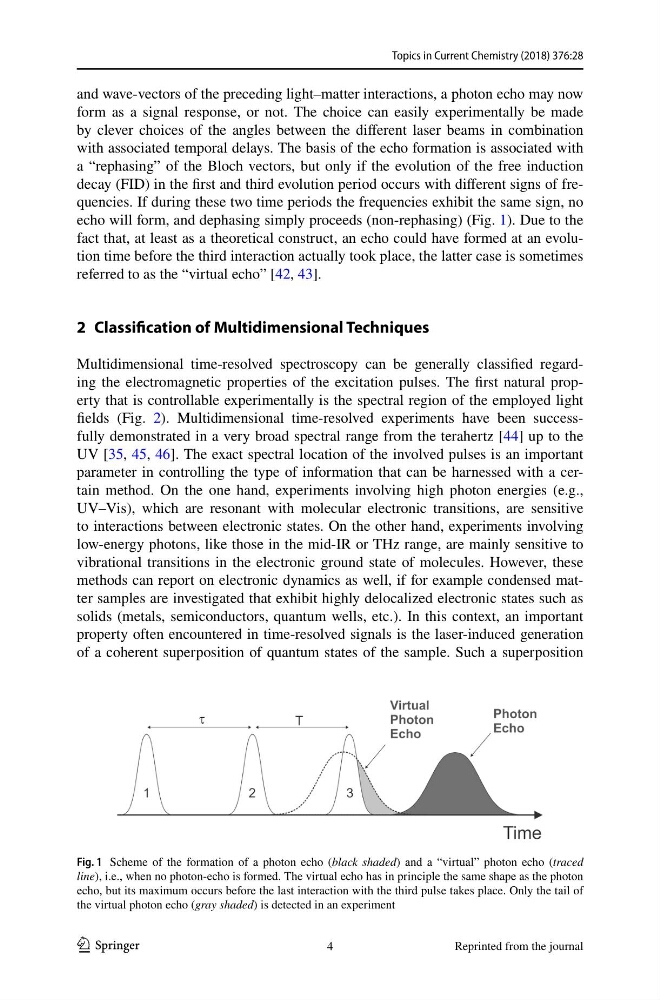
a “rephasing” of the Bloch vectors, but only if the evolution of the free induction
decay (FID) in the first and third evolution period occurs with different signs of frequencies. If during these two time periods the frequencies exhibit the same sign, no
echo will form, and dephasing simply proceeds (non-rephasing) (Fig. 1). Due to the
fact that, at least as a theoretical construct, an echo could have formed at an evolution time before the third interaction actually took place, the latter case is sometimes
referred to as the “virtual echo” [42, 43].
2 Classification of Multidimensional Techniques
Multidimensional time-resolved spectroscopy can be generally classified regarding the electromagnetic properties of the excitation pulses. The first natural property that is controllable experimentally is the spectral region of the employed light
fields (Fig. 2). Multidimensional time-resolved experiments have been successfully demonstrated in a very broad spectral range from the terahertz [44] up to the
UV [35, 45, 46]. The exact spectral location of the involved pulses is an important
parameter in controlling the type of information that can be harnessed with a certain method. On the one hand, experiments involving high photon energies (e.g.,
UV–Vis), which are resonant with molecular electronic transitions, are sensitive
to interactions between electronic states. On the other hand, experiments involving
low-energy photons, like those in the mid-IR or THz range, are mainly sensitive to
vibrational transitions in the electronic ground state of molecules. However, these
methods can report on electronic dynamics as well, if for example condensed matter samples are investigated that exhibit highly delocalized electronic states such as
solids (metals, semiconductors, quantum wells, etc.). In this context, an important
property often encountered in time-resolved signals is the laser-induced generation
of a coherent superposition of quantum states of the sample. Such a superposition
Fig. 1 Scheme of the formation of a photon echo (black shaded) and a “virtual” photon echo (traced
line), i.e., when no photon-echo is formed. The virtual echo has in principle the same shape as the photon
echo, but its maximum occurs before the last interaction with the third pulse takes place. Only the tail of
the virtual photon echo (gray shaded) is detected in an experiment
4
Reprinted from the journal
1 3
and wave-vectors of the preceding light–matter interactions, a photon echo may now
form as a signal response, or not. The choice can easily experimentally be made
by clever choices of the angles between the different laser beams in combination
with associated temporal delays. The basis of the echo formation is associated with
a “rephasing” of the Bloch vectors, but only if the evolution of the free induction
decay (FID) in the first and third evolution period occurs with different signs of frequencies. If during these two time periods the frequencies exhibit the same sign, no
echo will form, and dephasing simply proceeds (non-rephasing) (Fig. 1). Due to the
fact that, at least as a theoretical construct, an echo could have formed at an evolution time before the third interaction actually took place, the latter case is sometimes
referred to as the “virtual echo” [42, 43].
2 Classification of Multidimensional Techniques
Multidimensional time-resolved spectroscopy can be generally classified regarding the electromagnetic properties of the excitation pulses. The first natural property that is controllable experimentally is the spectral region of the employed light
fields (Fig. 2). Multidimensional time-resolved experiments have been successfully demonstrated in a very broad spectral range from the terahertz [44] up to the
UV [35, 45, 46]. The exact spectral location of the involved pulses is an important
parameter in controlling the type of information that can be harnessed with a certain method. On the one hand, experiments involving high photon energies (e.g.,
UV–Vis), which are resonant with molecular electronic transitions, are sensitive
to interactions between electronic states. On the other hand, experiments involving
low-energy photons, like those in the mid-IR or THz range, are mainly sensitive to
vibrational transitions in the electronic ground state of molecules. However, these
methods can report on electronic dynamics as well, if for example condensed matter samples are investigated that exhibit highly delocalized electronic states such as
solids (metals, semiconductors, quantum wells, etc.). In this context, an important
property often encountered in time-resolved signals is the laser-induced generation
of a coherent superposition of quantum states of the sample. Such a superposition
Fig. 1 Scheme of the formation of a photon echo (black shaded) and a “virtual” photon echo (traced
line), i.e., when no photon-echo is formed. The virtual echo has in principle the same shape as the photon
echo, but its maximum occurs before the last interaction with the third pulse takes place. Only the tail of
the virtual photon echo (gray shaded) is detected in an experiment
4
Reprinted from the journal