

Top Curr Chem (Z) (2018) 376:24
1 3
sensitivity by oscillations of signals intensities and/or spectral positions as a function of the delay time.
To obtain the required information listed above, 60 excited states were computed
simultaneously at the RASSCF(4,8|0,0|4,8)//PT2 level of theory, where the RAS
comprise all valence π-orbitals of the molecule, allowing up to quadruple excitations only in the RAS1/RAS3 spaces. Coherent vibrational dynamics were described
with the DHO model. The frequency (ω k ) and displacement ( ̃
d ik ) parameters used to
construct the line shape functions g ij (Eq. 17) were extracted from a 100-fs mixed
quantum–classical molecular dynamics simulation treating electrons quantummechanically by solving the time-dependent Schrödinger equation, while applying
classical Newtonian dynamics to the nuclei. The dynamics were initiated in the L a
state of pyrene at the FC point without initial kinetic energy. The choice of a reference Hamiltonian acting on the classical bath during the coherence propagation, as
is the case for the delay times t 1 and t 3 , is not unique [94], as the bra and the ket
sides of the density matrix are subject to different electronic potentials. We chose
to propagate the nuclear degrees of freedom as though interacting with the L a state.
The frequency and displacement parameters themselves were obtained by fitting the
electronic gaps E e (t)–E g (t) (giving rise to GSB and SE signals) and E f (t)–E e (t) (giving rise to ESAs), computed at the aforementioned RASSCF(4,8|0,0|4,8)//PT2 level
along the quantum–classical dynamics, to the analytical expression for the classical
time-dependent fluctuation of the L a − S n energy gap (n belonging to a state from
either the GS, g, or the f-manifold)
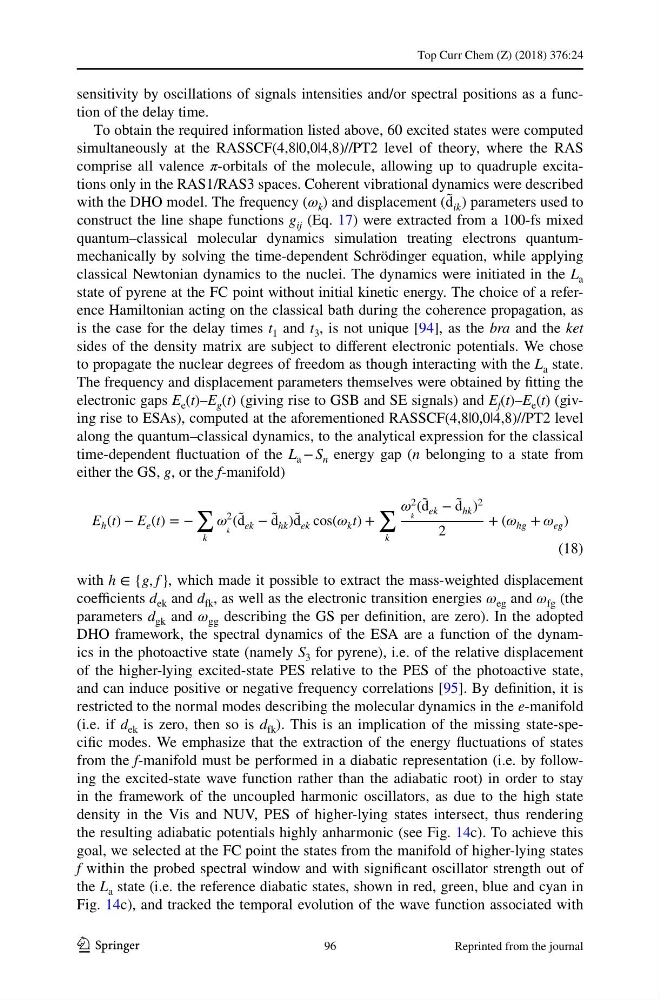
with h ∈ {g, f } , which made it possible to extract the mass-weighted displacement
coefficients d ek and d fk , as well as the electronic transition energies ω eg and ω fg (the
parameters d gk and ω gg describing the GS per definition, are zero). In the adopted
DHO framework, the spectral dynamics of the ESA are a function of the dynamics in the photoactive state (namely S 3 for pyrene), i.e. of the relative displacement
of the higher-lying excited-state PES relative to the PES of the photoactive state,
and can induce positive or negative frequency correlations [95]. By definition, it is
restricted to the normal modes describing the molecular dynamics in the e-manifold
(i.e. if d ek is zero, then so is d fk ). This is an implication of the missing state-specific modes. We emphasize that the extraction of the energy fluctuations of states
from the f-manifold must be performed in a diabatic representation (i.e. by following the excited-state wave function rather than the adiabatic root) in order to stay
in the framework of the uncoupled harmonic oscillators, as due to the high state
density in the Vis and NUV, PES of higher-lying states intersect, thus rendering
the resulting adiabatic potentials highly anharmonic (see Fig. 14c). To achieve this
goal, we selected at the FC point the states from the manifold of higher-lying states
f within the probed spectral window and with significant oscillator strength out of
the L a state (i.e. the reference diabatic states, shown in red, green, blue and cyan in
Fig. 14c), and tracked the temporal evolution of the wave function associated with
(18)
E h (t) − E e (t) = −
∑
k
í µí¼
2
k
( ̃
d ek − ̃
d hk ) ̃
d ek cos(í µí¼ k t) +
∑
k
í µí¼
2
k
( ̃
d ek − ̃
d hk )
2
2
+ (í µí¼ hg + í µí¼ eg )
96
Reprinted from the journal
1 3
sensitivity by oscillations of signals intensities and/or spectral positions as a function of the delay time.
To obtain the required information listed above, 60 excited states were computed
simultaneously at the RASSCF(4,8|0,0|4,8)//PT2 level of theory, where the RAS
comprise all valence π-orbitals of the molecule, allowing up to quadruple excitations only in the RAS1/RAS3 spaces. Coherent vibrational dynamics were described
with the DHO model. The frequency (ω k ) and displacement ( ̃
d ik ) parameters used to
construct the line shape functions g ij (Eq. 17) were extracted from a 100-fs mixed
quantum–classical molecular dynamics simulation treating electrons quantummechanically by solving the time-dependent Schrödinger equation, while applying
classical Newtonian dynamics to the nuclei. The dynamics were initiated in the L a
state of pyrene at the FC point without initial kinetic energy. The choice of a reference Hamiltonian acting on the classical bath during the coherence propagation, as
is the case for the delay times t 1 and t 3 , is not unique [94], as the bra and the ket
sides of the density matrix are subject to different electronic potentials. We chose
to propagate the nuclear degrees of freedom as though interacting with the L a state.
The frequency and displacement parameters themselves were obtained by fitting the
electronic gaps E e (t)–E g (t) (giving rise to GSB and SE signals) and E f (t)–E e (t) (giving rise to ESAs), computed at the aforementioned RASSCF(4,8|0,0|4,8)//PT2 level
along the quantum–classical dynamics, to the analytical expression for the classical
time-dependent fluctuation of the L a − S n energy gap (n belonging to a state from
either the GS, g, or the f-manifold)
with h ∈ {g, f } , which made it possible to extract the mass-weighted displacement
coefficients d ek and d fk , as well as the electronic transition energies ω eg and ω fg (the
parameters d gk and ω gg describing the GS per definition, are zero). In the adopted
DHO framework, the spectral dynamics of the ESA are a function of the dynamics in the photoactive state (namely S 3 for pyrene), i.e. of the relative displacement
of the higher-lying excited-state PES relative to the PES of the photoactive state,
and can induce positive or negative frequency correlations [95]. By definition, it is
restricted to the normal modes describing the molecular dynamics in the e-manifold
(i.e. if d ek is zero, then so is d fk ). This is an implication of the missing state-specific modes. We emphasize that the extraction of the energy fluctuations of states
from the f-manifold must be performed in a diabatic representation (i.e. by following the excited-state wave function rather than the adiabatic root) in order to stay
in the framework of the uncoupled harmonic oscillators, as due to the high state
density in the Vis and NUV, PES of higher-lying states intersect, thus rendering
the resulting adiabatic potentials highly anharmonic (see Fig. 14c). To achieve this
goal, we selected at the FC point the states from the manifold of higher-lying states
f within the probed spectral window and with significant oscillator strength out of
the L a state (i.e. the reference diabatic states, shown in red, green, blue and cyan in
Fig. 14c), and tracked the temporal evolution of the wave function associated with
(18)
E h (t) − E e (t) = −
∑
k
í µí¼
2
k
( ̃
d ek − ̃
d hk ) ̃
d ek cos(í µí¼ k t) +
∑
k
í µí¼
2
k
( ̃
d ek − ̃
d hk )
2
2
+ (í µí¼ hg + í µí¼ eg )
96
Reprinted from the journal