

Top Curr Chem (Z) (2018) 376:24
1 3
twisting and other slow vibrational modes). Nonlinear spectroscopy with ultrashort
sub-10-fs pulses (an order or magnitude shorter than most of the vibrational periods)
are capable of detecting this vibrational dynamic, which manifests in coherent oscillations of the spectral signatures. These coherences provide insight into the photoactive vibrational modes of the system and help in understanding its reactivity.
We begin this section by re-introducing a linear coupling of the electronic
degrees of freedom to a Gaussian bath, while still neglecting population transfer.
Regarding the description of ESAs, this corresponds to adding the phase function
e � fe ( 4 , 3 , 2 , 1 ) to Eqs. (14) and (15), where it is worth noting the absence of population transfer e’ = e in Eq. 14. The phase function acquires the following complex
form:
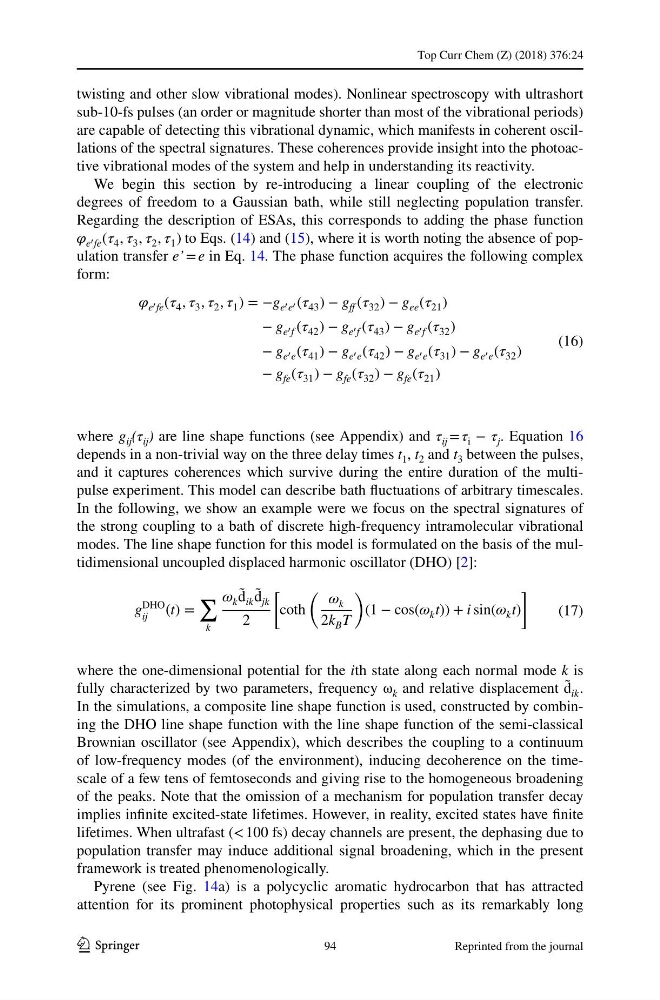
where g ij (τ ij ) are line shape functions (see Appendix) and τ ij = τ i − τ j . Equation 16
depends in a non-trivial way on the three delay times t 1 , t 2 and t 3 between the pulses,
and it captures coherences which survive during the entire duration of the multipulse experiment. This model can describe bath fluctuations of arbitrary timescales.
In the following, we show an example were we focus on the spectral signatures of
the strong coupling to a bath of discrete high-frequency intramolecular vibrational
modes. The line shape function for this model is formulated on the basis of the multidimensional uncoupled displaced harmonic oscillator (DHO) [2]:
where the one-dimensional potential for the ith state along each normal mode k is
fully characterized by two parameters, frequency ω k and relative displacement ̃
d ik .
In the simulations, a composite line shape function is used, constructed by combining the DHO line shape function with the line shape function of the semi-classical
Brownian oscillator (see Appendix), which describes the coupling to a continuum
of low-frequency modes (of the environment), inducing decoherence on the timescale of a few tens of femtoseconds and giving rise to the homogeneous broadening
of the peaks. Note that the omission of a mechanism for population transfer decay
implies infinite excited-state lifetimes. However, in reality, excited states have finite
lifetimes. When ultrafast (< 100 fs) decay channels are present, the dephasing due to
population transfer may induce additional signal broadening, which in the present
framework is treated phenomenologically.
Pyrene (see Fig. 14a) is a polycyclic aromatic hydrocarbon that has attracted
attention for its prominent photophysical properties such as its remarkably long
(16)
e � fe ( 4 , 3 , 2 , 1 ) = −g e � e � ( 43 ) − g ff ( 32 ) − g ee ( 21 )
− g e � f ( 42 ) − g e � f ( 43 ) − g e � f ( 32 )
− g e � e ( 41 ) − g e � e ( 42 ) − g e � e ( 31 ) − g e � e ( 32 )
− g fe ( 31 ) − g fe ( 32 ) − g fe ( 21 )
(17)
g
DHO
ij
(t) =
∑
k
í µí¼ k ̃
d ik ̃
d jk
2
coth
í µí¼ k
2k B T
(1 − cos(í µí¼ k t)) + i sin(í µí¼ k t)
94
Reprinted from the journal
1 3
twisting and other slow vibrational modes). Nonlinear spectroscopy with ultrashort
sub-10-fs pulses (an order or magnitude shorter than most of the vibrational periods)
are capable of detecting this vibrational dynamic, which manifests in coherent oscillations of the spectral signatures. These coherences provide insight into the photoactive vibrational modes of the system and help in understanding its reactivity.
We begin this section by re-introducing a linear coupling of the electronic
degrees of freedom to a Gaussian bath, while still neglecting population transfer.
Regarding the description of ESAs, this corresponds to adding the phase function
e � fe ( 4 , 3 , 2 , 1 ) to Eqs. (14) and (15), where it is worth noting the absence of population transfer e’ = e in Eq. 14. The phase function acquires the following complex
form:
where g ij (τ ij ) are line shape functions (see Appendix) and τ ij = τ i − τ j . Equation 16
depends in a non-trivial way on the three delay times t 1 , t 2 and t 3 between the pulses,
and it captures coherences which survive during the entire duration of the multipulse experiment. This model can describe bath fluctuations of arbitrary timescales.
In the following, we show an example were we focus on the spectral signatures of
the strong coupling to a bath of discrete high-frequency intramolecular vibrational
modes. The line shape function for this model is formulated on the basis of the multidimensional uncoupled displaced harmonic oscillator (DHO) [2]:
where the one-dimensional potential for the ith state along each normal mode k is
fully characterized by two parameters, frequency ω k and relative displacement ̃
d ik .
In the simulations, a composite line shape function is used, constructed by combining the DHO line shape function with the line shape function of the semi-classical
Brownian oscillator (see Appendix), which describes the coupling to a continuum
of low-frequency modes (of the environment), inducing decoherence on the timescale of a few tens of femtoseconds and giving rise to the homogeneous broadening
of the peaks. Note that the omission of a mechanism for population transfer decay
implies infinite excited-state lifetimes. However, in reality, excited states have finite
lifetimes. When ultrafast (< 100 fs) decay channels are present, the dephasing due to
population transfer may induce additional signal broadening, which in the present
framework is treated phenomenologically.
Pyrene (see Fig. 14a) is a polycyclic aromatic hydrocarbon that has attracted
attention for its prominent photophysical properties such as its remarkably long
(16)
e � fe ( 4 , 3 , 2 , 1 ) = −g e � e � ( 43 ) − g ff ( 32 ) − g ee ( 21 )
− g e � f ( 42 ) − g e � f ( 43 ) − g e � f ( 32 )
− g e � e ( 41 ) − g e � e ( 42 ) − g e � e ( 31 ) − g e � e ( 32 )
− g fe ( 31 ) − g fe ( 32 ) − g fe ( 21 )
(17)
g
DHO
ij
(t) =
∑
k
í µí¼ k ̃
d ik ̃
d jk
2
coth
í µí¼ k
2k B T
(1 − cos(í µí¼ k t)) + i sin(í µí¼ k t)
94
Reprinted from the journal