

90
6 Ultrasound as Mechanical Force
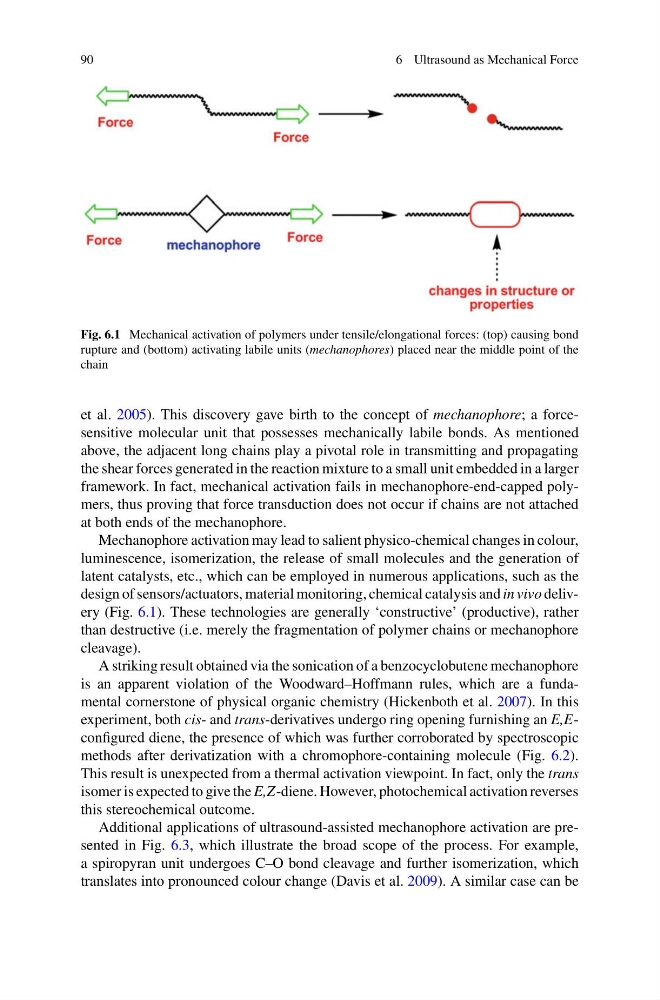
Fig. 6.1 Mechanical activation of polymers under tensile/elongational forces: (top) causing bond
rupture and (bottom) activating labile units (mechanophores) placed near the middle point of the
chain
et al. 2005). This discovery gave birth to the concept of mechanophore; a forcesensitive molecular unit that possesses mechanically labile bonds. As mentioned
above, the adjacent long chains play a pivotal role in transmitting and propagating
the shear forces generated in the reaction mixture to a small unit embedded in a larger
framework. In fact, mechanical activation fails in mechanophore-end-capped polymers, thus proving that force transduction does not occur if chains are not attached
at both ends of the mechanophore.
Mechanophore activation may lead to salient physico-chemical changes in colour,
luminescence, isomerization, the release of small molecules and the generation of
latent catalysts, etc., which can be employed in numerous applications, such as the
design of sensors/actuators, material monitoring, chemical catalysis and in vivo delivery (Fig. 6.1). These technologies are generally ‘constructive’ (productive), rather
than destructive (i.e. merely the fragmentation of polymer chains or mechanophore
cleavage).
A striking result obtained via the sonication of a benzocyclobutene mechanophore
is an apparent violation of the Woodward–Hoffmann rules, which are a fundamental cornerstone of physical organic chemistry (Hickenboth et al. 2007). In this
experiment, both cis- and trans-derivatives undergo ring opening furnishing an E,Econfigured diene, the presence of which was further corroborated by spectroscopic
methods after derivatization with a chromophore-containing molecule (Fig. 6.2).
This result is unexpected from a thermal activation viewpoint. In fact, only the trans
isomer is expected to give the E,Z-diene. However, photochemical activation reverses
this stereochemical outcome.
Additional applications of ultrasound-assisted mechanophore activation are presented in Fig. 6.3, which illustrate the broad scope of the process. For example,
a spiropyran unit undergoes C–O bond cleavage and further isomerization, which
translates into pronounced colour change (Davis et al. 2009). A similar case can be
6 Ultrasound as Mechanical Force
Fig. 6.1 Mechanical activation of polymers under tensile/elongational forces: (top) causing bond
rupture and (bottom) activating labile units (mechanophores) placed near the middle point of the
chain
et al. 2005). This discovery gave birth to the concept of mechanophore; a forcesensitive molecular unit that possesses mechanically labile bonds. As mentioned
above, the adjacent long chains play a pivotal role in transmitting and propagating
the shear forces generated in the reaction mixture to a small unit embedded in a larger
framework. In fact, mechanical activation fails in mechanophore-end-capped polymers, thus proving that force transduction does not occur if chains are not attached
at both ends of the mechanophore.
Mechanophore activation may lead to salient physico-chemical changes in colour,
luminescence, isomerization, the release of small molecules and the generation of
latent catalysts, etc., which can be employed in numerous applications, such as the
design of sensors/actuators, material monitoring, chemical catalysis and in vivo delivery (Fig. 6.1). These technologies are generally ‘constructive’ (productive), rather
than destructive (i.e. merely the fragmentation of polymer chains or mechanophore
cleavage).
A striking result obtained via the sonication of a benzocyclobutene mechanophore
is an apparent violation of the Woodward–Hoffmann rules, which are a fundamental cornerstone of physical organic chemistry (Hickenboth et al. 2007). In this
experiment, both cis- and trans-derivatives undergo ring opening furnishing an E,Econfigured diene, the presence of which was further corroborated by spectroscopic
methods after derivatization with a chromophore-containing molecule (Fig. 6.2).
This result is unexpected from a thermal activation viewpoint. In fact, only the trans
isomer is expected to give the E,Z-diene. However, photochemical activation reverses
this stereochemical outcome.
Additional applications of ultrasound-assisted mechanophore activation are presented in Fig. 6.3, which illustrate the broad scope of the process. For example,
a spiropyran unit undergoes C–O bond cleavage and further isomerization, which
translates into pronounced colour change (Davis et al. 2009). A similar case can be