

5.4 Micro-Sonoreactors: Miscellaneous Applications
83
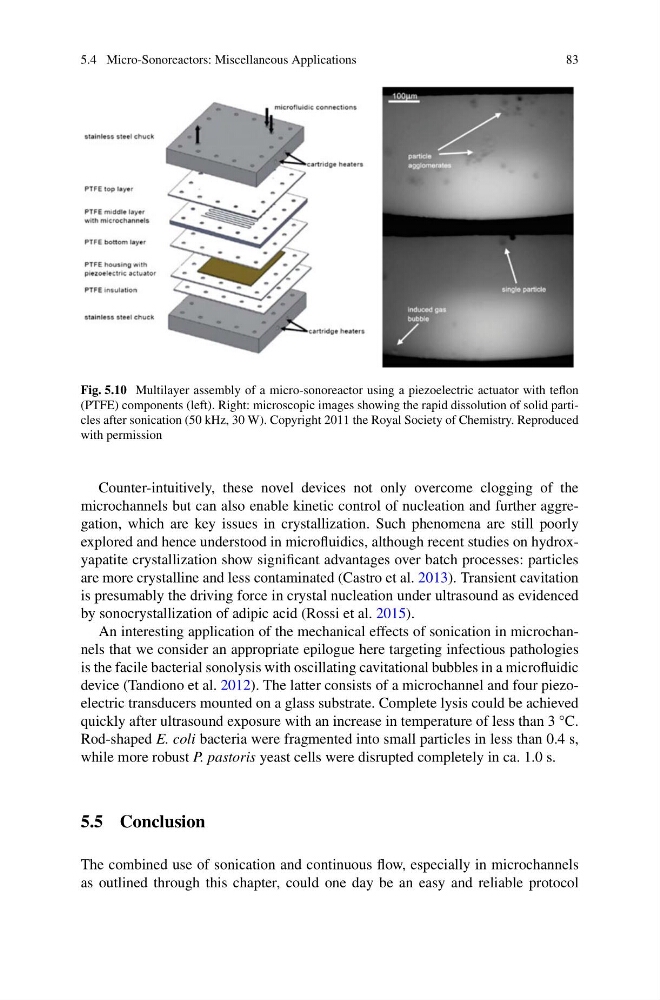
Fig. 5.10 Multilayer assembly of a micro-sonoreactor using a piezoelectric actuator with teflon
(PTFE) components (left). Right: microscopic images showing the rapid dissolution of solid particles after sonication (50 kHz, 30 W). Copyright 2011 the Royal Society of Chemistry. Reproduced
with permission
Counter-intuitively, these novel devices not only overcome clogging of the
microchannels but can also enable kinetic control of nucleation and further aggregation, which are key issues in crystallization. Such phenomena are still poorly
explored and hence understood in microfluidics, although recent studies on hydroxyapatite crystallization show significant advantages over batch processes: particles
are more crystalline and less contaminated (Castro et al. 2013). Transient cavitation
is presumably the driving force in crystal nucleation under ultrasound as evidenced
by sonocrystallization of adipic acid (Rossi et al. 2015).
An interesting application of the mechanical effects of sonication in microchannels that we consider an appropriate epilogue here targeting infectious pathologies
is the facile bacterial sonolysis with oscillating cavitational bubbles in a microfluidic
device (Tandiono et al. 2012). The latter consists of a microchannel and four piezoelectric transducers mounted on a glass substrate. Complete lysis could be achieved
quickly after ultrasound exposure with an increase in temperature of less than 3 °C.
Rod-shaped E. coli bacteria were fragmented into small particles in less than 0.4 s,
while more robust P. pastoris yeast cells were disrupted completely in ca. 1.0 s.
5.5 Conclusion
The combined use of sonication and continuous flow, especially in microchannels
as outlined through this chapter, could one day be an easy and reliable protocol
83
Fig. 5.10 Multilayer assembly of a micro-sonoreactor using a piezoelectric actuator with teflon
(PTFE) components (left). Right: microscopic images showing the rapid dissolution of solid particles after sonication (50 kHz, 30 W). Copyright 2011 the Royal Society of Chemistry. Reproduced
with permission
Counter-intuitively, these novel devices not only overcome clogging of the
microchannels but can also enable kinetic control of nucleation and further aggregation, which are key issues in crystallization. Such phenomena are still poorly
explored and hence understood in microfluidics, although recent studies on hydroxyapatite crystallization show significant advantages over batch processes: particles
are more crystalline and less contaminated (Castro et al. 2013). Transient cavitation
is presumably the driving force in crystal nucleation under ultrasound as evidenced
by sonocrystallization of adipic acid (Rossi et al. 2015).
An interesting application of the mechanical effects of sonication in microchannels that we consider an appropriate epilogue here targeting infectious pathologies
is the facile bacterial sonolysis with oscillating cavitational bubbles in a microfluidic
device (Tandiono et al. 2012). The latter consists of a microchannel and four piezoelectric transducers mounted on a glass substrate. Complete lysis could be achieved
quickly after ultrasound exposure with an increase in temperature of less than 3 °C.
Rod-shaped E. coli bacteria were fragmented into small particles in less than 0.4 s,
while more robust P. pastoris yeast cells were disrupted completely in ca. 1.0 s.
5.5 Conclusion
The combined use of sonication and continuous flow, especially in microchannels
as outlined through this chapter, could one day be an easy and reliable protocol