

22
2 Efficient Organic Synthesis: What Ultrasound Makes Easier
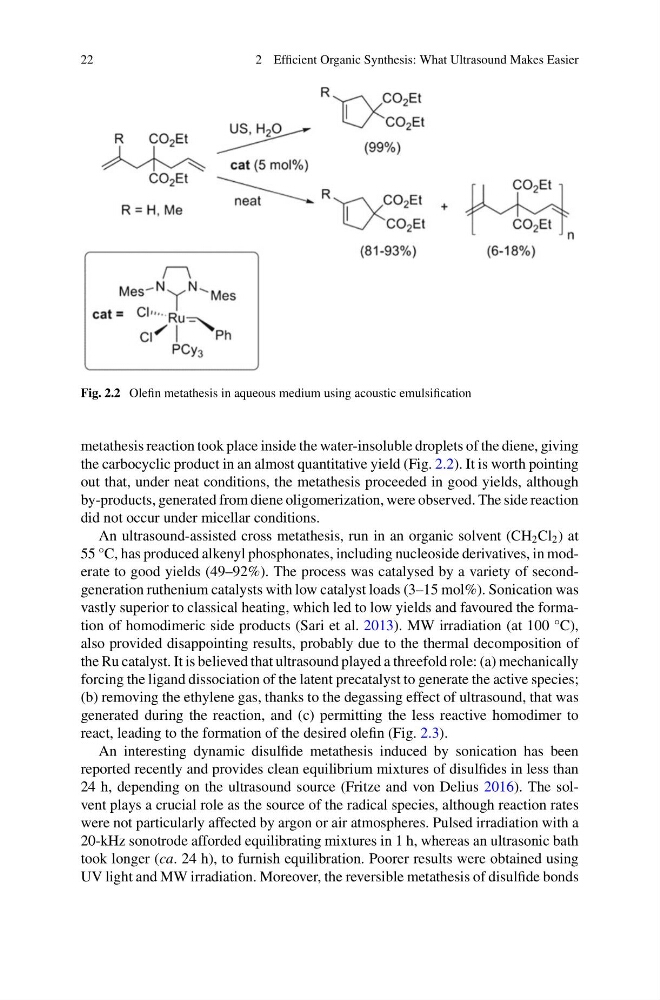
Fig. 2.2 Olefin metathesis in aqueous medium using acoustic emulsification
metathesis reaction took place inside the water-insoluble droplets of the diene, giving
the carbocyclic product in an almost quantitative yield (Fig. 2.2). It is worth pointing
out that, under neat conditions, the metathesis proceeded in good yields, although
by-products, generated from diene oligomerization, were observed. The side reaction
did not occur under micellar conditions.
An ultrasound-assisted cross metathesis, run in an organic solvent (CH 2 Cl 2 ) at
55 °C, has produced alkenyl phosphonates, including nucleoside derivatives, in moderate to good yields (49–92%). The process was catalysed by a variety of secondgeneration ruthenium catalysts with low catalyst loads (3–15 mol%). Sonication was
vastly superior to classical heating, which led to low yields and favoured the formation of homodimeric side products (Sari et al. 2013). MW irradiation (at 100 °C),
also provided disappointing results, probably due to the thermal decomposition of
the Ru catalyst. It is believed that ultrasound played a threefold role: (a) mechanically
forcing the ligand dissociation of the latent precatalyst to generate the active species;
(b) removing the ethylene gas, thanks to the degassing effect of ultrasound, that was
generated during the reaction, and (c) permitting the less reactive homodimer to
react, leading to the formation of the desired olefin (Fig. 2.3).
An interesting dynamic disulfide metathesis induced by sonication has been
reported recently and provides clean equilibrium mixtures of disulfides in less than
24 h, depending on the ultrasound source (Fritze and von Delius 2016). The solvent plays a crucial role as the source of the radical species, although reaction rates
were not particularly affected by argon or air atmospheres. Pulsed irradiation with a
20-kHz sonotrode afforded equilibrating mixtures in 1 h, whereas an ultrasonic bath
took longer (ca. 24 h), to furnish equilibration. Poorer results were obtained using
UV light and MW irradiation. Moreover, the reversible metathesis of disulfide bonds
2 Efficient Organic Synthesis: What Ultrasound Makes Easier
Fig. 2.2 Olefin metathesis in aqueous medium using acoustic emulsification
metathesis reaction took place inside the water-insoluble droplets of the diene, giving
the carbocyclic product in an almost quantitative yield (Fig. 2.2). It is worth pointing
out that, under neat conditions, the metathesis proceeded in good yields, although
by-products, generated from diene oligomerization, were observed. The side reaction
did not occur under micellar conditions.
An ultrasound-assisted cross metathesis, run in an organic solvent (CH 2 Cl 2 ) at
55 °C, has produced alkenyl phosphonates, including nucleoside derivatives, in moderate to good yields (49–92%). The process was catalysed by a variety of secondgeneration ruthenium catalysts with low catalyst loads (3–15 mol%). Sonication was
vastly superior to classical heating, which led to low yields and favoured the formation of homodimeric side products (Sari et al. 2013). MW irradiation (at 100 °C),
also provided disappointing results, probably due to the thermal decomposition of
the Ru catalyst. It is believed that ultrasound played a threefold role: (a) mechanically
forcing the ligand dissociation of the latent precatalyst to generate the active species;
(b) removing the ethylene gas, thanks to the degassing effect of ultrasound, that was
generated during the reaction, and (c) permitting the less reactive homodimer to
react, leading to the formation of the desired olefin (Fig. 2.3).
An interesting dynamic disulfide metathesis induced by sonication has been
reported recently and provides clean equilibrium mixtures of disulfides in less than
24 h, depending on the ultrasound source (Fritze and von Delius 2016). The solvent plays a crucial role as the source of the radical species, although reaction rates
were not particularly affected by argon or air atmospheres. Pulsed irradiation with a
20-kHz sonotrode afforded equilibrating mixtures in 1 h, whereas an ultrasonic bath
took longer (ca. 24 h), to furnish equilibration. Poorer results were obtained using
UV light and MW irradiation. Moreover, the reversible metathesis of disulfide bonds