

110
7 Hybrid Technologies in Action: Sonochemistry and Beyond
Table 7.2 Chemical composition of untreated, MW-assisted alkaline-treated, [EMIM] + Cl − treated,
bleached and H 2 SO 4 -treated jute stalk
Sample
α-cellulose (%) Hemicellulose
(%)
Lignin (%)
Moisture
content (%)
Yield (%)
Untreated jute
stalk S-1
64.30 ± 1.7
17.5 ± 1.4
6.9 ± 0.45 11.3 ± 0.3
–
MW-assisted
alkalinetreated jute
stalk (S-2)
76.07 ± 1.5
11.21 ± 0.89
1.21 ± 0.66 11.5 ± 0.2
68.65
Bleached jute
stalk (S-3)
84.32 ± 1.12
2.98 ± 0.77
0.72 ± 0.31 11.6 ± 0.3
59.63
[EMIM] + Cl −
treated jute
stalk (S-4)
87.09 ± 1.34
0.57 ± 0.21
0.54 ± 0.21 11.8 ± 0.4
48.33
H 2 SO 4 -treated
jute stalk (S-5)
93.89 ± 1.03
0.32 ± 0.12
0.22 ± 0.13 11.7 ± 0.5
42.98
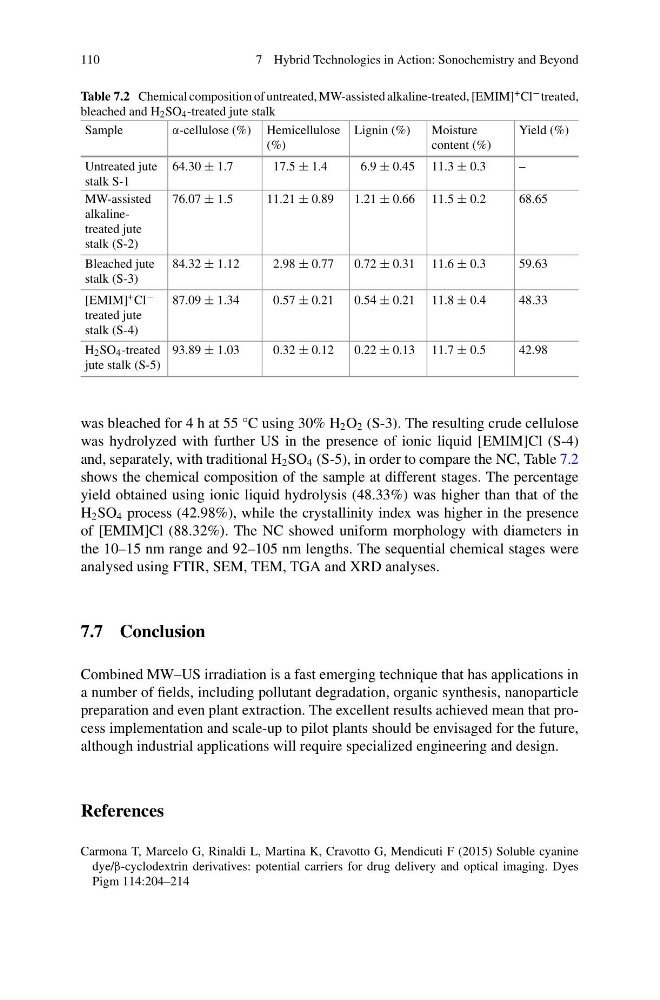
was bleached for 4 h at 55 °C using 30% H 2 O 2 (S-3). The resulting crude cellulose
was hydrolyzed with further US in the presence of ionic liquid [EMIM]Cl (S-4)
and, separately, with traditional H 2 SO 4 (S-5), in order to compare the NC, Table 7.2
shows the chemical composition of the sample at different stages. The percentage
yield obtained using ionic liquid hydrolysis (48.33%) was higher than that of the
H 2 SO 4 process (42.98%), while the crystallinity index was higher in the presence
of [EMIM]Cl (88.32%). The NC showed uniform morphology with diameters in
the 10–15 nm range and 92–105 nm lengths. The sequential chemical stages were
analysed using FTIR, SEM, TEM, TGA and XRD analyses.
7.7 Conclusion
Combined MW–US irradiation is a fast emerging technique that has applications in
a number of fields, including pollutant degradation, organic synthesis, nanoparticle
preparation and even plant extraction. The excellent results achieved mean that process implementation and scale-up to pilot plants should be envisaged for the future,
although industrial applications will require specialized engineering and design.
References
Carmona T, Marcelo G, Rinaldi L, Martina K, Cravotto G, Mendicuti F (2015) Soluble cyanine
dye/β-cyclodextrin derivatives: potential carriers for drug delivery and optical imaging. Dyes
Pigm 114:204–214
7 Hybrid Technologies in Action: Sonochemistry and Beyond
Table 7.2 Chemical composition of untreated, MW-assisted alkaline-treated, [EMIM] + Cl − treated,
bleached and H 2 SO 4 -treated jute stalk
Sample
α-cellulose (%) Hemicellulose
(%)
Lignin (%)
Moisture
content (%)
Yield (%)
Untreated jute
stalk S-1
64.30 ± 1.7
17.5 ± 1.4
6.9 ± 0.45 11.3 ± 0.3
–
MW-assisted
alkalinetreated jute
stalk (S-2)
76.07 ± 1.5
11.21 ± 0.89
1.21 ± 0.66 11.5 ± 0.2
68.65
Bleached jute
stalk (S-3)
84.32 ± 1.12
2.98 ± 0.77
0.72 ± 0.31 11.6 ± 0.3
59.63
[EMIM] + Cl −
treated jute
stalk (S-4)
87.09 ± 1.34
0.57 ± 0.21
0.54 ± 0.21 11.8 ± 0.4
48.33
H 2 SO 4 -treated
jute stalk (S-5)
93.89 ± 1.03
0.32 ± 0.12
0.22 ± 0.13 11.7 ± 0.5
42.98
was bleached for 4 h at 55 °C using 30% H 2 O 2 (S-3). The resulting crude cellulose
was hydrolyzed with further US in the presence of ionic liquid [EMIM]Cl (S-4)
and, separately, with traditional H 2 SO 4 (S-5), in order to compare the NC, Table 7.2
shows the chemical composition of the sample at different stages. The percentage
yield obtained using ionic liquid hydrolysis (48.33%) was higher than that of the
H 2 SO 4 process (42.98%), while the crystallinity index was higher in the presence
of [EMIM]Cl (88.32%). The NC showed uniform morphology with diameters in
the 10–15 nm range and 92–105 nm lengths. The sequential chemical stages were
analysed using FTIR, SEM, TEM, TGA and XRD analyses.
7.7 Conclusion
Combined MW–US irradiation is a fast emerging technique that has applications in
a number of fields, including pollutant degradation, organic synthesis, nanoparticle
preparation and even plant extraction. The excellent results achieved mean that process implementation and scale-up to pilot plants should be envisaged for the future,
although industrial applications will require specialized engineering and design.
References
Carmona T, Marcelo G, Rinaldi L, Martina K, Cravotto G, Mendicuti F (2015) Soluble cyanine
dye/β-cyclodextrin derivatives: potential carriers for drug delivery and optical imaging. Dyes
Pigm 114:204–214