

6.3 The Mechanophore Concept: Ultrasonication of Polymers
93
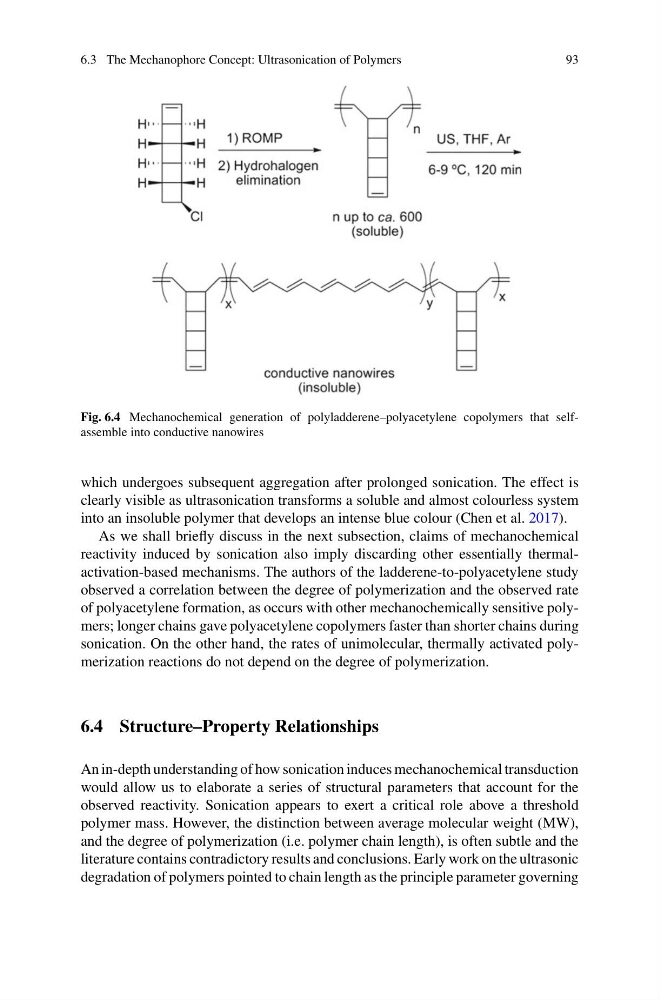
Fig. 6.4 Mechanochemical generation of polyladderene–polyacetylene copolymers that selfassemble into conductive nanowires
which undergoes subsequent aggregation after prolonged sonication. The effect is
clearly visible as ultrasonication transforms a soluble and almost colourless system
into an insoluble polymer that develops an intense blue colour (Chen et al. 2017).
As we shall briefly discuss in the next subsection, claims of mechanochemical
reactivity induced by sonication also imply discarding other essentially thermalactivation-based mechanisms. The authors of the ladderene-to-polyacetylene study
observed a correlation between the degree of polymerization and the observed rate
of polyacetylene formation, as occurs with other mechanochemically sensitive polymers; longer chains gave polyacetylene copolymers faster than shorter chains during
sonication. On the other hand, the rates of unimolecular, thermally activated polymerization reactions do not depend on the degree of polymerization.
6.4 Structure–Property Relationships
An in-depth understanding of how sonication induces mechanochemical transduction
would allow us to elaborate a series of structural parameters that account for the
observed reactivity. Sonication appears to exert a critical role above a threshold
polymer mass. However, the distinction between average molecular weight (MW),
and the degree of polymerization (i.e. polymer chain length), is often subtle and the
literature contains contradictory results and conclusions. Early work on the ultrasonic
degradation of polymers pointed to chain length as the principle parameter governing
93
Fig. 6.4 Mechanochemical generation of polyladderene–polyacetylene copolymers that selfassemble into conductive nanowires
which undergoes subsequent aggregation after prolonged sonication. The effect is
clearly visible as ultrasonication transforms a soluble and almost colourless system
into an insoluble polymer that develops an intense blue colour (Chen et al. 2017).
As we shall briefly discuss in the next subsection, claims of mechanochemical
reactivity induced by sonication also imply discarding other essentially thermalactivation-based mechanisms. The authors of the ladderene-to-polyacetylene study
observed a correlation between the degree of polymerization and the observed rate
of polyacetylene formation, as occurs with other mechanochemically sensitive polymers; longer chains gave polyacetylene copolymers faster than shorter chains during
sonication. On the other hand, the rates of unimolecular, thermally activated polymerization reactions do not depend on the degree of polymerization.
6.4 Structure–Property Relationships
An in-depth understanding of how sonication induces mechanochemical transduction
would allow us to elaborate a series of structural parameters that account for the
observed reactivity. Sonication appears to exert a critical role above a threshold
polymer mass. However, the distinction between average molecular weight (MW),
and the degree of polymerization (i.e. polymer chain length), is often subtle and the
literature contains contradictory results and conclusions. Early work on the ultrasonic
degradation of polymers pointed to chain length as the principle parameter governing