

700
interconnection of the equipments and information exchange in the IoT. However, this work
is still far from enough. It is necessary to speed up the development of overall common standards, perceptual standards, transport standards and application-layer standards.
4 THE IMPLEMENTATION OF THE ROUTE AND SAFEGUARD MEASURES
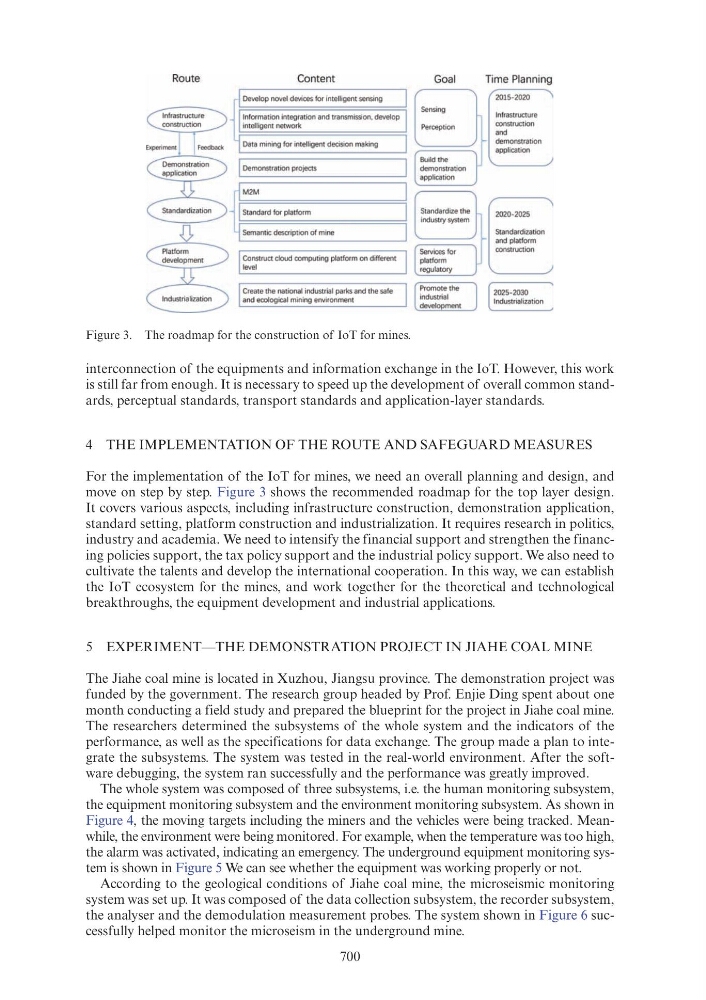
For the implementation of the IoT for mines, we need an overall planning and design, and
move on step by step. Figure 3 shows the recommended roadmap for the top layer design.
It covers various aspects, including infrastructure construction, demonstration application,
standard setting, platform construction and industrialization. It requires research in politics,
industry and academia. We need to intensify the financial support and strengthen the financing policies support, the tax policy support and the industrial policy support. We also need to
cultivate the talents and develop the international cooperation. In this way, we can establish
the IoT ecosystem for the mines, and work together for the theoretical and technological
breakthroughs, the equipment development and industrial applications.
5 EXPERIMENT—THE DEMONSTRATION PROJECT IN JIAHE COAL MINE
The Jiahe coal mine is located in Xuzhou, Jiangsu province. The demonstration project was
funded by the government. The research group headed by Prof. Enjie Ding spent about one
month conducting a field study and prepared the blueprint for the project in Jiahe coal mine.
The researchers determined the subsystems of the whole system and the indicators of the
performance, as well as the specifications for data exchange. The group made a plan to integrate the subsystems. The system was tested in the real-world environment. After the software debugging, the system ran successfully and the performance was greatly improved.
The whole system was composed of three subsystems, i.e. the human monitoring subsystem,
the equipment monitoring subsystem and the environment monitoring subsystem. As shown in
Figure 4, the moving targets including the miners and the vehicles were being tracked. Meanwhile, the environment were being monitored. For example, when the temperature was too high,
the alarm was activated, indicating an emergency. The underground equipment monitoring system is shown in Figure 5 We can see whether the equipment was working properly or not.
According to the geological conditions of Jiahe coal mine, the microseismic monitoring
system was set up. It was composed of the data collection subsystem, the recorder subsystem,
the analyser and the demodulation measurement probes. The system shown in Figure 6 successfully helped monitor the microseism in the underground mine.
Figure 3. The roadmap for the construction of IoT for mines.
Route
Content
Goa l
Ti me Planning
2015- 2020
Sensing
Infrastructure
Perception
construction
and
demonstration
application
I Demonstration projects
Build the
demonstration
applicatio n
M2M
I Standard for p latform
Standard ize t he
2020- 2025
industry system
Semant ic descrip tion o f mine
Standardization
and platform
Services for
J
construction
Const ruct cloud computing platform on d ifferent
platform
level
regulatory
Create the na tional ind ustrial parks and t he safe
Promote the
2025- 2030
and ecological mining environment
industrial
Industrialization
development