

682
conditions of environment in which the robot moves. Depending on the type of terrain, various configurations of the Klann mechanism are optimal.
Under varied surface conditions, the robot should be able to overcome many different
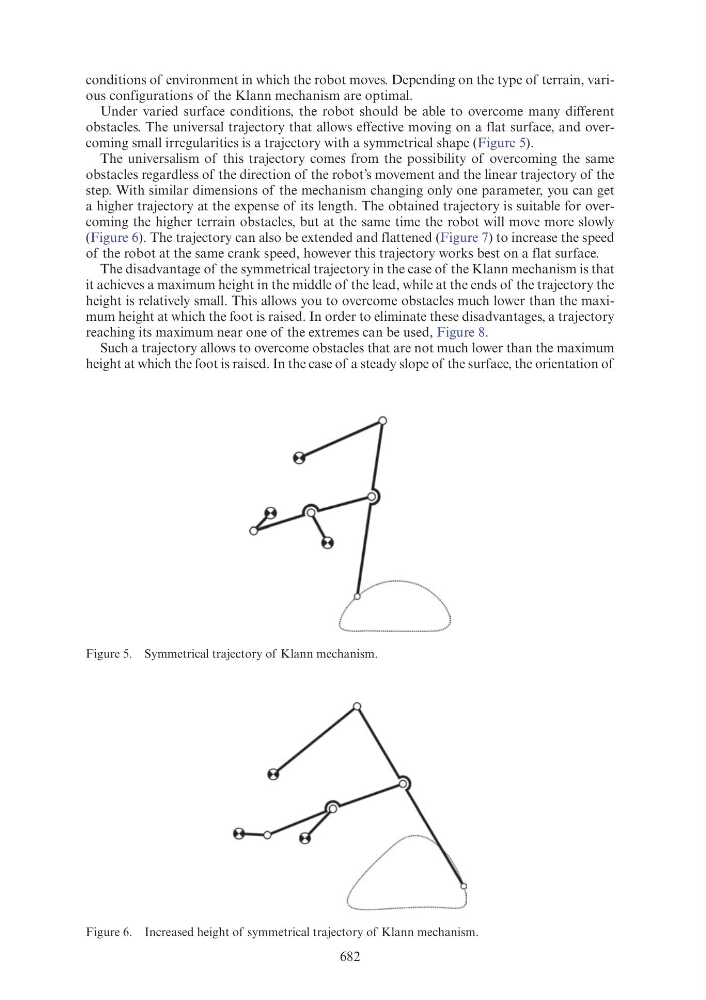
obstacles. The universal trajectory that allows effective moving on a flat surface, and overcoming small irregularities is a trajectory with a symmetrical shape (Figure 5).
The universalism of this trajectory comes from the possibility of overcoming the same
obstacles regardless of the direction of the robot’s movement and the linear trajectory of the
step. With similar dimensions of the mechanism changing only one parameter, you can get
a higher trajectory at the expense of its length. The obtained trajectory is suitable for overcoming the higher terrain obstacles, but at the same time the robot will move more slowly
(Figure 6). The trajectory can also be extended and flattened (Figure 7) to increase the speed
of the robot at the same crank speed, however this trajectory works best on a flat surface.
The disadvantage of the symmetrical trajectory in the case of the Klann mechanism is that
it achieves a maximum height in the middle of the lead, while at the ends of the trajectory the
height is relatively small. This allows you to overcome obstacles much lower than the maximum height at which the foot is raised. In order to eliminate these disadvantages, a trajectory
reaching its maximum near one of the extremes can be used, Figure 8.
Such a trajectory allows to overcome obstacles that are not much lower than the maximum
height at which the foot is raised. In the case of a steady slope of the surface, the orientation of
Figure 5. Symmetrical trajectory of Klann mechanism.
Figure 6. Increased height of symmetrical trajectory of Klann mechanism.
.... ················· ..................... .
/" .. ·
.......... ·:_:)
t ........................ .......... . .
......
....
....
... ··
/_,....
. ... . .. ····· . .. .l
·· ..................... .. .