

665
3.1.2 Model validation
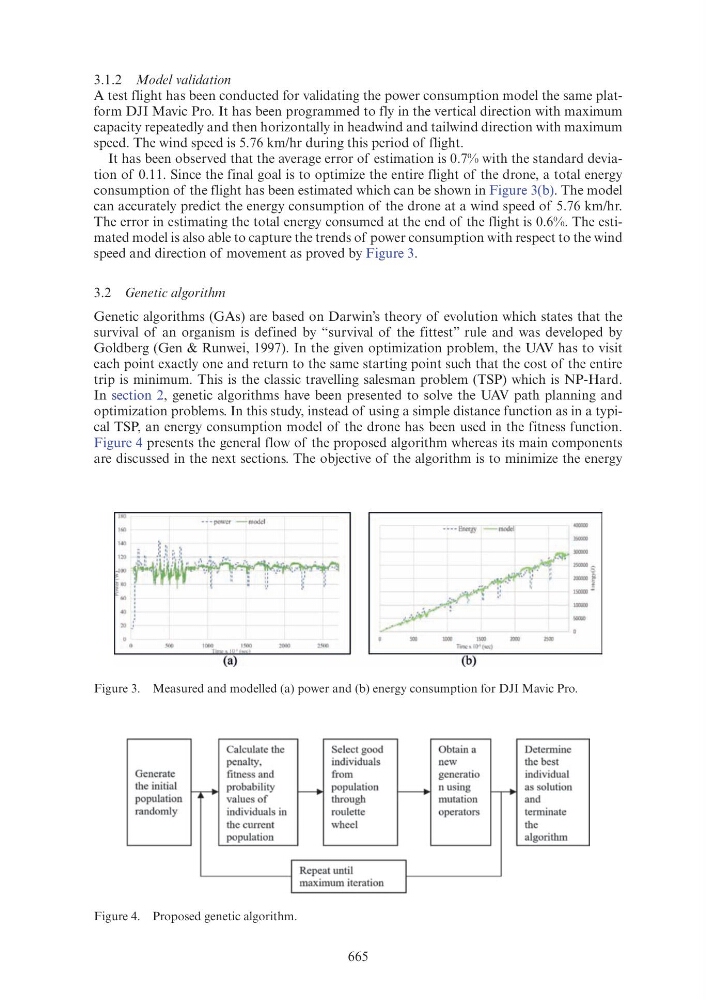
A test flight has been conducted for validating the power consumption model the same platform DJI Mavic Pro. It has been programmed to fly in the vertical direction with maximum
capacity repeatedly and then horizontally in headwind and tailwind direction with maximum
speed. The wind speed is 5.76 km/hr during this period of flight.
It has been observed that the average error of estimation is 0.7% with the standard deviation of 0.11. Since the final goal is to optimize the entire flight of the drone, a total energy
consumption of the flight has been estimated which can be shown in Figure 3(b). The model
can accurately predict the energy consumption of the drone at a wind speed of 5.76 km/hr.
The error in estimating the total energy consumed at the end of the flight is 0.6%. The estimated model is also able to capture the trends of power consumption with respect to the wind
speed and direction of movement as proved by Figure 3.
3.2 Genetic algorithm
Genetic algorithms (GAs) are based on Darwin’s theory of evolution which states that the
survival of an organism is defined by “survival of the fittest” rule and was developed by
Goldberg (Gen & Runwei, 1997). In the given optimization problem, the UAV has to visit
each point exactly one and return to the same starting point such that the cost of the entire
trip is minimum. This is the classic travelling salesman problem (TSP) which is NP-Hard.
In section 2, genetic algorithms have been presented to solve the UAV path planning and
optimization problems. In this study, instead of using a simple distance function as in a typical TSP, an energy consumption model of the drone has been used in the fitness function.
Figure 4 presents the general flow of the proposed algorithm whereas its main components
are discussed in the next sections. The objective of the algorithm is to minimize the energy
Figure 3. Measured and modelled (a) power and (b) energy consumption for DJI Mavic Pro.
Figure 4. Proposed genetic algorithm.
'"
--- power - model
"''
---- Energy -
model
1000
'""
2000
1500
, 1500
2000
1500
Timex IG-1 (~c)
(a)
(b)
Calculate the
Select good
Obtain a
Detennine
penalty,
individuals
new
the best
Generate
fitness and
from
generatio
individual
the initial
~
probability
-population
r---n using
,. as solution
population
values of
through
mutation
and
randomly
individuals in
roulette
operators
terminate
the current
wheel
the
population
algorithm
I Repeat until
I
I maximum iteration I