

656
2 MATERIALS AND METHOTDS
2.1 Site selection
The mining face intended for the characterization had to be selected considering the number
of in situ different materials that are mined separately, due to their different qualities or
economic interest, and that are visually similar. Also, the mining face selected should ideally
stay untouched until the sensor is selected and a flight performed to register the mineral
characteristics using an UAV. To cover those requirements, a phosphate mining face has
been selected for the samples collection. It is located in the Tapira mine, nearby Araxá,
Brazil.
2.2 Sampling
In total, 25 samples have been collected, identified, georeferenced and kept in appropriate bags
to preserve their original characteristics, such as moisture and granulometric distribution.
The transition zone between the ore, called base isalterite, and top isalterite, which has
analogous constitution to the base, but with higher titanium grade. Both lithologies present
similar color when their moistures are alike. However, during the dry season, the waste
retains more water, making the visual contrast between materials more evident. Also, other
materials present colors that could bewilder when considering only RGB, such as aloterite
(upper clay) and deeper, less weathered ore. Figure 2 shows the sampling location on the
mining face.
The samples collected on the elevation 1,280 m represent aloterite region, typically a waste
zone. On elevation 1,270 m, 15 samples were taken in a transition zone between the high-Ti
top isalterite and the ore zone. In the high-Ti zone, the material tends to be more moisturized
and composed by silt and does not preserve any remaining structure from the original rock.
It is constituted by anatasium and Fe and Al oxi-hidroxides, crandalite, magnetite, caulinite
and quartz. The mineralized zone presents more preserved structures from the original rock
with higher apatite content, reflecting on P 2 O 5 grades higher than 5% and TiO 2 lower than
10%.
On the 1,240 m bench, six samples were taken in the transition zone between the weathered
and the semi-compact ore, with more granular material. This presents a decrease of the P, Ti
and Fe contents. Minerals such as anatasium, vermiculite, titanium-rich magnetite and iron
oxi-hidroxides are less frequent as the elevation decreases. On the other hand, carbonates and
phlogopites are more abundant.
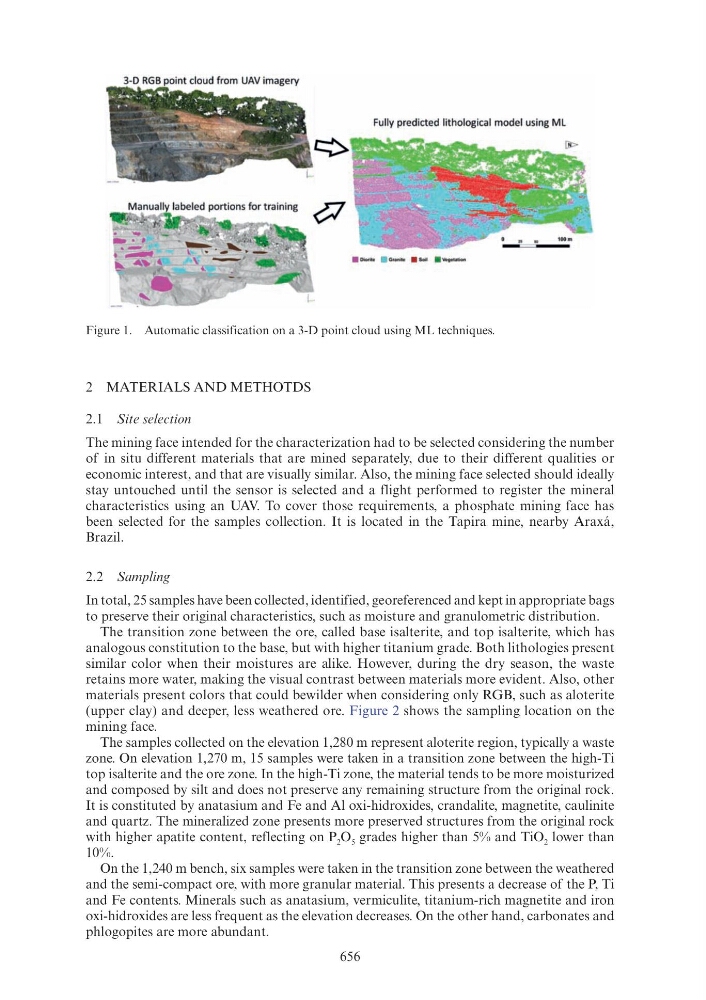
Figure 1. Automatic classification on a 3-D point cloud using ML techniques.
Fully predicted lithological model using M L
. Diorite . Granite . Soil . v.g.t•tion