

641
gas concentration in the gas pipeline. However, there are a number of challenges in monitoring methane in the pipeline system, first, in order to operate gas extraction system safely, a
large amount of water mist is usually sprayed into the pipeline, resulting in a high humidity
condition in the pipeline; secondly, the methane concentration during the extraction process
varies considerably, this requires the methane sensor can be operated over a large concentration range; thirdly, during the extraction process the pipeline leakage to may occurs, and it is
very danger if the leakage occurs in a confined area, as the methane gas would explode if its
concentration reaches to a range of 5%–16% (Xu), this requires that the methane monitoring
sensor needs to have a accuracy over large concentration range; fourthly, the gas drainage
pipelines are usually laid out over a long distance and the surrounding environment along the
pipeline is very complicated for monitoring system to be installed.
Currently the methane gas sensors used in coal mines mainly are based on the technologies
such as catalytic combustion, thermal conductivity, optical interference and infrared absorption. These detection methods have some shortfalls and disadvantages in methane pipeline
monitoring. For instance, the measured results with the use of those gas sensors are easy to
drift; the measurement range is relatively small, they can be easily affected by the water or mist
in the pipeline, and resulting low precision and poor reliability; also it is easy to be poison at
high gas concentration, etc. Whilst for the Infrared absorption sensors, the measured results
can be easily interfered by different other gases presented in the extracted gas (Chen, Liu, Ye).
To overcome the difficulties encountered with traditional methane sensors, fiber optic sensors
based on laser spectral absorption becomes an alternative solution to offer accurate measurements over a large operational range of methane concentration. The features of insensitive to
water and other gases make it more suitable to be employed in real time and in harsh environments such as online monitoring of gas pipelines (Liu, Wang). The laser methane sensor has
the characteristics of large measuring range, low measuring error, fast response time, long
calibration period, long service life, no gas cross interference and easy maintenance. Comparing with several other sensors, the laser methane sensor has considerable advantages in terms
of stability and reliability, which make these sensors to be particularly suitable for being used
in harsh environments such as gas drainage pipes in coal mines.
Due to the large variation of gas pressure and ambient temperature in the extraction pipeline, it greatly affects the accuracy of the measured value of gas concentration. In order to
improve the measurement accuracy, this paper introduces a new laser methane sensor based
on VCSEL as its light source has been developed. This sensor can be operated over a wide
range of temperature and pressure variation. With the use of Internet of Things technology,
it can achieve remote real-time gas concentration monitoring.
2 WORKING PRINCIPLE OF THE LASER MECHANE SENSOR
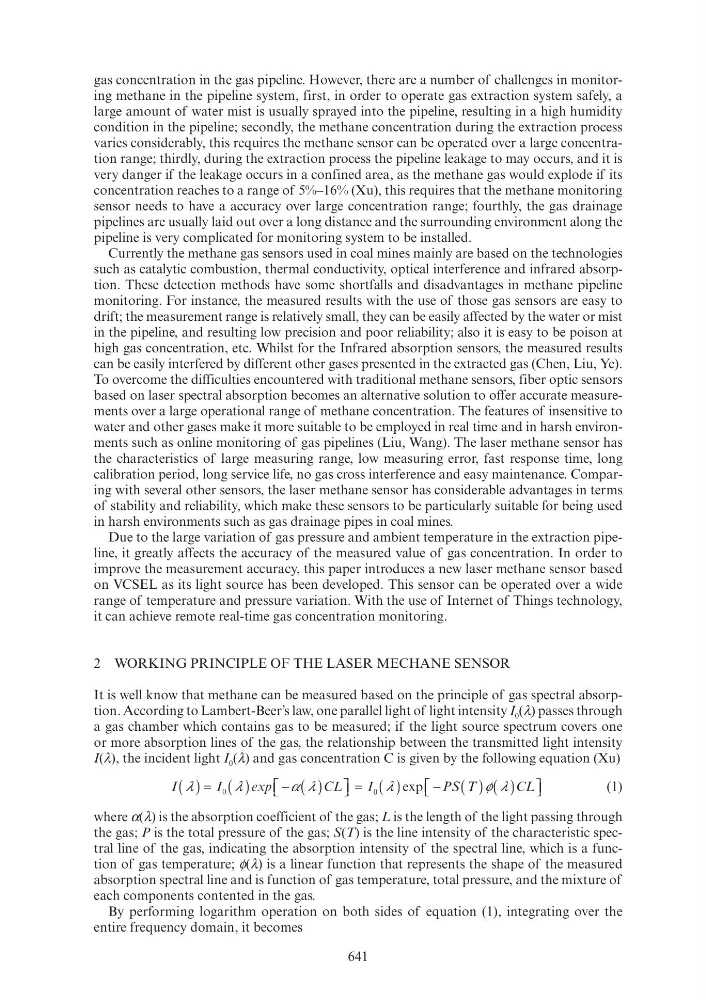
It is well know that methane can be measured based on the principle of gas spectral absorption. According to Lambert-Beer’s law, one parallel light of light intensity I 0 (λ) passes through
a gas chamber which contains gas to be measured; if the light source spectrum covers one
or more absorption lines of the gas, the relationship between the transmitted light intensity
I(λ), the incident light I 0 (λ) and gas concentration C is given by the following equation (Xu)
I
exp x
PS
CL C C
I
CL
I
C
φ
PS
CL
I
C
( )
λ
( )
λ
( )
λ
⎡ ⎣
⎤ ⎦
( )
λ λ
( )
T T ( )
λ
⎡ ⎣
⎤ ⎦ ⎤ ⎤
0
I I
CL C C
0
exp x
I I ( )
λ
( )
⎣
⎦
(1)
where α(λ) is the absorption coefficient of the gas; L is the length of the light passing through
the gas; P is the total pressure of the gas; S(T) is the line intensity of the characteristic spectral line of the gas, indicating the absorption intensity of the spectral line, which is a function of gas temperature; φ(λ) is a linear function that represents the shape of the measured
absorption spectral line and is function of gas temperature, total pressure, and the mixture of
each components contented in the gas.
By performing logarithm operation on both sides of equation (1), integrating over the
entire frequency domain, it becomes