

617
number of dust particles had escaped from the vortex region and entered the stable region.
When DT = 30.0 s, most dust particles had been got out of vortex region while only few
of them, which were mainly small particles with diameters of 20 um and 40 um, were still
flowing in the circulation.
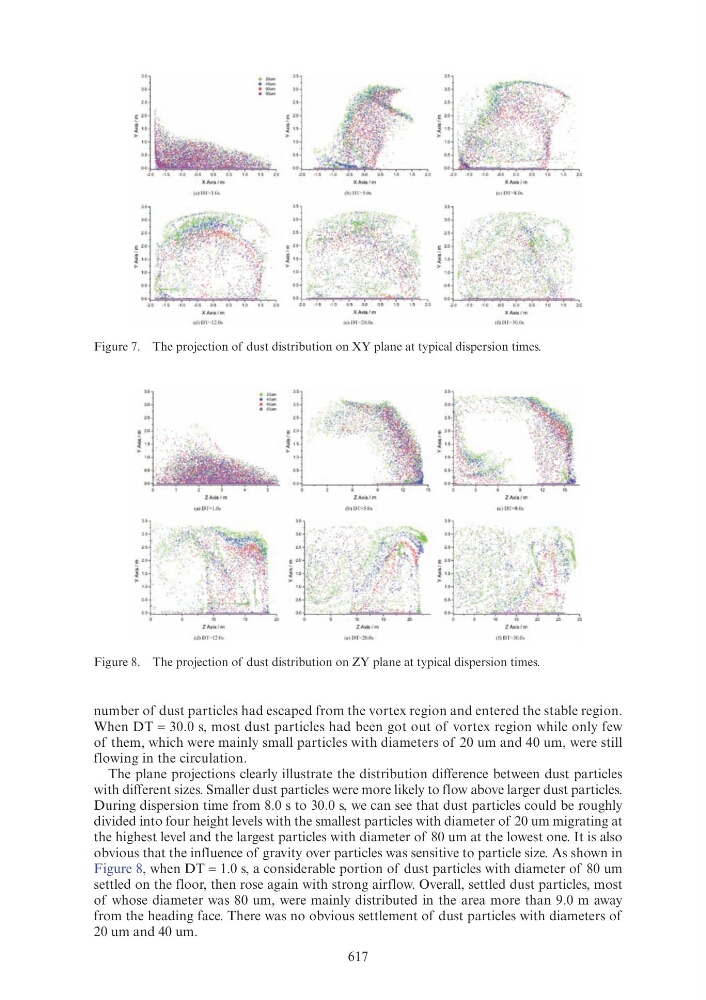
The plane projections clearly illustrate the distribution difference between dust particles
with different sizes. Smaller dust particles were more likely to flow above larger dust particles.
During dispersion time from 8.0 s to 30.0 s, we can see that dust particles could be roughly
divided into four height levels with the smallest particles with diameter of 20 um migrating at
the highest level and the largest particles with diameter of 80 um at the lowest one. It is also
obvious that the influence of gravity over particles was sensitive to particle size. As shown in
Figure 8, when DT = 1.0 s, a considerable portion of dust particles with diameter of 80 um
settled on the floor, then rose again with strong airflow. Overall, settled dust particles, most
of whose diameter was 80 um, were mainly distributed in the area more than 9.0 m away
from the heading face. There was no obvious settlement of dust particles with diameters of
20 um and 40 um.
Figure 7. The projection of dust distribution on XY plane at typical dispersion times.
Figure 8. The projection of dust distribution on ZY plane at typical dispersion times.
E
!
XA:
ZAld•lm
{a) DT• J.O.
ZA..ut l m
(d~ DT 12.0.
ZMt/ m
(b) J)J"-"~.I,bi
! ~'~lli!lf . " ZA!litlm
C~) DT 20.0i
{c) JH -tc O.
{0 01 30.05
Z ~/ m
{c)DT .0.
~~-~i~ . "
Z~ / m
CI) DT JO.Oi