

613
(blowing, exhaust and mixed ventilation) using the CFD method and this numerical study was
validated by the measurements taken in a real mine gallery (Parra et al., 2006).
All of the above studies using the CFD method show that the distribution and movement
of dust are affected obviously by the airflow field. However, most of them mainly pay their
attention to the dust dispersion at a macro-scale; as the CFD method is difficult to reveal
the movement characteristics of particles from a microscopic viewpoint. Recently, CFDDEM (computational fluid dynamics and discrete element method) coupling method has
been under development for numerical simulation with fluid-solid two-phase flows involved.
Using this method, the airflow is simulated and investigated by the traditional CFD method
while the simulation of particles is performed by the DEM method; thus allowing the interaction between fluid and solid to be considered. Therefore, the motion of any particle in
the airflow can be tracked and its migration can be accurately determined. Moreover, this
method requires less empirical parameters and affords the ability to clearly present the particle trajectory and the interaction between particle and fluid (Yu et al., 2018).
In this study, an airflow-dust model was established using a CFD-DEM coupling method.
The dispersion process of dust particles in a roadway installed with single-forced ventilation system was numerically simulated and the effect of particle size on dust dispersion and
distribution was analysed. The aim of this study is to improve the understanding of dust
dispersion mechanism and present the performance of the CFD-DEM coupling method on
studying the particle migration in airflow.
2 NUMERICAL MODELLING OF AIR-DUST COUPLED FLOW
In this study, Eulerian-Lagrangian method was employed to track the particle trajectory
in the airflow. As the total volume of particles was far smaller than that of the fluid, which
caused little force of dusts on airflow, one-way coupling modelling was employed, which
means that the influence of dusts on airflow was not taken into consideration. As the sphere
is the most typical shape of dust, spherical dust particles with different sizes were considered.
Spherical particles with diameters of 20 um, 40 um, 60 um and 80 um were created to analyse
the size effect.
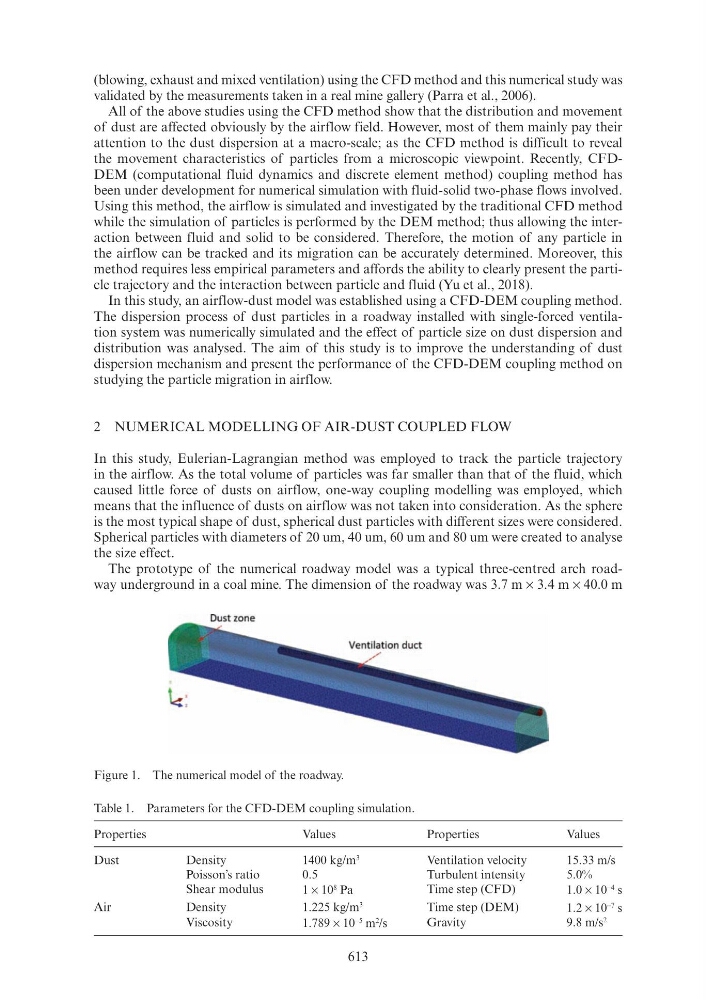
The prototype of the numerical roadway model was a typical three-centred arch roadway underground in a coal mine. The dimension of the roadway was 3.7 m × 3.4 m × 40.0 m
Figure 1. The numerical model of the roadway.
Table 1. Parameters for the CFD-DEM coupling simulation.
Properties
Values
Properties
Values
Dust
Density
1400 kg/m
3
Ventilation velocity
15.33 m/s
Poisson’s ratio
0.5
Turbulent intensity
5.0%
Shear modulus
1 × 10
8 Pa
Time step (CFD)
1.0 × 10
−4 s
Air
Density
1.225 kg/m
3
Time step (DEM)
1.2 × 10
−7 s
Viscosity
1.789 × 10
−5 m
2 /s
Gravity
9.8 m/s
2