

610
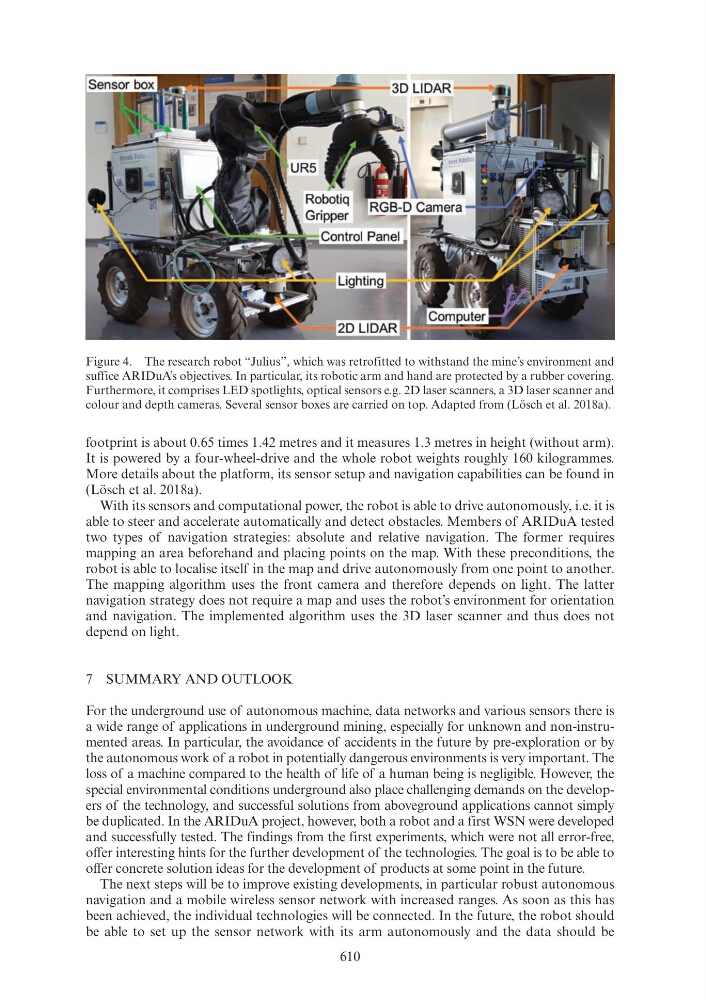
footprint is about 0.65 times 1.42 metres and it measures 1.3 metres in height (without arm).
It is powered by a four-wheel-drive and the whole robot weights roughly 160 kilogrammes.
More details about the platform, its sensor setup and navigation capabilities can be found in
(Lösch et al. 2018a).
With its sensors and computational power, the robot is able to drive autonomously, i.e. it is
able to steer and accelerate automatically and detect obstacles. Members of ARIDuA tested
two types of navigation strategies: absolute and relative navigation. The former requires
mapping an area beforehand and placing points on the map. With these preconditions, the
robot is able to localise itself in the map and drive autonomously from one point to another.
The mapping algorithm uses the front camera and therefore depends on light. The latter
navigation strategy does not require a map and uses the robot’s environment for orientation
and navigation. The implemented algorithm uses the 3D laser scanner and thus does not
depend on light.
7 SUMMARY AND OUTLOOK
For the underground use of autonomous machine, data networks and various sensors there is
a wide range of applications in underground mining, especially for unknown and non-instrumented areas. In particular, the avoidance of accidents in the future by pre-exploration or by
the autonomous work of a robot in potentially dangerous environments is very important. The
loss of a machine compared to the health of life of a human being is negligible. However, the
special environmental conditions underground also place challenging demands on the developers of the technology, and successful solutions from aboveground applications cannot simply
be duplicated. In the ARIDuA project, however, both a robot and a first WSN were developed
and successfully tested. The findings from the first experiments, which were not all error-free,
offer interesting hints for the further development of the technologies. The goal is to be able to
offer concrete solution ideas for the development of products at some point in the future.
The next steps will be to improve existing developments, in particular robust autonomous
navigation and a mobile wireless sensor network with increased ranges. As soon as this has
been achieved, the individual technologies will be connected. In the future, the robot should
be able to set up the sensor network with its arm autonomously and the data should be
Figure 4. The research robot “Julius”, which was retrofitted to withstand the mine’s environment and
suffice ARIDuA’s objectives. In particular, its robotic arm and hand are protected by a rubber covering.
Furthermore, it comprises LED spotlights, optical sensors e.g. 2D laser scanners, a 3D laser scanner and
colour and depth cameras. Several sensor boxes are carried on top. Adapted from (Lösch et al. 2018a).