

609
challenges of the “Reiche Zeche” (see 5.6). In addition, excellent work has been done in the
field of data evaluation, automated geological mapping, robotic manipulation and navigation, which is here not further discussed.
6.1 Wireless Sensor Network (WSN)
The developments within the project regarding the WSN have focussed so far on two aspects:
the identification of a wireless data transmission technology suitable for the layout of the
Research and Teaching Mine and the implementation of sensors for relevant variables as listed
in Table 1. Suitable equipment for both tasks were selected from commercially available components with special emphasis on low energy consumption, small form factor and freely accessible data interfaces. This approach enables the assembly of tailor-made and battery powered
sensor nodes from parts by various manufacturers for specific measuring tasks. All sensor
nodes consist of at least four functional units: a power supply, a microcontroller, a wireless
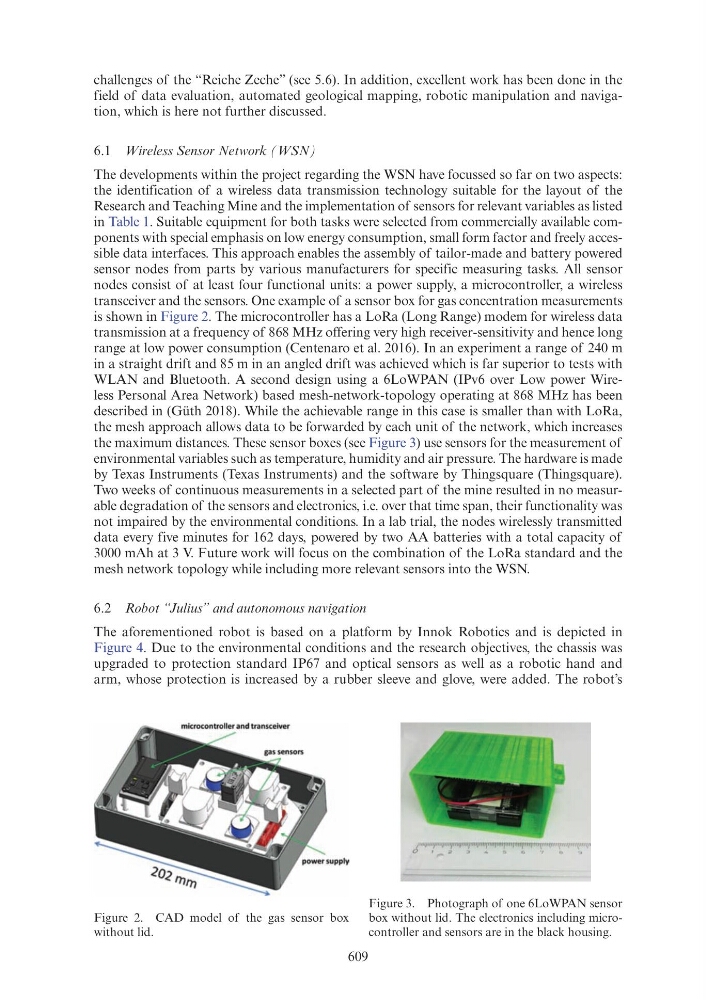
transceiver and the sensors. One example of a sensor box for gas concentration measurements
is shown in Figure 2. The microcontroller has a LoRa (Long Range) modem for wireless data
transmission at a frequency of 868 MHz offering very high receiver-sensitivity and hence long
range at low power consumption (Centenaro et al. 2016). In an experiment a range of 240 m
in a straight drift and 85 m in an angled drift was achieved which is far superior to tests with
WLAN and Bluetooth. A second design using a 6LoWPAN (IPv6 over Low power Wireless Personal Area Network) based mesh-network-topology operating at 868 MHz has been
described in (Güth 2018). While the achievable range in this case is smaller than with LoRa,
the mesh approach allows data to be forwarded by each unit of the network, which increases
the maximum distances. These sensor boxes (see Figure 3) use sensors for the measurement of
environmental variables such as temperature, humidity and air pressure. The hardware is made
by Texas Instruments (Texas Instruments) and the software by Thingsquare (Thingsquare).
Two weeks of continuous measurements in a selected part of the mine resulted in no measurable degradation of the sensors and electronics, i.e. over that time span, their functionality was
not impaired by the environmental conditions. In a lab trial, the nodes wirelessly transmitted
data every five minutes for 162 days, powered by two AA batteries with a total capacity of
3000 mAh at 3 V. Future work will focus on the combination of the LoRa standard and the
mesh network topology while including more relevant sensors into the WSN.
6.2 Robot “Julius” and autonomous navigation
The aforementioned robot is based on a platform by Innok Robotics and is depicted in
Figure 4. Due to the environmental conditions and the research objectives, the chassis was
upgraded to protection standard IP67 and optical sensors as well as a robotic hand and
arm, whose protection is increased by a rubber sleeve and glove, were added. The robot’s
Figure 2. CAD model of the gas sensor box
without lid.
Figure 3. Photograph of one 6LoWPAN sensor
box without lid. The electronics including microcontroller and sensors are in the black housing.
6'111flll~lillf1111f1111(1111f1111fi~H/H I I/!H!III!!J'U!\111l\lll\\ll;l\ll ll\llll\llll\l\l\
1,.. 2
3
"
"'
b
"/
e.
CJ