

565
2.2 EPC
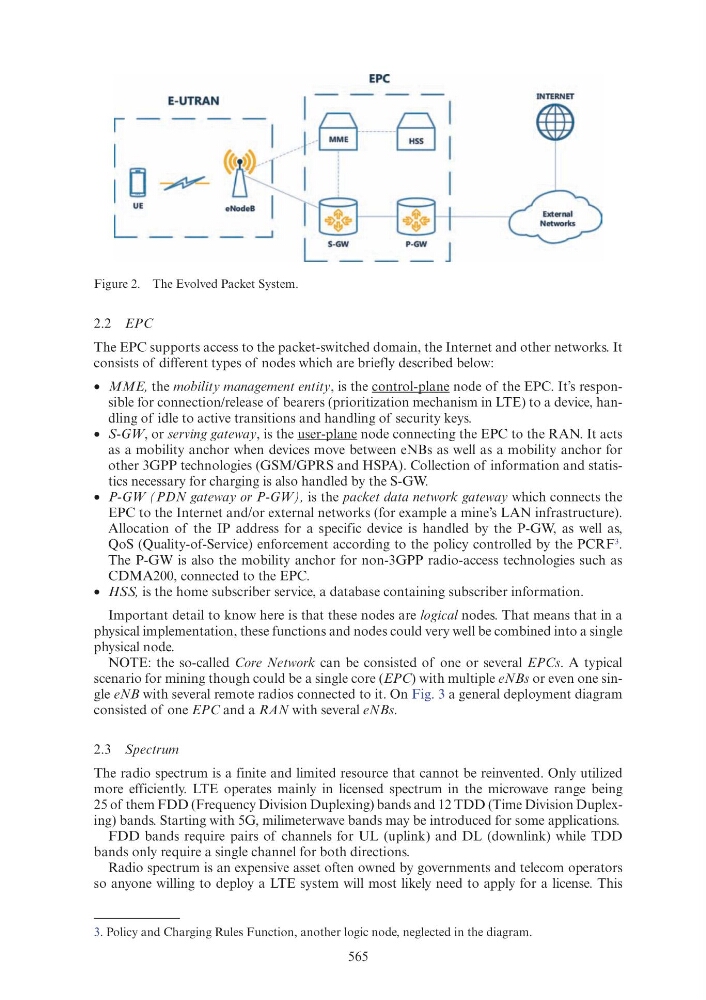
The EPC supports access to the packet-switched domain, the Internet and other networks. It
consists of different types of nodes which are briefly described below:
• MME, the mobility management entity, is the control-plane node of the EPC. It’s responsible for connection/release of bearers (prioritization mechanism in LTE) to a device, handling of idle to active transitions and handling of security keys.
• S-GW, or serving gateway, is the user-plane node connecting the EPC to the RAN. It acts
as a mobility anchor when devices move between eNBs as well as a mobility anchor for
other 3GPP technologies (GSM/GPRS and HSPA). Collection of information and statistics necessary for charging is also handled by the S-GW.
• P-GW (PDN gateway or P-GW), is the packet data network gateway which connects the
EPC to the Internet and/or external networks (for example a mine’s LAN infrastructure).
Allocation of the IP address for a specific device is handled by the P-GW, as well as,
QoS (Quality-of-Service) enforcement according to the policy controlled by the PCRF
3
.
The P-GW is also the mobility anchor for non-3GPP radio-access technologies such as
CDMA200, connected to the EPC.
• HSS, is the home subscriber service, a database containing subscriber information.
Important detail to know here is that these nodes are logical nodes. That means that in a
physical implementation, these functions and nodes could very well be combined into a single
physical node.
NOTE: the so-called Core Network can be consisted of one or several EPCs. A typical
scenario for mining though could be a single core (EPC) with multiple eNBs or even one single eNB with several remote radios connected to it. On Fig. 3 a general deployment diagram
consisted of one EPC and a RAN with several eNBs.
2.3 Spectrum
The radio spectrum is a finite and limited resource that cannot be reinvented. Only utilized
more efficiently. LTE operates mainly in licensed spectrum in the microwave range being
25 of them FDD (Frequency Division Duplexing) bands and 12 TDD (Time Division Duplexing) bands. Starting with 5G, milimeterwave bands may be introduced for some applications.
FDD bands require pairs of channels for UL (uplink) and DL (downlink) while TDD
bands only require a single channel for both directions.
Radio spectrum is an expensive asset often owned by governments and telecom operators
so anyone willing to deploy a LTE system will most likely need to apply for a license. This
3. Policy and Charging Rules Function, another logic node, neglected in the diagram.
Figure 2. The Evolved Packet System.
E-UTRAN
EPC
,---- ~---1
"~ I l § o I
I D - \<< ,>,----r------ i ~ 1
...
~
I
:
UE
'
L
...... I
I
-
__J
INTERNET