

552
the clustering algorithm classifies each data point into a specific group, relating samples in a
way that the most similar are grouped together.
Indicator Kriging (IK) involves the linking of an indicator to a geological domain, in this
case to a cluster domain, providing the probability of each unsampled location of belonging
to each cluster domain and becomes theoretically possible to predict, for a given oxides grade
the recovery expected for that block/region.
Identifying ore classes and distinguishing their behavior on the processes, anticipates the
expected behavior for these ore types when mine planning. Estimating how they are spatially
distributed helps mine planners to strategically schedule their operations. maximizing the use
of the resource.
2 MATERIALS AND METHODS
The sampled data consisted of 734 samples from 62 rotary drilled holes with a sample length
of 2.5 m and arrangement in a grid with an average spacing of 90 x 90 m that belongs to a
medium plan region from the pit.
2.1 Geometallurgy
Geometallurgical programs can be divided into three approaches: traditional, proxies and
mineralogical. In the traditional approach, the metallurgical response of an ore in the mineral processing plant is calculated from the chemical assays using mathematical functions.
The proxies approach uses geometallurgical tests for many samples and the mineralogical approach includes quantitative mineralogical information. For our study, a traditional
approach was taken considering correlation between the elemental grades: CaO, Fe 2 O 3 ,
MgO, SiO 2 , TiO 2 , Na 2 O, K 2 O, MnO and geometallurgical tests were performed, as well as
prediction being done through a mathematical function. A total of 361 samples were bench
tested according to an industrial flowsheet, and the all the batch flotation test results were
averaged. On MINITAB® their recovery responses were correlated with their ore chemical
components and fitted into a regression equation.
2.2 Clustering analysis
Machine Learning is a method of data analysis that automates the construction of an analytical model. The purpose of machine learning is to develop computational techniques
that allow the simulation of the learning process and the construction of systems capable
of gaining knowledge automatically (Mitchell, 1997). Hierarchical cluster analysis (HCA)
is a machine learning technique that seeks to build a hierarchy of clusters, one by one, until
clustering all points into a single group. One of the HCA features is to display the data in
a two-dimensional space in order to display the groupings as one dendogram. The distance
between the points reflects the similarity of its properties, being useful to determine the similarity between objects. In theory, data points that are in the same group should have similar
properties and/or features, while data points in different groups should have highly dissimilar
properties and/or features. In other words, all clustering is done with the goal of maximizing
the homogeneity within each cluster and maximizing the heterogeneity between clusters.
2.3 Indicator kriging
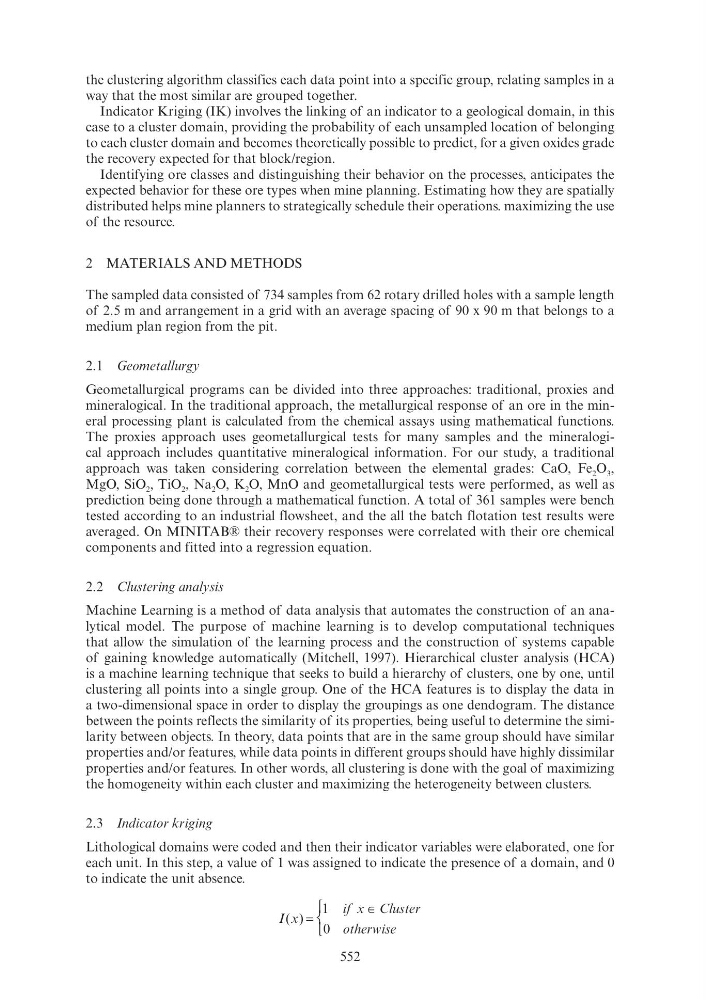
Lithological domains were coded and then their indicator variables were elaborated, one for
each unit. In this step, a value of 1 was assigned to indicate the presence of a domain, and 0
to indicate the unit absence.
I
if x Clu
C C ster
otherwise
( )
x =
⎧
⎨
⎧ ⎧
⎩
⎨ ⎨
1
0