

549
6 CONCLUSIONS
Due to advances in technology and its incorporation in the mineral sector, the study of the
automation of transport systems in open pit mines is very relevant.
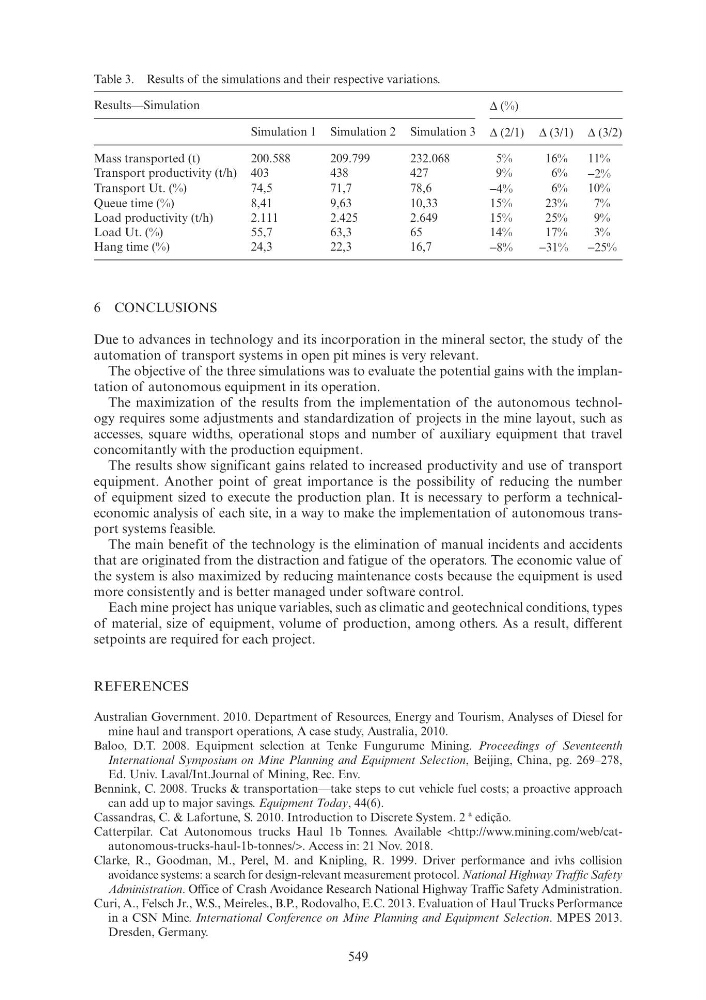
The objective of the three simulations was to evaluate the potential gains with the implantation of autonomous equipment in its operation.
The maximization of the results from the implementation of the autonomous technology requires some adjustments and standardization of projects in the mine layout, such as
accesses, square widths, operational stops and number of auxiliary equipment that travel
concomitantly with the production equipment.
The results show significant gains related to increased productivity and use of transport
equipment. Another point of great importance is the possibility of reducing the number
of equipment sized to execute the production plan. It is necessary to perform a technicaleconomic analysis of each site, in a way to make the implementation of autonomous transport systems feasible.
The main benefit of the technology is the elimination of manual incidents and accidents
that are originated from the distraction and fatigue of the operators. The economic value of
the system is also maximized by reducing maintenance costs because the equipment is used
more consistently and is better managed under software control.
Each mine project has unique variables, such as climatic and geotechnical conditions, types
of material, size of equipment, volume of production, among others. As a result, different
setpoints are required for each project.
REFERENCES
Australian Government. 2010. Department of Resources, Energy and Tourism, Analyses of Diesel for
mine haul and transport operations, A case study, Australia, 2010.
Baloo, D.T. 2008. Equipment selection at Tenke Fungurume Mining. Proceedings of Seventeenth
International Symposium on Mine Planning and Equipment Selection, Beijing, China, pg. 269–278,
Ed. Univ. Laval/Int.Journal of Mining, Rec. Env.
Bennink, C. 2008. Trucks & transportation—take steps to cut vehicle fuel costs; a proactive approach
can add up to major savings. Equipment Today, 44(6).
Cassandras, C. & Lafortune, S. 2010. Introduction to Discrete System. 2 ª edição.
Catterpilar. Cat Autonomous trucks Haul 1b Tonnes. Available
Clarke, R., Goodman, M., Perel, M. and Knipling, R. 1999. Driver performance and ivhs collision
avoidance systems: a search for design-relevant measurement protocol. National Highway Traffic Safety
Administration. Office of Crash Avoidance Research National Highway Traffic Safety Administration.
Curi, A., Felsch Jr., W.S., Meireles., B.P., Rodovalho, E.C. 2013. Evaluation of Haul Trucks Performance
in a CSN Mine. International Conference on Mine Planning and Equipment Selection. MPES 2013.
Dresden, Germany.
Table 3. Results of the simulations and their respective variations.
Results—Simulation
Δ (%)
Simulation 1 Simulation 2 Simulation 3 Δ (2/1) Δ (3/1) Δ (3/2)
Mass transported (t)
200.588
209.799
232.068
5%
16%
11%
Transport productivity (t/h) 403
438
427
9%
6%
−2%
Transport Ut. (%)
74,5
71,7
78,6
−4%
6%
10%
Queue time (%)
8,41
9,63
10,33
15%
23%
7%
Load productivity (t/h)
2.111
2.425
2.649
15%
25%
9%
Load Ut. (%)
55,7
63,3
65
14%
17%
3%
Hang time (%)
24,3
22,3
16,7
−8%
−31%
−25%