

546
of the autonomous technology. Through statistical analysis, the average fleet speed was stratified for each mine operator, being calculated through the normal distribution the value of its
3rd quartile, according to Table 2.
It can be verified that there are several operators that already practice simulated speed
through the 3rd quartile. In addition to the improvements of the mentioned conditions, the
training of the operators is shown with great importance to leverage the results.
3.2 Simulation 3
Autonomous operation with speed stipulated through the 3rd quartile.
The autonomous operation was designed in the simulator through the exclusion of operational stops of the trucks that have direct relation with the use of operators. The stop motives
that have been changed are: Turn shift; Fog; Meeting; Meal; Lack of operator; Inspection of
the operator; Operator displacement; Stop for physiological needs; Operator sleepy. These
operational stops were replaced by hours of equipment operation.
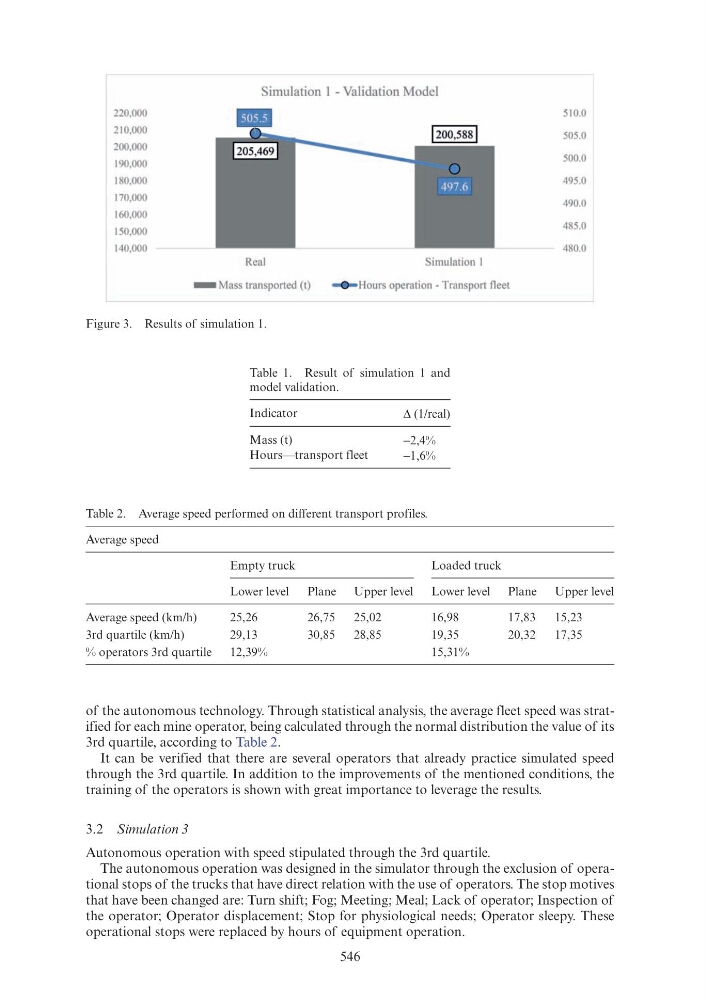
Figure 3. Results of simulation 1.
Table 1. Result of simulation 1 and
model validation.
Indicator
Δ (1/real)
Mass (t)
−2,4%
Hours—transport fleet
−1,6%
Table 2. Average speed performed on different transport profiles.
Average speed
Empty truck
Loaded truck
Lower level
Plane Upper level Lower level Plane Upper level
Average speed (km/h)
25,26
26,75
25,02
16,98
17,83
15,23
3rd quartile (km/h)
29,13
30,85
28,85
19,35
20,32
17,35
% operators 3rd quartile 12,39%
15,31%
220,000
210,000
200,000
190,000
180,000
170,000
160,000
150,000
140,000
Simulation 1 - Validation Model
Real
Simulation I
-Mass transported (t)
-
Hours operation -Transport fleet
510.0
505.0
500.0
495.0
490.0
485.0
480.0