

545
The software used to perform the simulations was the Delphos Open Pit Simulator©
(DSIM), which is a discrete event simulation tool, developed by the Advanced Technological Mining Center (AMTC) at the University of Chile. DSIM© can estimate the production
of a mining plan from three basic elements: mine layout (topography, operation fronts and
routes); fleet of cargo and transportation equipment, detailed production plan.
First, a simulation was performed in order to validate the actual operation compared to
the DSIM© information.
The information regarding a day of operation of the study target mine with a duration of
24 hours was imputed in the simulator. The following variables were inserted in the software:
detailed production plan by origin and destination; operational losses (reasons for stopping
the equipment); MTBF; MTTR; average speed; distributions of values related to loading
times, download time and queue time.
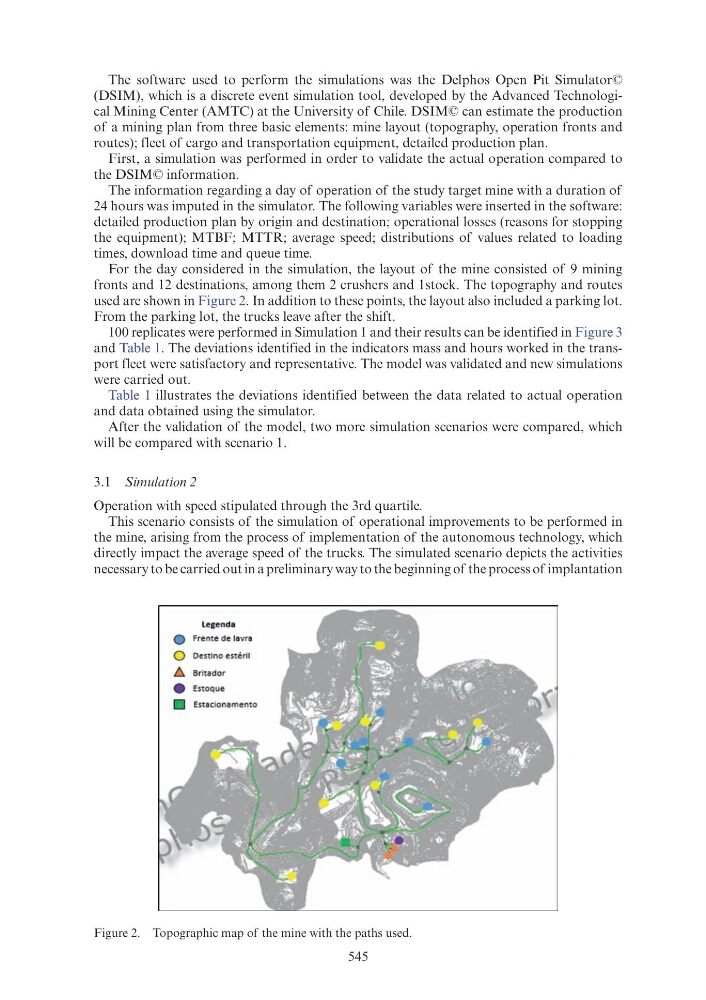
For the day considered in the simulation, the layout of the mine consisted of 9 mining
fronts and 12 destinations, among them 2 crushers and 1stock. The topography and routes
used are shown in Figure 2. In addition to these points, the layout also included a parking lot.
From the parking lot, the trucks leave after the shift.
100 replicates were performed in Simulation 1 and their results can be identified in Figure 3
and Table 1. The deviations identified in the indicators mass and hours worked in the transport fleet were satisfactory and representative. The model was validated and new simulations
were carried out.
Table 1 illustrates the deviations identified between the data related to actual operation
and data obtained using the simulator.
After the validation of the model, two more simulation scenarios were compared, which
will be compared with scenario 1.
3.1 Simulation 2
Operation with speed stipulated through the 3rd quartile.
This scenario consists of the simulation of operational improvements to be performed in
the mine, arising from the process of implementation of the autonomous technology, which
directly impact the average speed of the trucks. The simulated scenario depicts the activities
necessary to be carried out in a preliminary way to the beginning of the process of implantation
Figure 2. Topographic map of the mine with the paths used.
Legend a
Frente de lavr a
0 Des.ti no esteril
/:::,. Britodor
•
Estoque
1111 Esta ciona me nto