

520
this paper we would like to focus on seemingly “stationary” parts of the process and dynamic
phenomena occurring during these periods. “Stationary part” means that number of factors
that could influence dynamics is minimized.
Signals acquired from the machine are extremely nonstationary, thus the primary idea here
is to make the problem simpler by selection of the most stationary part of data. In theory,
there are several possible ways to select “stationary” segments, however, based on some preliminary investigation it was decided that best solution is to use gear number 2, mostly used
for driving from mining screen to mining face and back. Using other variables (speed, fuel
consumption) is complicated due to the nature of the variability of these parameters.
It is worth mentioning that data has been standardized in sense of sampling frequency (all
variables with 1 Hz). After mentioned segmentation (selection of samples for gear number = 2
only), data were grouped into segments of the loaded and unloaded machine and statistically
analyzed. It was found that due to the influence of other operational parameters (speed, rpm)
global (calculated for all segments with gear = 2 and unloaded box) statistical measures are
not effective. It is due to influence of other factors that on this stage of research have not been
precisely identified yet. It was previously stated that due to complexity of the problem, analysis
of data acquired from LHD machines should take into account many variables, i.e. should be
multidimensional [14, 15]. Therefore, in the second phase of segmentation, part of signals with
the same gear and similar speed have been investigated for the unloaded machine. Analysis of
variance [14] of these segments has allowed recognizing the change in vibration for various
road roughness. At this stage, there is no automatic procedure to achieve final results (i.e. road
recognition system) but it has been proved that identification of road surface might be possible
based on vibration analysis. Overview of the proposed idea is shown in Fig. 5.
4 RESULTS
In this section the preprocessed data and the results of our investigations are presented.
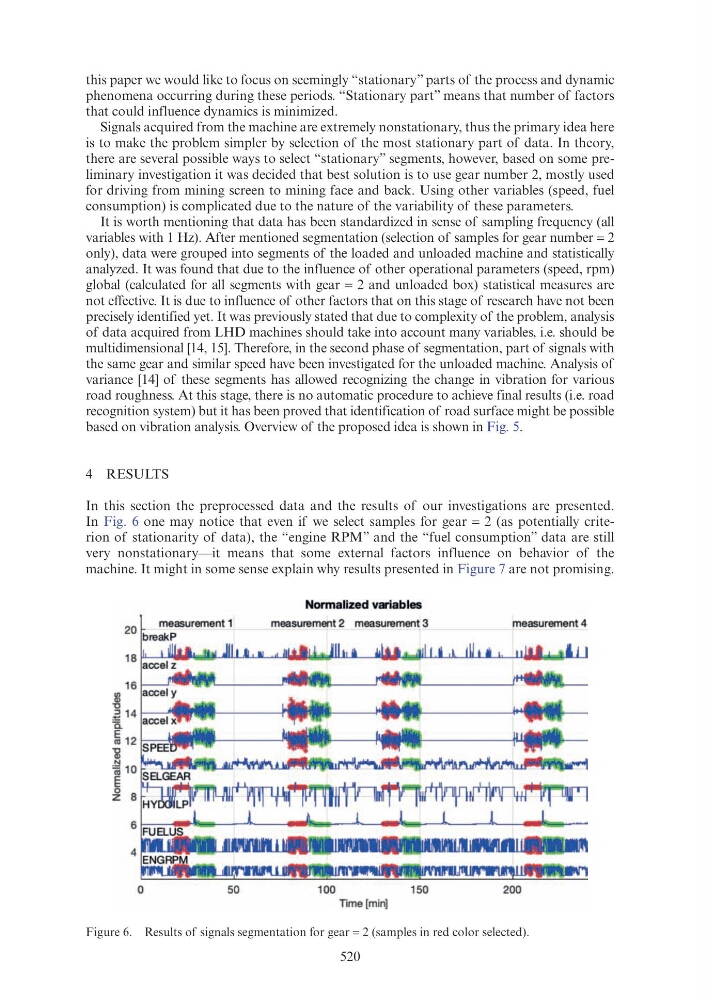
In Fig. 6 one may notice that even if we select samples for gear = 2 (as potentially criterion of stationarity of data), the “engine RPM” and the “fuel consumption” data are still
very nonstationary—it means that some external factors influence on behavior of the
machine. It might in some sense explain why results presented in Figure 7 are not promising.
Figure 6. Results of signals segmentation for gear = 2 (samples in red color selected).
20
18
16
"'
,g 14
c.
~ 12
~
'iii 10
E 0 8
z
6
4
0
50
Norma lized variables
measurement 2 measurement 3
100
150
Time [min)
measurement 4
200