

516
habits (dynamics of driving style), machine conditions etc., might have a serious influence on
overall dynamic load of such a machine. Obviously, it will also affect the wear/degradation
of the machine and overall efficiency of the machine.
The paper is a kind of introductory work. First, we have done several experiments using
the regular car and two examples of the road–results appeared very promising [1]. Other
authors also have tried to use mobile phones to measure some parameters and use them
to evaluate of quality of roads [2, 3, 4, 5, 6, 7, 8, 9]. However, in the deep mine using heavy
duty machines is a challenging issue. In order to “control” experimental work during regular
activities of the machine (ore transport from mining face to mining screen–i.e. unloading
point), we combined vibration data with existing onboard monitoring system used in the
mine. From that system, one might measure speed, fuel consumption, current gear, and many
other parameters. It helps us to link vibration level with machine operational regimes, acceleration, deceleration, changing driving direction, etc.
The paper is organized as follows: first, we briefly present a machine, describe the experiment and the data from the onboard monitoring system. Then we propose a simple methodology, that is based mostly on a simple statistical analysis and—on this stage–a visual
inspection of the data rather than an advanced algorithm. Some basic conclusions are drawn
at the end of the paper.
2 MACHINE AND EXPERIMENT
2.1 Machine description
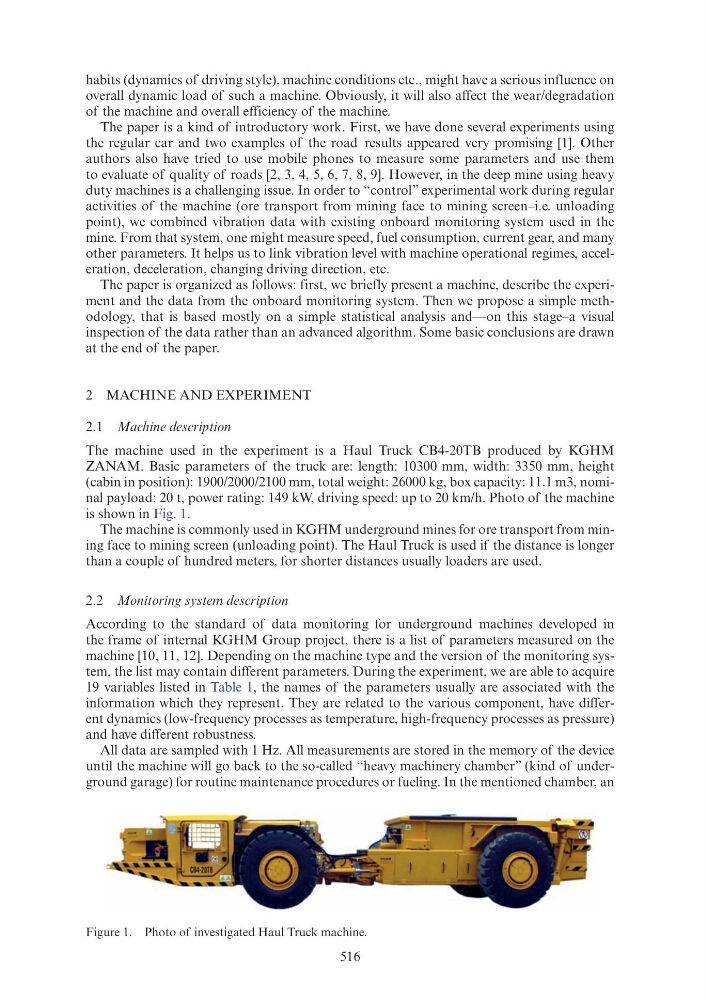
The machine used in the experiment is a Haul Truck CB4-20TB produced by KGHM
ZANAM. Basic parameters of the truck are: length: 10300 mm, width: 3350 mm, height
(cabin in position): 1900/2000/2100 mm, total weight: 26000 kg, box capacity: 11.1 m3, nominal payload: 20 t, power rating: 149 kW, driving speed: up to 20 km/h. Photo of the machine
is shown in Fig. 1.
The machine is commonly used in KGHM underground mines for ore transport from mining face to mining screen (unloading point). The Haul Truck is used if the distance is longer
than a couple of hundred meters, for shorter distances usually loaders are used.
2.2 Monitoring system description
According to the standard of data monitoring for underground machines developed in
the frame of internal KGHM Group project, there is a list of parameters measured on the
machine [10, 11, 12]. Depending on the machine type and the version of the monitoring system, the list may contain different parameters. During the experiment, we are able to acquire
19 variables listed in Table 1, the names of the parameters usually are associated with the
information which they represent. They are related to the various component, have different dynamics (low-frequency processes as temperature, high-frequency processes as pressure)
and have different robustness.
All data are sampled with 1 Hz. All measurements are stored in the memory of the device
until the machine will go back to the so-called “heavy machinery chamber” (kind of underground garage) for routine maintenance procedures or fueling. In the mentioned chamber, an
Figure 1. Photo of investigated Haul Truck machine.