

442
Gamification is defined as the application of typical elements of game playing (e.g. points,
competition, cooperative play, levelling, etc.) to other areas of activity. This is how most of
the world now interacts, regardless of culture and country of origin; through smart devices,
whose applications typically include gamification elements as a means of creating addiction
to an app. This modern nearly-universal human phenomenon can be applied to positive
effect by applying a digital points system, levelling, and competition/collaboration mechanics to safety and productivity.
4.1 US coal operation
A gamification application was applied at a coal operation in the United States where the
fueling time was subtly added to a leader board, where operators could see their point accumulation throughout the day. Without an explicit improvement program, simply using the
gamification program, within a few days of creating the digital “medal” award, the automatically detected fueling events went from an average of 703 seconds to 495 seconds. The leader
board included several key performance indicators (KPIs). As can be seen, an improvement
of 30% was seen before gamification was applied versus after.
4.2 US underground lead mine
A gamification application was applied at an underground lead mine in the United States,
where a transition period occurred where the app had been deployed but no gamification
was enacted. Then the operators where introduced to the gamification points and trophies.
The system was deployed to improve overall productivity as well as pre-op checklist-form
completion compliance. There were a few objectives to the gamification, first in order to
improve productivity, a key leading indicator is quicker shift start-ups, where the machine
operators should get to their machines, do the pre-check, and begin operating as quickly as
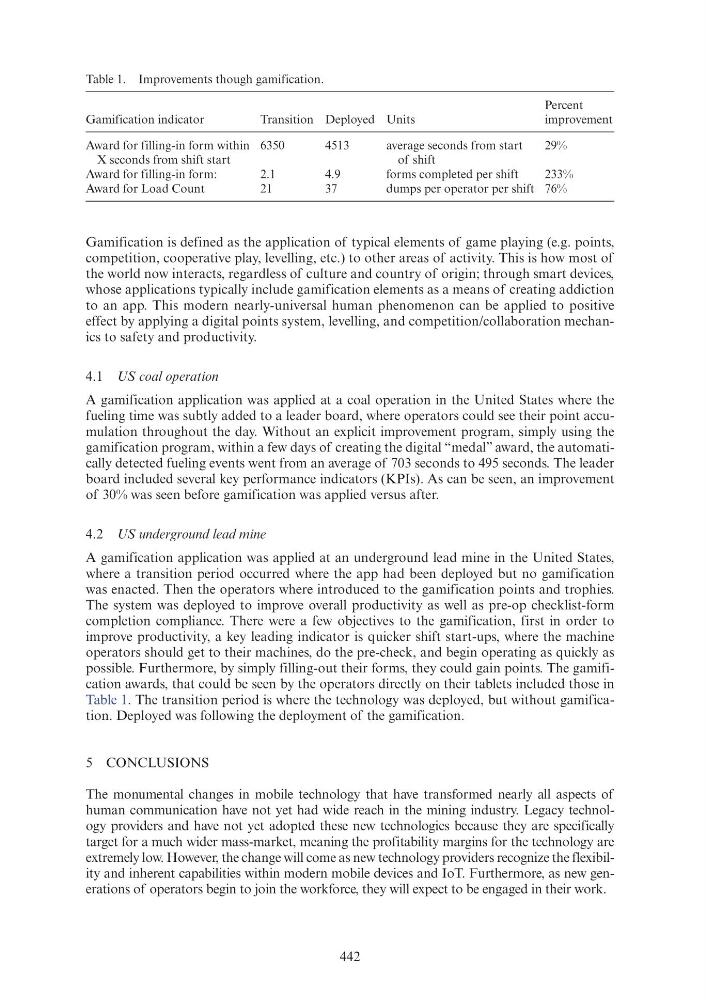
possible. Furthermore, by simply filling-out their forms, they could gain points. The gamification awards, that could be seen by the operators directly on their tablets included those in
Table 1. The transition period is where the technology was deployed, but without gamification. Deployed was following the deployment of the gamification.
5 CONCLUSIONS
The monumental changes in mobile technology that have transformed nearly all aspects of
human communication have not yet had wide reach in the mining industry. Legacy technology providers and have not yet adopted these new technologies because they are specifically
target for a much wider mass-market, meaning the profitability margins for the technology are
extremely low. However, the change will come as new technology providers recognize the flexibility and inherent capabilities within modern mobile devices and IoT. Furthermore, as new generations of operators begin to join the workforce, they will expect to be engaged in their work.
Table 1. Improvements though gamification.
Gamification indicator
Transition Deployed Units
Percent
improvement
Award for filling-in form within
X seconds from shift start
6350
4513
average seconds from start
of shift
29%
Award for filling-in form:
2.1
4.9
forms completed per shift
233%
Award for Load Count
21
37
dumps per operator per shift 76%
Gamification is defined as the application of typical elements of game playing (e.g. points,
competition, cooperative play, levelling, etc.) to other areas of activity. This is how most of
the world now interacts, regardless of culture and country of origin; through smart devices,
whose applications typically include gamification elements as a means of creating addiction
to an app. This modern nearly-universal human phenomenon can be applied to positive
effect by applying a digital points system, levelling, and competition/collaboration mechanics to safety and productivity.
4.1 US coal operation
A gamification application was applied at a coal operation in the United States where the
fueling time was subtly added to a leader board, where operators could see their point accumulation throughout the day. Without an explicit improvement program, simply using the
gamification program, within a few days of creating the digital “medal” award, the automatically detected fueling events went from an average of 703 seconds to 495 seconds. The leader
board included several key performance indicators (KPIs). As can be seen, an improvement
of 30% was seen before gamification was applied versus after.
4.2 US underground lead mine
A gamification application was applied at an underground lead mine in the United States,
where a transition period occurred where the app had been deployed but no gamification
was enacted. Then the operators where introduced to the gamification points and trophies.
The system was deployed to improve overall productivity as well as pre-op checklist-form
completion compliance. There were a few objectives to the gamification, first in order to
improve productivity, a key leading indicator is quicker shift start-ups, where the machine
operators should get to their machines, do the pre-check, and begin operating as quickly as
possible. Furthermore, by simply filling-out their forms, they could gain points. The gamification awards, that could be seen by the operators directly on their tablets included those in
Table 1. The transition period is where the technology was deployed, but without gamification. Deployed was following the deployment of the gamification.
5 CONCLUSIONS
The monumental changes in mobile technology that have transformed nearly all aspects of
human communication have not yet had wide reach in the mining industry. Legacy technology providers and have not yet adopted these new technologies because they are specifically
target for a much wider mass-market, meaning the profitability margins for the technology are
extremely low. However, the change will come as new technology providers recognize the flexibility and inherent capabilities within modern mobile devices and IoT. Furthermore, as new generations of operators begin to join the workforce, they will expect to be engaged in their work.
Table 1. Improvements though gamification.
Gamification indicator
Transition Deployed Units
Percent
improvement
Award for filling-in form within
X seconds from shift start
6350
4513
average seconds from start
of shift
29%
Award for filling-in form:
2.1
4.9
forms completed per shift
233%
Award for Load Count
21
37
dumps per operator per shift 76%