

425
5 CONCLUSIONS
The aim of this work was to create a computer software, based on two mathematical models
that represent the two main issues for the railway company that transports minerals and supplies in the North region of Chile. The company uses the system to generate the sequence of
relay points for crew replacements and then, based on this itinerary, decide the crew assignment
to the drivers. The two implemented models are presented in this paper and can be used to generate different efficient feasible solutions very quickly, depending on different scenarios tested
by the user. Moreover, the speed of calculations permits the user to generate in some minutes
several efficient diagrams (in terms of practical loads for the crews), compared with traditional
processes, based on exchanging hand-made files along several weeks of negotiations.
The software tool was developed to provide a friendly environment for user interaction.
The computerized tool is currently operating in a train transportation company, but the
model could be adapted to tackle other kinds of crew scheduling problems, especially those
arising in urban or interurban transportation systems. The main benefit for the company is
not only of economic nature, but also the tool permits to facilitate the negotiations between
management and the unions, providing objective solutions for the decision-making process.
ACKNOWLEDGMENTS
The authors thank FCAB-Antofagasta Minerals Co. for support and real data testing. The
software is currently operating on the National Laboratory for High Performance Computing (ECM-02), University of Chile.
REFERENCES
Amaya, J. & Uribe, P. 2018. A model and computational tool for crew scheduling in train transportation
of mine materials by using a local search strategy. TOP-Journal of the Spanish Society of Statistics
and Operations Research. 26:383–402.
Ceder, A. (first ed.) 2007. Public transit planning and operation: Modeling, practice and behavior. CRC
press.
Drexl, M., Rieck, J., Sigl, T., & Press, B. 2013. Simultaneous vehicle and crew routing and scheduling for
partial-and full-load long-distance road transport. Business Research, 6(2): 242–264.
Sahin, G. & Yuceoglu, B. 2011. Tactical crew planning in railways. Transportation Research Part E:
Logistics and Transportation Review, 47(6): 1221–1243.
Suyabatmaz, A.C., & Sahin, G. 2015. Railway crew capacity planning problem with connectivity of
schedules. Transportation Research Part E: Logistics and Transportation Review, 84.: 88–100.
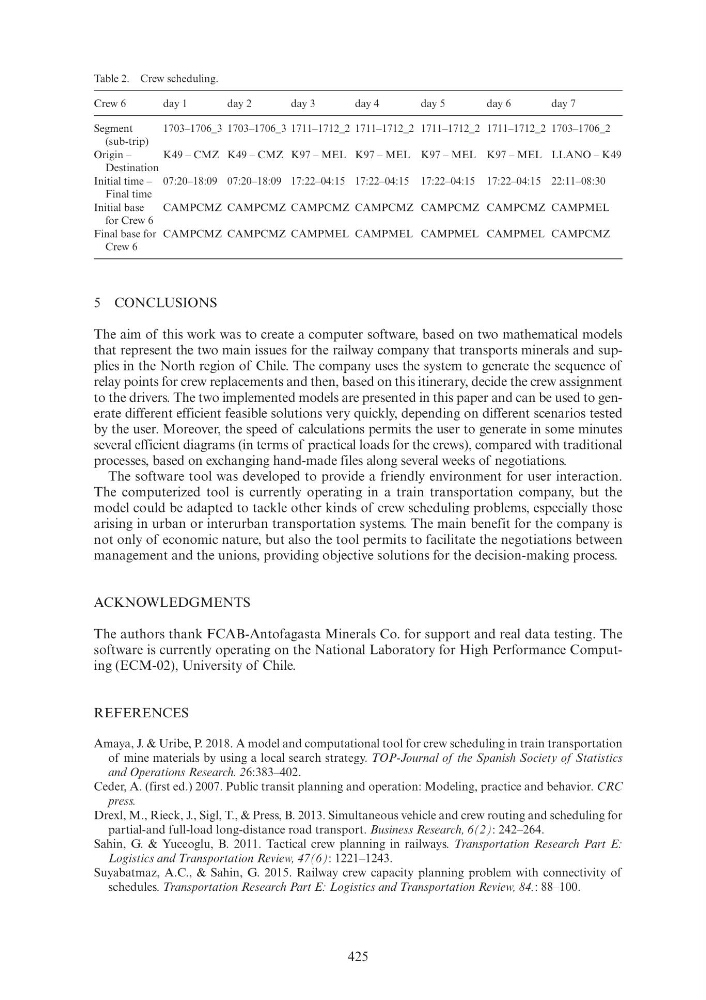
Table 2. Crew scheduling.
Crew 6
day 1
day 2
day 3
day 4
day 5
day 6
day 7
Segment
(sub-trip)
1703–1706_3 1703–1706_3 1711–1712_2 1711–1712_2 1711–1712_2 1711–1712_2 1703–1706_2
Origin –
Destination
K49 – CMZ K49 – CMZ K97 – MEL K97 – MEL K97 – MEL K97 – MEL LLANO – K49
Initial time –
Final time
07:20–18:09 07:20–18:09 17:22–04:15 17:22–04:15 17:22–04:15 17:22–04:15 22:11–08:30
Initial base
for Crew 6
CAMPCMZ CAMPCMZ CAMPCMZ CAMPCMZ CAMPCMZ CAMPCMZ CAMPMEL
Final base for
Crew 6
CAMPCMZ CAMPCMZ CAMPMEL CAMPMEL CAMPMEL CAMPMEL CAMPCMZ
5 CONCLUSIONS
The aim of this work was to create a computer software, based on two mathematical models
that represent the two main issues for the railway company that transports minerals and supplies in the North region of Chile. The company uses the system to generate the sequence of
relay points for crew replacements and then, based on this itinerary, decide the crew assignment
to the drivers. The two implemented models are presented in this paper and can be used to generate different efficient feasible solutions very quickly, depending on different scenarios tested
by the user. Moreover, the speed of calculations permits the user to generate in some minutes
several efficient diagrams (in terms of practical loads for the crews), compared with traditional
processes, based on exchanging hand-made files along several weeks of negotiations.
The software tool was developed to provide a friendly environment for user interaction.
The computerized tool is currently operating in a train transportation company, but the
model could be adapted to tackle other kinds of crew scheduling problems, especially those
arising in urban or interurban transportation systems. The main benefit for the company is
not only of economic nature, but also the tool permits to facilitate the negotiations between
management and the unions, providing objective solutions for the decision-making process.
ACKNOWLEDGMENTS
The authors thank FCAB-Antofagasta Minerals Co. for support and real data testing. The
software is currently operating on the National Laboratory for High Performance Computing (ECM-02), University of Chile.
REFERENCES
Amaya, J. & Uribe, P. 2018. A model and computational tool for crew scheduling in train transportation
of mine materials by using a local search strategy. TOP-Journal of the Spanish Society of Statistics
and Operations Research. 26:383–402.
Ceder, A. (first ed.) 2007. Public transit planning and operation: Modeling, practice and behavior. CRC
press.
Drexl, M., Rieck, J., Sigl, T., & Press, B. 2013. Simultaneous vehicle and crew routing and scheduling for
partial-and full-load long-distance road transport. Business Research, 6(2): 242–264.
Sahin, G. & Yuceoglu, B. 2011. Tactical crew planning in railways. Transportation Research Part E:
Logistics and Transportation Review, 47(6): 1221–1243.
Suyabatmaz, A.C., & Sahin, G. 2015. Railway crew capacity planning problem with connectivity of
schedules. Transportation Research Part E: Logistics and Transportation Review, 84.: 88–100.
Table 2. Crew scheduling.
Crew 6
day 1
day 2
day 3
day 4
day 5
day 6
day 7
Segment
(sub-trip)
1703–1706_3 1703–1706_3 1711–1712_2 1711–1712_2 1711–1712_2 1711–1712_2 1703–1706_2
Origin –
Destination
K49 – CMZ K49 – CMZ K97 – MEL K97 – MEL K97 – MEL K97 – MEL LLANO – K49
Initial time –
Final time
07:20–18:09 07:20–18:09 17:22–04:15 17:22–04:15 17:22–04:15 17:22–04:15 22:11–08:30
Initial base
for Crew 6
CAMPCMZ CAMPCMZ CAMPCMZ CAMPCMZ CAMPCMZ CAMPCMZ CAMPMEL
Final base for
Crew 6
CAMPCMZ CAMPCMZ CAMPMEL CAMPMEL CAMPMEL CAMPMEL CAMPCMZ