

423
initial and final locations of the train, we then define V
V
e
f
V V
V V
.
{
}
v f
v
v v
V V V V
These two trips will
be assigned to fictitious days 0 and 8 respectively. To define compatibility, we use a new variable d v,vv,b , corresponding to the duration of the travel from the final location of v to the camp
b and then to the origin of trip vv. We also define h v k
h h ,
0 and h v k
h h
f
, as the initial and final times of
trip v at day k. The parameter TE denotes the legal maximal duration for the transportation
of the crew, from the location to the base camp.
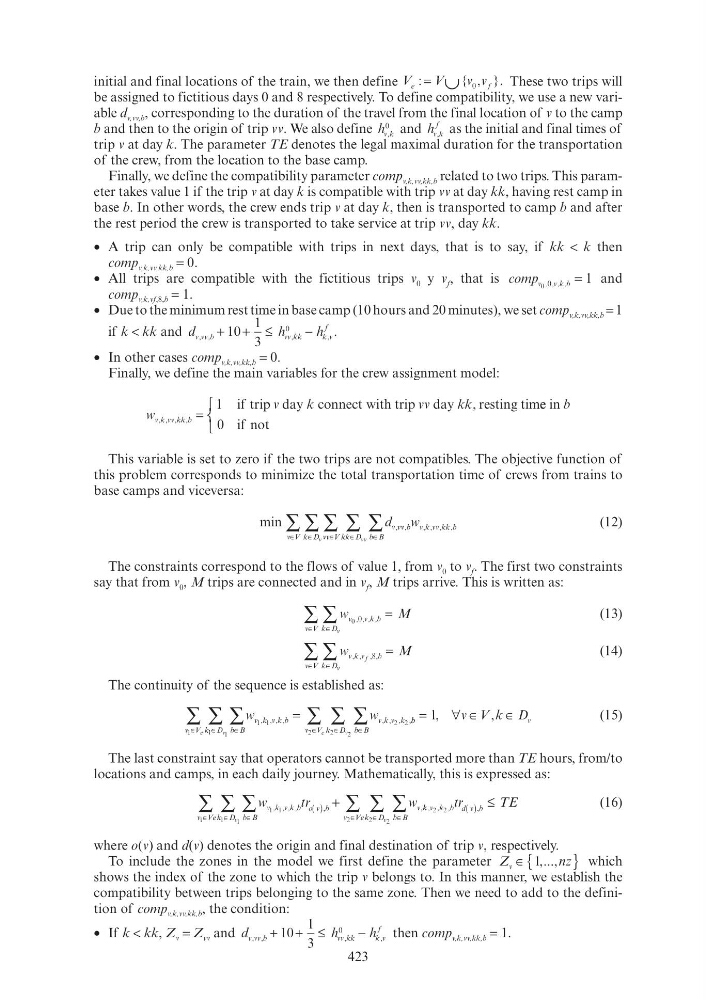
Finally, we define the compatibility parameter comp v,k,vv,kk,b related to two trips. This parameter takes value 1 if the trip v at day k is compatible with trip vv at day kk, having rest camp in
base b. In other words, the crew ends trip v at day k, then is transported to camp b and after
the rest period the crew is transported to take service at trip vv, day kk.
• A trip can only be compatible with trips in next days, that is to say, if kk < k then
comp v,k,vv,kk,b = 0.
• All trips are compatible with the fictitious trips v 0 y v f , that is
v
vk b
0 0
1
, , , ,
k = and
comp v,k,vf,8,b = 1.
• Due to the minimum rest time in base camp (10 hours and 20 minutes), we set comp v,k,vv,kk,b = 1
if k < kk and d
h
h
v v
d d v b
vv
h h kk
k v
h
f
, ,
vv
,
,
kk
k .
−
h vv
h h kk
1
3
0
• In other cases comp v,k,vv,kk,b = 0.
Finally, we define the main variables for the crew assignment model:
w
v
k
vv
kk
v k vv kk b
, ,
k , ,
kk =
1 if trip d
v ay connect with trip day
r
kk, esting time e i
e e n
if not
b
0
⎧
⎨
⎧ ⎧
⎩
⎨ ⎨
This variable is set to zero if the two trips are not compatibles. The objective function of
this problem corresponds to minimize the total transportation time of crews from trains to
base camps and viceversa:
min
, ,
, , , ,
v V k D vv V kk D b B
v v
, v b
,
v k
, vv kk b
v
v
D D vv V kk D
D v
d w
v vv b
V k
∈V kk
V kk
∑ ∑ ∑ ∑ ∑
(12)
The constraints correspond to the flows of value 1, from v 0 to v f . The first two constraints
say that from v 0 , M trips are connected and in v f , M trips arrive. This is written as:
v V k D
v
vk b
v
D D
w
M
v
vk b
V k
∑ ∑ 0 , , , ,
k
(13)
v V k D
v k v
b
v
D D
f
v
w
M
v k v
b
V k
∑ ∑ , ,
k , ,
(14)
The continuity of the sequence is established as:
v V k D b B
v V k D b B
v k v k
e
v
D D
e
v
D
w
1
v V
v e
V V k
1
1 1
2 V k k
e
V V k
2
2 2
k k
V k
V k k
e
V V k
B
v
D b
v
D D 2
∑ ∑ ∑
∑
v k v k b
w v k v k b
1 1
v k
v k
∑ ∑
1
k k
, ,
k
,
2
k b
v
b b
v V k D v
=
∀ V k
(15)
The last constraint say that operators cannot be transported more than TE hours, from/to
locations and camps, in each daily journey. Mathematically, this is expressed as:
v V k
V
D b B
v V k
V
D b B
v
v
v
D b
D
B
v
D D
w
1
1
v V
v
ek
V
1
1 1
Vek V
2
∈
Vek V 1
Vek k
V V
∈
( )
∈
Vek V 2
Vek k
V V Vek V V
∈
∑ ∑
∑
b
∑
∑
v k v k b o
w
t
v k v k b r b
1 1
v k
v k
( )
v
∑ ∑
1
k k
,
,k v
k k
k b d
b
tr d
TE
,v
,
,
2 2
k k
,
( )
v
≤
(16)
where o(v) and d(v) denotes the origin and final destination of trip v, respectively.
To include the zones in the model we first define the parameter Z v
Z Z {
}
nz which
shows the index of the zone to which the trip v belongs to. In this manner, we establish the
compatibility between trips belonging to the same zone. Then we need to add to the definition of comp v,k,vv,kk,b , the condition:
• If k < kk, Z v = Z vv and d
h
h
v v
d d v b
vv
h h kk
k v
h
f
, ,
vv
,
,
kk
k
−
h vv
h h kk
1
3
0
then comp v,k,vv,kk,b = 1.
initial and final locations of the train, we then define V
V
e
f
V V
V V
.
{
}
v f
v
v v
V V V V
These two trips will
be assigned to fictitious days 0 and 8 respectively. To define compatibility, we use a new variable d v,vv,b , corresponding to the duration of the travel from the final location of v to the camp
b and then to the origin of trip vv. We also define h v k
h h ,
0 and h v k
h h
f
, as the initial and final times of
trip v at day k. The parameter TE denotes the legal maximal duration for the transportation
of the crew, from the location to the base camp.
Finally, we define the compatibility parameter comp v,k,vv,kk,b related to two trips. This parameter takes value 1 if the trip v at day k is compatible with trip vv at day kk, having rest camp in
base b. In other words, the crew ends trip v at day k, then is transported to camp b and after
the rest period the crew is transported to take service at trip vv, day kk.
• A trip can only be compatible with trips in next days, that is to say, if kk < k then
comp v,k,vv,kk,b = 0.
• All trips are compatible with the fictitious trips v 0 y v f , that is
v
vk b
0 0
1
, , , ,
k = and
comp v,k,vf,8,b = 1.
• Due to the minimum rest time in base camp (10 hours and 20 minutes), we set comp v,k,vv,kk,b = 1
if k < kk and d
h
h
v v
d d v b
vv
h h kk
k v
h
f
, ,
vv
,
,
kk
k .
−
h vv
h h kk
1
3
0
• In other cases comp v,k,vv,kk,b = 0.
Finally, we define the main variables for the crew assignment model:
w
v
k
vv
kk
v k vv kk b
, ,
k , ,
kk =
1 if trip d
v ay connect with trip day
r
kk, esting time e i
e e n
if not
b
0
⎧
⎨
⎧ ⎧
⎩
⎨ ⎨
This variable is set to zero if the two trips are not compatibles. The objective function of
this problem corresponds to minimize the total transportation time of crews from trains to
base camps and viceversa:
min
, ,
, , , ,
v V k D vv V kk D b B
v v
, v b
,
v k
, vv kk b
v
v
D D vv V kk D
D v
d w
v vv b
V k
∈V kk
V kk
∑ ∑ ∑ ∑ ∑
(12)
The constraints correspond to the flows of value 1, from v 0 to v f . The first two constraints
say that from v 0 , M trips are connected and in v f , M trips arrive. This is written as:
v V k D
v
vk b
v
D D
w
M
v
vk b
V k
∑ ∑ 0 , , , ,
k
(13)
v V k D
v k v
b
v
D D
f
v
w
M
v k v
b
V k
∑ ∑ , ,
k , ,
(14)
The continuity of the sequence is established as:
v V k D b B
v V k D b B
v k v k
e
v
D D
e
v
D
w
1
v V
v e
V V k
1
1 1
2 V k k
e
V V k
2
2 2
k k
V k
V k k
e
V V k
B
v
D b
v
D D 2
∑ ∑ ∑
∑
v k v k b
w v k v k b
1 1
v k
v k
∑ ∑
1
k k
, ,
k
,
2
k b
v
b b
v V k D v
=
∀ V k
(15)
The last constraint say that operators cannot be transported more than TE hours, from/to
locations and camps, in each daily journey. Mathematically, this is expressed as:
v V k
V
D b B
v V k
V
D b B
v
v
v
D b
D
B
v
D D
w
1
1
v V
v
ek
V
1
1 1
Vek V
2
∈
Vek V 1
Vek k
V V
∈
( )
∈
Vek V 2
Vek k
V V Vek V V
∈
∑ ∑
∑
b
∑
∑
v k v k b o
w
t
v k v k b r b
1 1
v k
v k
( )
v
∑ ∑
1
k k
,
,k v
k k
k b d
b
tr d
TE
,v
,
,
2 2
k k
,
( )
v
≤
(16)
where o(v) and d(v) denotes the origin and final destination of trip v, respectively.
To include the zones in the model we first define the parameter Z v
Z Z {
}
nz which
shows the index of the zone to which the trip v belongs to. In this manner, we establish the
compatibility between trips belonging to the same zone. Then we need to add to the definition of comp v,k,vv,kk,b , the condition:
• If k < kk, Z v = Z vv and d
h
h
v v
d d v b
vv
h h kk
k v
h
f
, ,
vv
,
,
kk
k
−
h vv
h h kk
1
3
0
then comp v,k,vv,kk,b = 1.