

408
scheduling interval. During the years of minerals extraction, scheduling is based on specific
information on extraction method, project investment, available mining machinery, mining
costs, and geological information of ore deposits in long-term scheduling. After scheduling, it
is necessary to determine specialized departments (Drilling, Blasting, Loading, Hauling, etc.),
on each of which decisions are made separately. Since the output of each department should
be checked, special monitoring seems to be necessary in each section. Finally, technical corrections are taken into account to make the ultimate decisions on each section.
5 STRUCTURE OF THE PRODUCTION SCHEDULING PROBLEM
AT OPEN PIT MINES
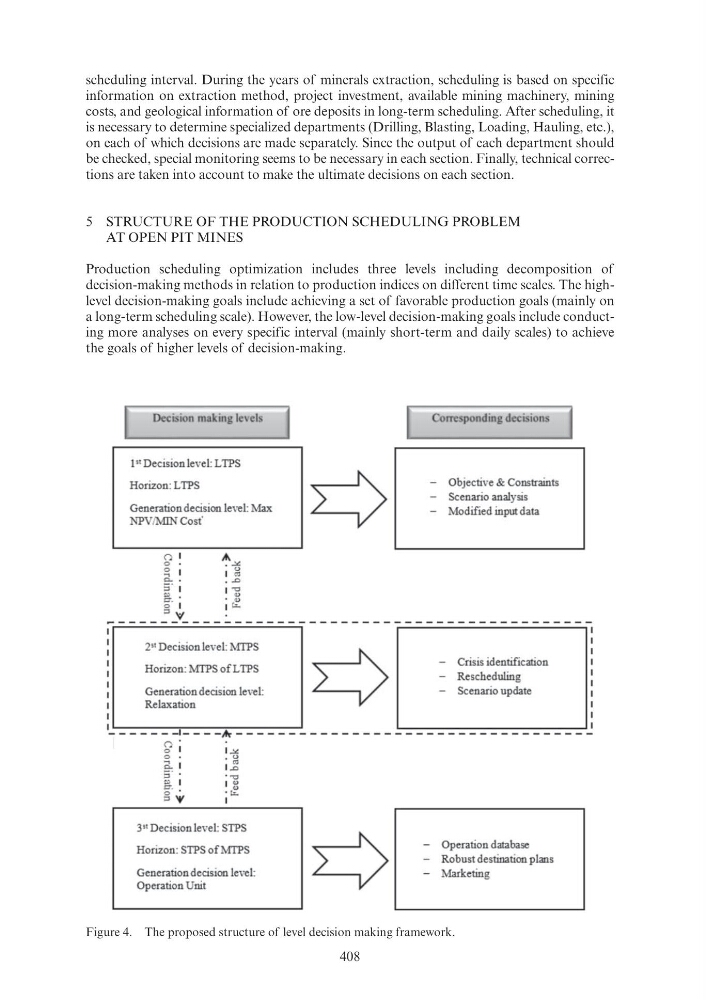
Production scheduling optimization includes three levels including decomposition of
decision-making methods in relation to production indices on different time scales. The highlevel decision-making goals include achieving a set of favorable production goals (mainly on
a long-term scheduling scale). However, the low-level decision-making goals include conducting more analyses on every specific interval (mainly short-term and daily scales) to achieve
the goals of higher levels of decision-making.
Figure 4. The proposed structure of level decision making framework.
Decision making le\el
I" Decision level: L TPS
Horizon: L TPS
Generationdecis.ion level: Max
NPV!tv!IN Cosf
0
0
0
..,
0..
5
., a-.
o I
::S y
-!'~ 0
I "'
• ..0
I "'
"
i ~
Objective & Constraints
Scenario analysis.
Modified input data
---------------------------------------------2" Decision level: MTPS
Q
Crisis identification
Horizon: MTPS ofL TPS
Rescheduling
1
Generation decision level:
Scenario update
:
Relaxation
1
I
I
~-----~----·---------------------------------2
I -"
.g
l ..c
. ..,
I ~
• Lz_
I
3" Decision level: STPS
Horizon: STPS ofMTPS
Generation decision level:
Operation Unit
Operation database
Robust destination plans
Marketing
scheduling interval. During the years of minerals extraction, scheduling is based on specific
information on extraction method, project investment, available mining machinery, mining
costs, and geological information of ore deposits in long-term scheduling. After scheduling, it
is necessary to determine specialized departments (Drilling, Blasting, Loading, Hauling, etc.),
on each of which decisions are made separately. Since the output of each department should
be checked, special monitoring seems to be necessary in each section. Finally, technical corrections are taken into account to make the ultimate decisions on each section.
5 STRUCTURE OF THE PRODUCTION SCHEDULING PROBLEM
AT OPEN PIT MINES
Production scheduling optimization includes three levels including decomposition of
decision-making methods in relation to production indices on different time scales. The highlevel decision-making goals include achieving a set of favorable production goals (mainly on
a long-term scheduling scale). However, the low-level decision-making goals include conducting more analyses on every specific interval (mainly short-term and daily scales) to achieve
the goals of higher levels of decision-making.
Figure 4. The proposed structure of level decision making framework.
Decision making le\el
I" Decision level: L TPS
Horizon: L TPS
Generationdecis.ion level: Max
NPV!tv!IN Cosf
0
0
0
..,
0..
5
., a-.
o I
::S y
-!'~ 0
I "'
• ..0
I "'
"
i ~
Objective & Constraints
Scenario analysis.
Modified input data
---------------------------------------------2" Decision level: MTPS
Q
Crisis identification
Horizon: MTPS ofL TPS
Rescheduling
1
Generation decision level:
Scenario update
:
Relaxation
1
I
I
~-----~----·---------------------------------2
I -"
.g
l ..c
. ..,
I ~
• Lz_
I
3" Decision level: STPS
Horizon: STPS ofMTPS
Generation decision level:
Operation Unit
Operation database
Robust destination plans
Marketing