

404
2 PRODUCTION SCHEDULING METHODS IN MINES
In general, there are three methods for production scheduling in mines:
• The use of trial and error is the first and oldest method in production scheduling. This
method is based on the designer, who first considers various options for production of
the mine so that all operational and production constraints are satisfied and then the best
option with the highest value is selected as the final choice for production scheduling. The
proposed program, although practical, is not necessarily economically feasible.
• The use of heuristic methods in production scheduling. In this method, although a good
solution can be attained by using optimization techniques and designer’s experience, the
solution is not necessarily optimal. The floating cone is a heuristic method.
• The use of mathematical programming techniques in optimal production scheduling. Although
the proposed program is mathematically optimal, it may be practically impossible to implement because of the lack of direct involvement of the designer in the optimization process.
Therefore, the mine designing and scheduling is a multivariate optimization process and
requires a simultaneous solution, which is unfortunately not easily solvable and computable.
After three decades of continuous effort, the designing and production scheduling in open
pit mines remain unresolved, even considering all aspects at the same time. In this regard, the
production designing and scheduling benches of a mine are summarized as follows:
2.1 Preparation of three dimensional block model of ore deposit
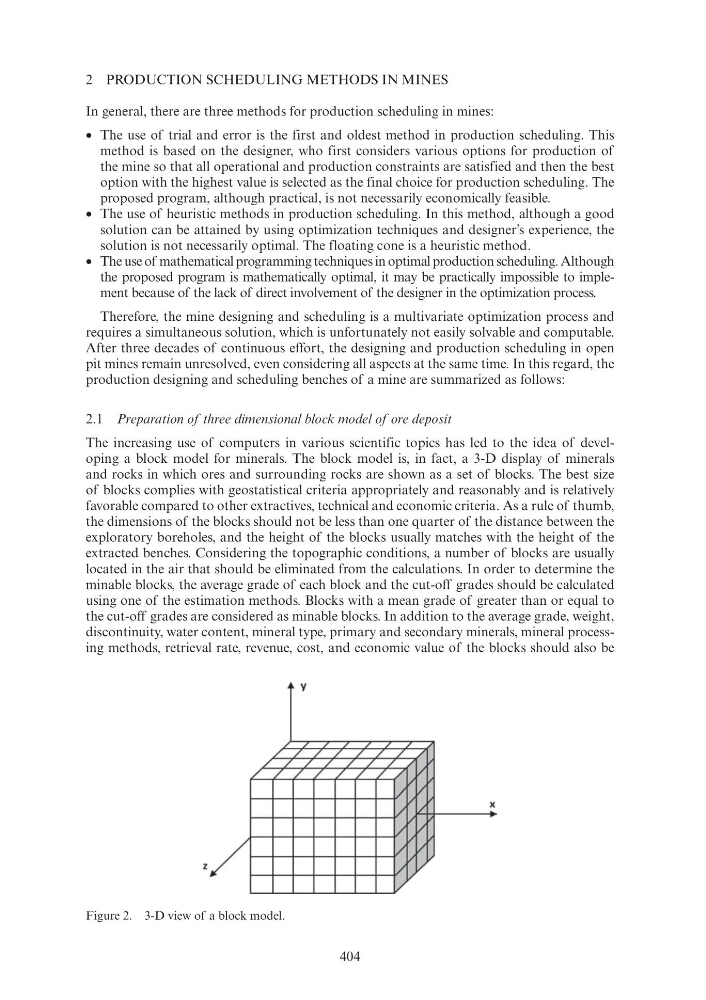
The increasing use of computers in various scientific topics has led to the idea of developing a block model for minerals. The block model is, in fact, a 3-D display of minerals
and rocks in which ores and surrounding rocks are shown as a set of blocks. The best size
of blocks complies with geostatistical criteria appropriately and reasonably and is relatively
favorable compared to other extractives, technical and economic criteria. As a rule of thumb,
the dimensions of the blocks should not be less than one quarter of the distance between the
exploratory boreholes, and the height of the blocks usually matches with the height of the
extracted benches. Considering the topographic conditions, a number of blocks are usually
located in the air that should be eliminated from the calculations. In order to determine the
minable blocks, the average grade of each block and the cut-off grades should be calculated
using one of the estimation methods. Blocks with a mean grade of greater than or equal to
the cut-off grades are considered as minable blocks. In addition to the average grade, weight,
discontinuity, water content, mineral type, primary and secondary minerals, mineral processing methods, retrieval rate, revenue, cost, and economic value of the blocks should also be
Figure 2. 3-D view of a block model.
y
/
/
/
/
/
/
/
/
/
v
/
/
/
/
/
/
/
z
I/ vv
I/
v
X
I/ vv
/
I/ vv
1/ vv
v
2 PRODUCTION SCHEDULING METHODS IN MINES
In general, there are three methods for production scheduling in mines:
• The use of trial and error is the first and oldest method in production scheduling. This
method is based on the designer, who first considers various options for production of
the mine so that all operational and production constraints are satisfied and then the best
option with the highest value is selected as the final choice for production scheduling. The
proposed program, although practical, is not necessarily economically feasible.
• The use of heuristic methods in production scheduling. In this method, although a good
solution can be attained by using optimization techniques and designer’s experience, the
solution is not necessarily optimal. The floating cone is a heuristic method.
• The use of mathematical programming techniques in optimal production scheduling. Although
the proposed program is mathematically optimal, it may be practically impossible to implement because of the lack of direct involvement of the designer in the optimization process.
Therefore, the mine designing and scheduling is a multivariate optimization process and
requires a simultaneous solution, which is unfortunately not easily solvable and computable.
After three decades of continuous effort, the designing and production scheduling in open
pit mines remain unresolved, even considering all aspects at the same time. In this regard, the
production designing and scheduling benches of a mine are summarized as follows:
2.1 Preparation of three dimensional block model of ore deposit
The increasing use of computers in various scientific topics has led to the idea of developing a block model for minerals. The block model is, in fact, a 3-D display of minerals
and rocks in which ores and surrounding rocks are shown as a set of blocks. The best size
of blocks complies with geostatistical criteria appropriately and reasonably and is relatively
favorable compared to other extractives, technical and economic criteria. As a rule of thumb,
the dimensions of the blocks should not be less than one quarter of the distance between the
exploratory boreholes, and the height of the blocks usually matches with the height of the
extracted benches. Considering the topographic conditions, a number of blocks are usually
located in the air that should be eliminated from the calculations. In order to determine the
minable blocks, the average grade of each block and the cut-off grades should be calculated
using one of the estimation methods. Blocks with a mean grade of greater than or equal to
the cut-off grades are considered as minable blocks. In addition to the average grade, weight,
discontinuity, water content, mineral type, primary and secondary minerals, mineral processing methods, retrieval rate, revenue, cost, and economic value of the blocks should also be
Figure 2. 3-D view of a block model.
y
/
/
/
/
/
/
/
/
/
v
/
/
/
/
/
/
/
z
I/ vv
I/
v
X
I/ vv
/
I/ vv
1/ vv
v