

403
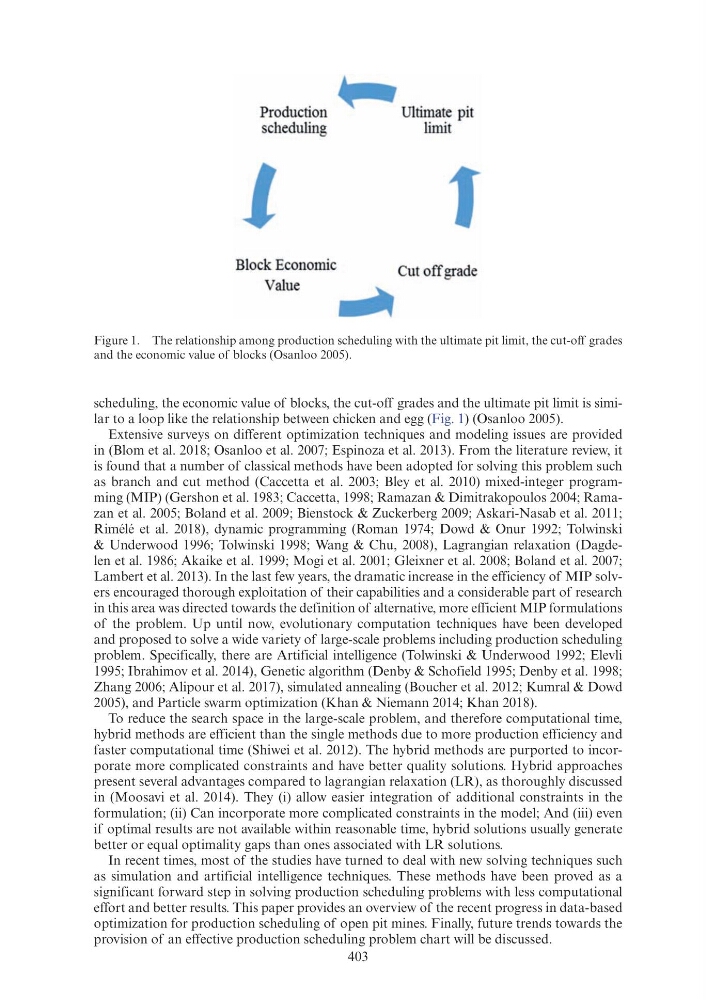
scheduling, the economic value of blocks, the cut-off grades and the ultimate pit limit is similar to a loop like the relationship between chicken and egg (Fig. 1) (Osanloo 2005).
Extensive surveys on different optimization techniques and modeling issues are provided
in (Blom et al. 2018; Osanloo et al. 2007; Espinoza et al. 2013). From the literature review, it
is found that a number of classical methods have been adopted for solving this problem such
as branch and cut method (Caccetta et al. 2003; Bley et al. 2010) mixed-integer programming (MIP) (Gershon et al. 1983; Caccetta, 1998; Ramazan & Dimitrakopoulos 2004; Ramazan et al. 2005; Boland et al. 2009; Bienstock & Zuckerberg 2009; Askari-Nasab et al. 2011;
Rimélé et al. 2018), dynamic programming (Roman 1974; Dowd & Onur 1992; Tolwinski
& Underwood 1996; Tolwinski 1998; Wang & Chu, 2008), Lagrangian relaxation (Dagdelen et al. 1986; Akaike et al. 1999; Mogi et al. 2001; Gleixner et al. 2008; Boland et al. 2007;
Lambert et al. 2013). In the last few years, the dramatic increase in the efficiency of MIP solvers encouraged thorough exploitation of their capabilities and a considerable part of research
in this area was directed towards the definition of alternative, more efficient MIP formulations
of the problem. Up until now, evolutionary computation techniques have been developed
and proposed to solve a wide variety of large-scale problems including production scheduling
problem. Specifically, there are Artificial intelligence (Tolwinski & Underwood 1992; Elevli
1995; Ibrahimov et al. 2014), Genetic algorithm (Denby & Schofield 1995; Denby et al. 1998;
Zhang 2006; Alipour et al. 2017), simulated annealing (Boucher et al. 2012; Kumral & Dowd
2005), and Particle swarm optimization (Khan & Niemann 2014; Khan 2018).
To reduce the search space in the large-scale problem, and therefore computational time,
hybrid methods are efficient than the single methods due to more production efficiency and
faster computational time (Shiwei et al. 2012). The hybrid methods are purported to incorporate more complicated constraints and have better quality solutions. Hybrid approaches
present several advantages compared to lagrangian relaxation (LR), as thoroughly discussed
in (Moosavi et al. 2014). They (i) allow easier integration of additional constraints in the
formulation; (ii) Can incorporate more complicated constraints in the model; And (iii) even
if optimal results are not available within reasonable time, hybrid solutions usually generate
better or equal optimality gaps than ones associated with LR solutions.
In recent times, most of the studies have turned to deal with new solving techniques such
as simulation and artificial intelligence techniques. These methods have been proved as a
significant forward step in solving production scheduling problems with less computational
effort and better results. This paper provides an overview of the recent progress in data-based
optimization for production scheduling of open pit mines. Finally, future trends towards the
provision of an effective production scheduling problem chart will be discussed.
Figure 1. The relationship among production scheduling with the ultimate pit limit, the cut-off grades
and the economic value of blocks (Osanloo 2005).
Production
scheduling
l
Block Economic
Value
. . . illtimate pit
limit
f
Cut offgrade
scheduling, the economic value of blocks, the cut-off grades and the ultimate pit limit is similar to a loop like the relationship between chicken and egg (Fig. 1) (Osanloo 2005).
Extensive surveys on different optimization techniques and modeling issues are provided
in (Blom et al. 2018; Osanloo et al. 2007; Espinoza et al. 2013). From the literature review, it
is found that a number of classical methods have been adopted for solving this problem such
as branch and cut method (Caccetta et al. 2003; Bley et al. 2010) mixed-integer programming (MIP) (Gershon et al. 1983; Caccetta, 1998; Ramazan & Dimitrakopoulos 2004; Ramazan et al. 2005; Boland et al. 2009; Bienstock & Zuckerberg 2009; Askari-Nasab et al. 2011;
Rimélé et al. 2018), dynamic programming (Roman 1974; Dowd & Onur 1992; Tolwinski
& Underwood 1996; Tolwinski 1998; Wang & Chu, 2008), Lagrangian relaxation (Dagdelen et al. 1986; Akaike et al. 1999; Mogi et al. 2001; Gleixner et al. 2008; Boland et al. 2007;
Lambert et al. 2013). In the last few years, the dramatic increase in the efficiency of MIP solvers encouraged thorough exploitation of their capabilities and a considerable part of research
in this area was directed towards the definition of alternative, more efficient MIP formulations
of the problem. Up until now, evolutionary computation techniques have been developed
and proposed to solve a wide variety of large-scale problems including production scheduling
problem. Specifically, there are Artificial intelligence (Tolwinski & Underwood 1992; Elevli
1995; Ibrahimov et al. 2014), Genetic algorithm (Denby & Schofield 1995; Denby et al. 1998;
Zhang 2006; Alipour et al. 2017), simulated annealing (Boucher et al. 2012; Kumral & Dowd
2005), and Particle swarm optimization (Khan & Niemann 2014; Khan 2018).
To reduce the search space in the large-scale problem, and therefore computational time,
hybrid methods are efficient than the single methods due to more production efficiency and
faster computational time (Shiwei et al. 2012). The hybrid methods are purported to incorporate more complicated constraints and have better quality solutions. Hybrid approaches
present several advantages compared to lagrangian relaxation (LR), as thoroughly discussed
in (Moosavi et al. 2014). They (i) allow easier integration of additional constraints in the
formulation; (ii) Can incorporate more complicated constraints in the model; And (iii) even
if optimal results are not available within reasonable time, hybrid solutions usually generate
better or equal optimality gaps than ones associated with LR solutions.
In recent times, most of the studies have turned to deal with new solving techniques such
as simulation and artificial intelligence techniques. These methods have been proved as a
significant forward step in solving production scheduling problems with less computational
effort and better results. This paper provides an overview of the recent progress in data-based
optimization for production scheduling of open pit mines. Finally, future trends towards the
provision of an effective production scheduling problem chart will be discussed.
Figure 1. The relationship among production scheduling with the ultimate pit limit, the cut-off grades
and the economic value of blocks (Osanloo 2005).
Production
scheduling
l
Block Economic
Value
. . . illtimate pit
limit
f
Cut offgrade