

361
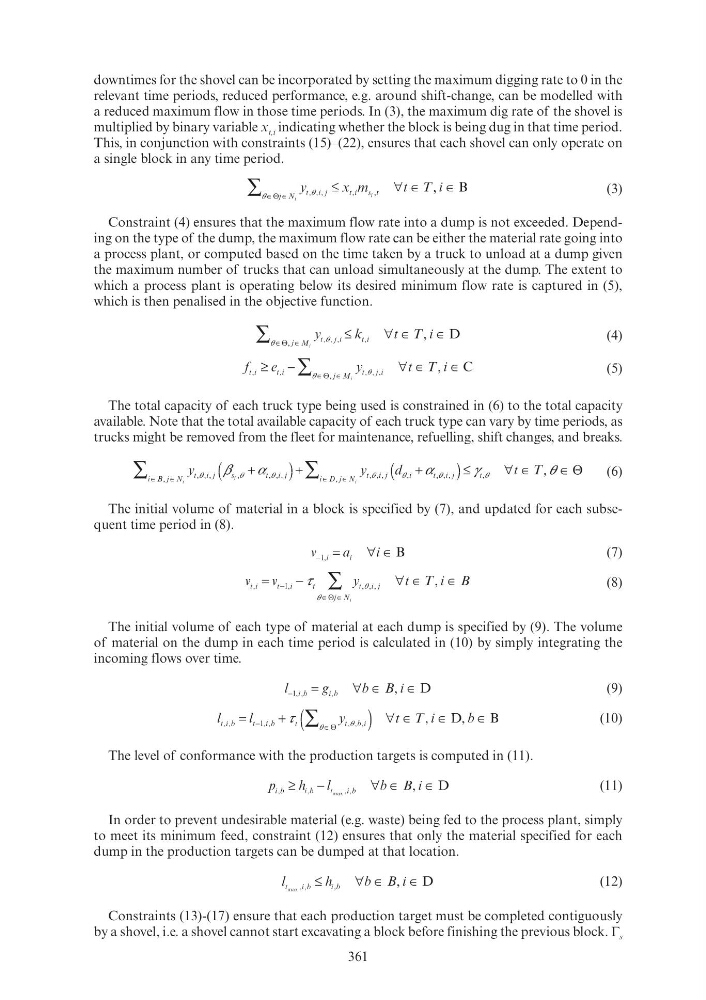
downtimes for the shovel can be incorporated by setting the maximum digging rate to 0 in the
relevant time periods, reduced performance, e.g. around shift-change, can be modelled with
a reduced maximum flow in those time periods. In (3), the maximum dig rate of the shovel is
multiplied by binary variable x t,i indicating whether the block is being dug in that time period.
This, in conjunction with constraints (15)–(22), ensures that each shovel can only operate on
a single block in any time period.
y
t T i
t i j
t
x i s
m t
j N
i
i
N N
, , ,
,
j
t
,
,
θ
≤
∀
x m
t
x i m
∈
∈
T i
j
∈
∑ Θj Θj j j j
B
(3)
Constraint (4) ensures that the maximum flow rate into a dump is not exceeded. Depending on the type of the dump, the maximum flow rate can be either the material rate going into
a process plant, or computed based on the time taken by a truck to unload at a dump given
the maximum number of trucks that can unload simultaneously at the dump. The extent to
which a process plant is operating below its desired minimum flow rate is captured in (5),
which is then penalised in the objective function.
y
k
t T i
t j
t
k k i
j M i
M
,
,
i
t
,
,
θ
∀
k t
k i
∈
T i
,
j
,
∈
∑ Θ
D
(4)
f
e
y
t T i
t
f f
t i
t j i
j M i
M
,
,
i
t
,
,
,
−
e t i
∀ ∈
t
∈
∈ j
,
∑ θ Θ
C
(5)
The total capacity of each truck type being used is constrained in (6) to the total capacity
available. Note that the total available capacity of each truck type can vary by time periods, as
trucks might be removed from the fleet for maintenance, refuelling, shift changes, and breaks.
j
i B j N
i j
i D j N
i
N N
i
N N
, , ,
,
, , ,
,
y t
i D j N
,
B j
,
D j
,
D j
∑
∑
y t j
i B j N
, , ,
i j
, ,
B j
(
)
j
i ,
,, j
i ,
,
t ,
s i ,
θ j
,i
β
α
s
y i j
θ
y t
∑
,θ ,
θ
,
θ
,
(
)
d i
t
,
θ
α t
+
d i
θ
, ,
, ,θ , j
, ,
≤
∀
γ θ
∈
θ
,
Θ
(6)
The initial volume of material in a block is specified by (7), and updated for each subsequent time period in (8).
v
i
i
i
a
−
=
∀
a i
a
∈
1,
B
(7)
v
v
y
t T i B
t i
t i
t
j N
t i j
i
N N
,
,
i
t
, , ,
,
−
v
∀ ∈
t
∈
j
∈
∑
1
τ
θ Θj Θj j j j
(8)
The initial volume of each type of material at each dump is specified by (9). The volume
of material on the dump in each time period is calculated in (10) by simply integrating the
incoming flows over time.
l
g
b B
i
i b
∀
g i b
B
1, ,
,
g
b
i
,
D
i ∈
i
(9)
l
l
t T i
b
t i
l l b t
l l i b t
, ,
i
, ,
i
,
,
i
+
l t
l i b
(
)
y t
y b i
, , ,
∀ ∈
t
∈
−1
τ
D
B
b ∈
b
,
(10)
The level of conformance with the production targets is computed in (11).
p
h
l
b B i
i
i b
h h
t
i
l l
b
,
,
b
i
, ,
i
ma
t t x
,
−
h i b
h
∈
b
∈ D
(11)
In order to prevent undesirable material (e.g. waste) being fed to the process plant, simply
to meet its minimum feed, constraint (12) ensures that only the material specified for each
dump in the production targets can be dumped at that location.
l
h
b B i
t
i
l l
b
i
h h b
ma
t t x , ,
i
,
,
∀
h i
h b
∈
B i
,
D
(12)
Constraints (13)-(17) ensure that each production target must be completed contiguously
by a shovel, i.e. a shovel cannot start excavating a block before finishing the previous block. Γ s
downtimes for the shovel can be incorporated by setting the maximum digging rate to 0 in the
relevant time periods, reduced performance, e.g. around shift-change, can be modelled with
a reduced maximum flow in those time periods. In (3), the maximum dig rate of the shovel is
multiplied by binary variable x t,i indicating whether the block is being dug in that time period.
This, in conjunction with constraints (15)–(22), ensures that each shovel can only operate on
a single block in any time period.
y
t T i
t i j
t
x i s
m t
j N
i
i
N N
, , ,
,
j
t
,
,
θ
≤
∀
x m
t
x i m
∈
∈
T i
j
∈
∑ Θj Θj j j j
B
(3)
Constraint (4) ensures that the maximum flow rate into a dump is not exceeded. Depending on the type of the dump, the maximum flow rate can be either the material rate going into
a process plant, or computed based on the time taken by a truck to unload at a dump given
the maximum number of trucks that can unload simultaneously at the dump. The extent to
which a process plant is operating below its desired minimum flow rate is captured in (5),
which is then penalised in the objective function.
y
k
t T i
t j
t
k k i
j M i
M
,
,
i
t
,
,
θ
∀
k t
k i
∈
T i
,
j
,
∈
∑ Θ
D
(4)
f
e
y
t T i
t
f f
t i
t j i
j M i
M
,
,
i
t
,
,
,
−
e t i
∀ ∈
t
∈
∈ j
,
∑ θ Θ
C
(5)
The total capacity of each truck type being used is constrained in (6) to the total capacity
available. Note that the total available capacity of each truck type can vary by time periods, as
trucks might be removed from the fleet for maintenance, refuelling, shift changes, and breaks.
j
i B j N
i j
i D j N
i
N N
i
N N
, , ,
,
, , ,
,
y t
i D j N
,
B j
,
D j
,
D j
∑
∑
y t j
i B j N
, , ,
i j
, ,
B j
(
)
j
i ,
,, j
i ,
,
t ,
s i ,
θ j
,i
β
α
s
y i j
θ
y t
∑
,θ ,
θ
,
θ
,
(
)
d i
t
,
θ
α t
+
d i
θ
, ,
, ,θ , j
, ,
≤
∀
γ θ
∈
θ
,
Θ
(6)
The initial volume of material in a block is specified by (7), and updated for each subsequent time period in (8).
v
i
i
i
a
−
=
∀
a i
a
∈
1,
B
(7)
v
v
y
t T i B
t i
t i
t
j N
t i j
i
N N
,
,
i
t
, , ,
,
−
v
∀ ∈
t
∈
j
∈
∑
1
τ
θ Θj Θj j j j
(8)
The initial volume of each type of material at each dump is specified by (9). The volume
of material on the dump in each time period is calculated in (10) by simply integrating the
incoming flows over time.
l
g
b B
i
i b
∀
g i b
B
1, ,
,
g
b
i
,
D
i ∈
i
(9)
l
l
t T i
b
t i
l l b t
l l i b t
, ,
i
, ,
i
,
,
i
+
l t
l i b
(
)
y t
y b i
, , ,
∀ ∈
t
∈
−1
τ
D
B
b ∈
b
,
(10)
The level of conformance with the production targets is computed in (11).
p
h
l
b B i
i
i b
h h
t
i
l l
b
,
,
b
i
, ,
i
ma
t t x
,
−
h i b
h
∈
b
∈ D
(11)
In order to prevent undesirable material (e.g. waste) being fed to the process plant, simply
to meet its minimum feed, constraint (12) ensures that only the material specified for each
dump in the production targets can be dumped at that location.
l
h
b B i
t
i
l l
b
i
h h b
ma
t t x , ,
i
,
,
∀
h i
h b
∈
B i
,
D
(12)
Constraints (13)-(17) ensure that each production target must be completed contiguously
by a shovel, i.e. a shovel cannot start excavating a block before finishing the previous block. Γ s