

360
Similar to N i , above M j represents the set of possible sources for material sent to a location
j L; if j B, then M D
j
M
, meaning that if the destination is a block, then only empty
trucks (from dumps) can travel there. Likewise, if j D, then M B
j
M
, i.e. if the destination
is any dump, the source must be a block.
Decision variable y t i j
, , ,
θ
is a continuous variable indicating the flow rate in time period t
for truck type θ from location i L to location j N i
N N . Variable v t b
, is a continuous variable
indicating the volume remaining in block b in time period t. The continuous variable l t i
l l b
, ,
i
denotes the volume of material type b at dump i D in time period t. f t i
f f , is a continuous
variable representing the flow rate below the minimum desired flow rate into process plant
i C in time period t. The continuous variable p i b
, denotes the gap between the target volume of material b that must be moved to dump i D and the achieved volume. x t b
, ∈{ }
, , is
a binary variable indicating whether block b is being dug in time period t. Finally, x
s
t b
, ∈{ }
, ,
and x
f
t b
, ∈{ }
, , are binary variables representing the start and finish time respectively of
block b; they are 0 in all time periods before the start/finish event, and 1 thereafter.
The parameters used in the MIP are as follows:
τ t
length of time period t
c θ
operating cost per unit time of truck type θ
φ θ
capacity of truck type θ
γ t,θ total capacity of truck type θ available in time period t
α t,θ,i,j travel time of truck type θ from location i ∈ L to location j ∈ L in time period t
d θ,i time taken for truck type θ to dump at location i ∈ D
β si,θ time taken for shovel s ∈ S located at location i ∈ B to load truck type θ
π i
low feed cost of process plant i ∈ C
ψ b,i cost per unit volume under plan of material b ∈ B at dump i ∈ D
s i
shovel allocated to block i ∈ B
m si,t maximum digging rate of shovel s ∈ S allocated to block i ∈ B in time period t
k t,i maximum flow rate into dump i ∈ D in time period t
e t,i
minimum desired flow rate into process plant i ∈ C in time period t
a b
initial volume of material in block b
g i,b initial volume of material from block b at dump i ∈ D
h i,b targeted volume of material from block b to dump i ∈ D
w b
the block that must be completed before block b
δ b
number of time periods taken for a shovel to move to block b.
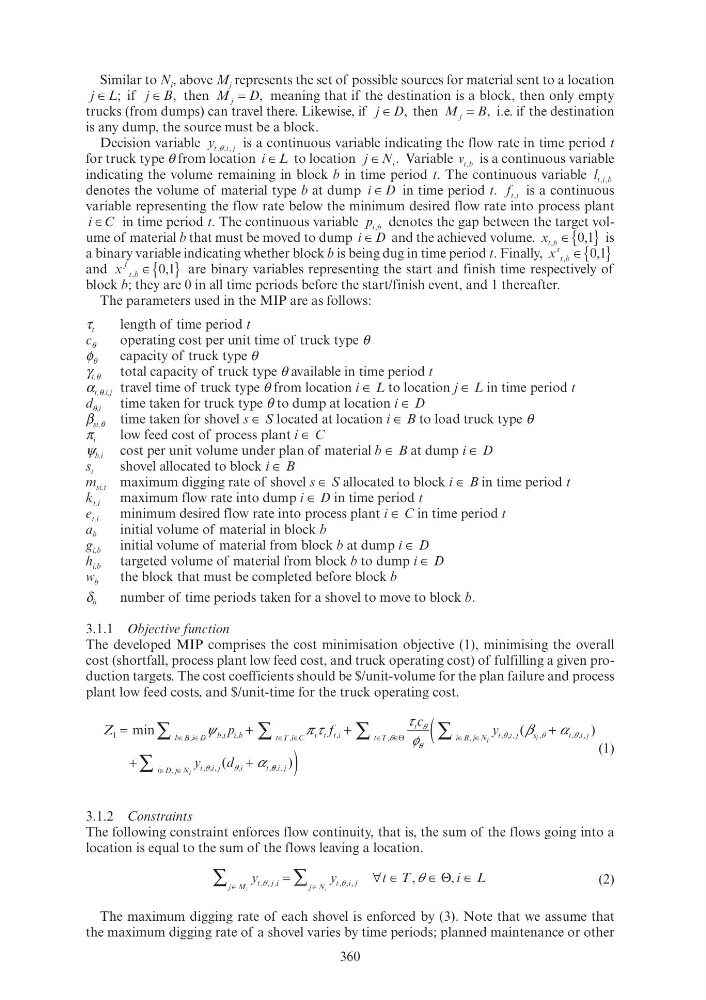
3.1.1 Objective function
The developed MIP comprises the cost minimisation objective (1), minimising the overall
cost (shortfall, process plant low feed cost, and truck operating cost) of fulfilling a given production targets. The cost coefficients should be $/unit-volume for the plan failure and process
plant low feed costs, and $/unit-time for the truck operating cost.
Z
f
c
y
b B
i t
t
i C
t i
f f
t
t T
t
1
Z Z
+
B
T i
∈
T
∑
∑
p
b
b
b
D
+
p
B i
∑
i
i i
,
,
i D
t T
i
T
∑
D
i
,
,
,
π
t T i C
T i
∑
p
b
i b +
p i b
p
i i
τ t
τ t
φ
θ
θ
θ∈ ∈
θ
Θ
, , ,
,
,
,,
, , ,
,
,
,
(
)
,
i j
,
i B j N
,
s
i j
, ,
t,
j
i D j N
i
t
i
N N
i
i
N N
y t,
d
(
,
B j
,
D j
∑
∑
(
+
i
+
y
d
(
t
∑
β
α
,
s ,
α t
θ
, ,
θ
, ,
i
, j d
, (
i
, j d
(
i j
θ θ , )
i j
, )
(1)
3.1.2 Constraints
The following constraint enforces flow continuity, that is, the sum of the flows going into a
location is equal to the sum of the flows leaving a location.
t T
i L
j M
i j
N
i
i
j N N
,
N
, ,
i
,
,
θ
y t,
y t
j N
θ
j
M
j
i
M
j
,
j j
∑
∑
y t
j M
j,i
t j
M
,
j,i
∀
y i j
θ
y t
∑
∈
T,θ Θ
(2)
The maximum digging rate of each shovel is enforced by (3). Note that we assume that
the maximum digging rate of a shovel varies by time periods; planned maintenance or other
Similar to N i , above M j represents the set of possible sources for material sent to a location
j L; if j B, then M D
j
M
, meaning that if the destination is a block, then only empty
trucks (from dumps) can travel there. Likewise, if j D, then M B
j
M
, i.e. if the destination
is any dump, the source must be a block.
Decision variable y t i j
, , ,
θ
is a continuous variable indicating the flow rate in time period t
for truck type θ from location i L to location j N i
N N . Variable v t b
, is a continuous variable
indicating the volume remaining in block b in time period t. The continuous variable l t i
l l b
, ,
i
denotes the volume of material type b at dump i D in time period t. f t i
f f , is a continuous
variable representing the flow rate below the minimum desired flow rate into process plant
i C in time period t. The continuous variable p i b
, denotes the gap between the target volume of material b that must be moved to dump i D and the achieved volume. x t b
, ∈{ }
, , is
a binary variable indicating whether block b is being dug in time period t. Finally, x
s
t b
, ∈{ }
, ,
and x
f
t b
, ∈{ }
, , are binary variables representing the start and finish time respectively of
block b; they are 0 in all time periods before the start/finish event, and 1 thereafter.
The parameters used in the MIP are as follows:
τ t
length of time period t
c θ
operating cost per unit time of truck type θ
φ θ
capacity of truck type θ
γ t,θ total capacity of truck type θ available in time period t
α t,θ,i,j travel time of truck type θ from location i ∈ L to location j ∈ L in time period t
d θ,i time taken for truck type θ to dump at location i ∈ D
β si,θ time taken for shovel s ∈ S located at location i ∈ B to load truck type θ
π i
low feed cost of process plant i ∈ C
ψ b,i cost per unit volume under plan of material b ∈ B at dump i ∈ D
s i
shovel allocated to block i ∈ B
m si,t maximum digging rate of shovel s ∈ S allocated to block i ∈ B in time period t
k t,i maximum flow rate into dump i ∈ D in time period t
e t,i
minimum desired flow rate into process plant i ∈ C in time period t
a b
initial volume of material in block b
g i,b initial volume of material from block b at dump i ∈ D
h i,b targeted volume of material from block b to dump i ∈ D
w b
the block that must be completed before block b
δ b
number of time periods taken for a shovel to move to block b.
3.1.1 Objective function
The developed MIP comprises the cost minimisation objective (1), minimising the overall
cost (shortfall, process plant low feed cost, and truck operating cost) of fulfilling a given production targets. The cost coefficients should be $/unit-volume for the plan failure and process
plant low feed costs, and $/unit-time for the truck operating cost.
Z
f
c
y
b B
i t
t
i C
t i
f f
t
t T
t
1
Z Z
+
B
T i
∈
T
∑
∑
p
b
b
b
D
+
p
B i
∑
i
i i
,
,
i D
t T
i
T
∑
D
i
,
,
,
π
t T i C
T i
∑
p
b
i b +
p i b
p
i i
τ t
τ t
φ
θ
θ
θ∈ ∈
θ
Θ
, , ,
,
,
,,
, , ,
,
,
,
(
)
,
i j
,
i B j N
,
s
i j
, ,
t,
j
i D j N
i
t
i
N N
i
i
N N
y t,
d
(
,
B j
,
D j
∑
∑
(
+
i
+
y
d
(
t
∑
β
α
,
s ,
α t
θ
, ,
θ
, ,
i
, j d
, (
i
, j d
(
i j
θ θ , )
i j
, )
(1)
3.1.2 Constraints
The following constraint enforces flow continuity, that is, the sum of the flows going into a
location is equal to the sum of the flows leaving a location.
t T
i L
j M
i j
N
i
i
j N N
,
N
, ,
i
,
,
θ
y t,
y t
j N
θ
j
M
j
i
M
j
,
j j
∑
∑
y t
j M
j,i
t j
M
,
j,i
∀
y i j
θ
y t
∑
∈
T,θ Θ
(2)
The maximum digging rate of each shovel is enforced by (3). Note that we assume that
the maximum digging rate of a shovel varies by time periods; planned maintenance or other