

338
2.2 Strategic mine planning
Strategic mine planning is the process where the mine planning process is integrated with
the strategic objectives of the project, which is to optimize the utilization of the principal
resources (capital, labor, technology and mineral reserves) and maximize the strengths and
opportunities of a mining company, while minimizing its weaknesses and threats
[4]
.
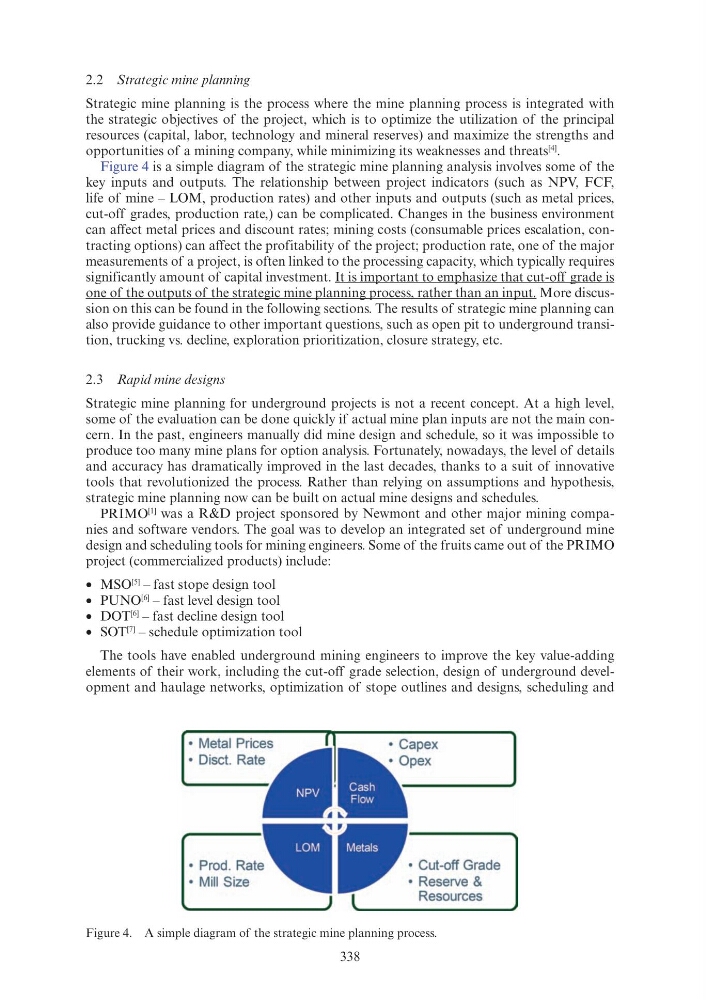
Figure 4 is a simple diagram of the strategic mine planning analysis involves some of the
key inputs and outputs. The relationship between project indicators (such as NPV, FCF,
life of mine – LOM, production rates) and other inputs and outputs (such as metal prices,
cut-off grades, production rate,) can be complicated. Changes in the business environment
can affect metal prices and discount rates; mining costs (consumable prices escalation, contracting options) can affect the profitability of the project; production rate, one of the major
measurements of a project, is often linked to the processing capacity, which typically requires
significantly amount of capital investment. It is important to emphasize that cut-off grade is
one of the outputs of the strategic mine planning process, rather than an input. More discussion on this can be found in the following sections. The results of strategic mine planning can
also provide guidance to other important questions, such as open pit to underground transition, trucking vs. decline, exploration prioritization, closure strategy, etc.
2.3 Rapid mine designs
Strategic mine planning for underground projects is not a recent concept. At a high level,
some of the evaluation can be done quickly if actual mine plan inputs are not the main concern. In the past, engineers manually did mine design and schedule, so it was impossible to
produce too many mine plans for option analysis. Fortunately, nowadays, the level of details
and accuracy has dramatically improved in the last decades, thanks to a suit of innovative
tools that revolutionized the process. Rather than relying on assumptions and hypothesis,
strategic mine planning now can be built on actual mine designs and schedules.
PRIMO
[1] was a R&D project sponsored by Newmont and other major mining companies and software vendors. The goal was to develop an integrated set of underground mine
design and scheduling tools for mining engineers. Some of the fruits came out of the PRIMO
project (commercialized products) include:
• MSO
[5] – fast stope design tool
• PUNO
[6] – fast level design tool
• DOT
[6] – fast decline design tool
• SOT
[7] – schedule optimization tool
The tools have enabled underground mining engineers to improve the key value-adding
elements of their work, including the cut-off grade selection, design of underground development and haulage networks, optimization of stope outlines and designs, scheduling and
Figure 4. A simple diagram of the strategic mine planning process.
• Metal Prices
• Disct. Rate
• Mill Size
• Cut-off Grade
• Reserve &
Resources
2.2 Strategic mine planning
Strategic mine planning is the process where the mine planning process is integrated with
the strategic objectives of the project, which is to optimize the utilization of the principal
resources (capital, labor, technology and mineral reserves) and maximize the strengths and
opportunities of a mining company, while minimizing its weaknesses and threats
[4]
.
Figure 4 is a simple diagram of the strategic mine planning analysis involves some of the
key inputs and outputs. The relationship between project indicators (such as NPV, FCF,
life of mine – LOM, production rates) and other inputs and outputs (such as metal prices,
cut-off grades, production rate,) can be complicated. Changes in the business environment
can affect metal prices and discount rates; mining costs (consumable prices escalation, contracting options) can affect the profitability of the project; production rate, one of the major
measurements of a project, is often linked to the processing capacity, which typically requires
significantly amount of capital investment. It is important to emphasize that cut-off grade is
one of the outputs of the strategic mine planning process, rather than an input. More discussion on this can be found in the following sections. The results of strategic mine planning can
also provide guidance to other important questions, such as open pit to underground transition, trucking vs. decline, exploration prioritization, closure strategy, etc.
2.3 Rapid mine designs
Strategic mine planning for underground projects is not a recent concept. At a high level,
some of the evaluation can be done quickly if actual mine plan inputs are not the main concern. In the past, engineers manually did mine design and schedule, so it was impossible to
produce too many mine plans for option analysis. Fortunately, nowadays, the level of details
and accuracy has dramatically improved in the last decades, thanks to a suit of innovative
tools that revolutionized the process. Rather than relying on assumptions and hypothesis,
strategic mine planning now can be built on actual mine designs and schedules.
PRIMO
[1] was a R&D project sponsored by Newmont and other major mining companies and software vendors. The goal was to develop an integrated set of underground mine
design and scheduling tools for mining engineers. Some of the fruits came out of the PRIMO
project (commercialized products) include:
• MSO
[5] – fast stope design tool
• PUNO
[6] – fast level design tool
• DOT
[6] – fast decline design tool
• SOT
[7] – schedule optimization tool
The tools have enabled underground mining engineers to improve the key value-adding
elements of their work, including the cut-off grade selection, design of underground development and haulage networks, optimization of stope outlines and designs, scheduling and
Figure 4. A simple diagram of the strategic mine planning process.
• Metal Prices
• Disct. Rate
• Mill Size
• Cut-off Grade
• Reserve &
Resources