

324
compared to the previous solution. If there is an improvement or with a certain probability, the new solution is accepted as the current solution. The iteration continues from the
current solution.
3 METHODOLOGY
The proposed approach is composed of two main stages: (1) First, a stope layout plan is generated. (2) Then, the stope sequence is generated for different risk levels of grade uncertainty.
More details to each stage are provided in this section. In the end, the decision is left to the
mine managers given all the information.
3.1 Stope layout plan generation
There are multiple approaches in the literature for generating the stope layout (Villalba Matamoros and Kumral 2017, 2018; Musingwini 2016; Sari and Kumral 2018b). At this time, the
timing of extraction is not known thus the approaches find the portions of the deposit that
are economically feasible by maximizing the profit instead of NPV. Also, the mining and
mineral processing capacities are not considered for the same reason. Although their methods vary, the output of all approaches is composed of selected stopes in a deposit within
the pre-determined height, width and length range. The resulting stopes have a rectangular
shape and they are non-overlapping. One of the stope layout generation approaches is used
to obtain the location to be sequenced in the next step.
3.2 Stope sequencing considering grade uncertainty
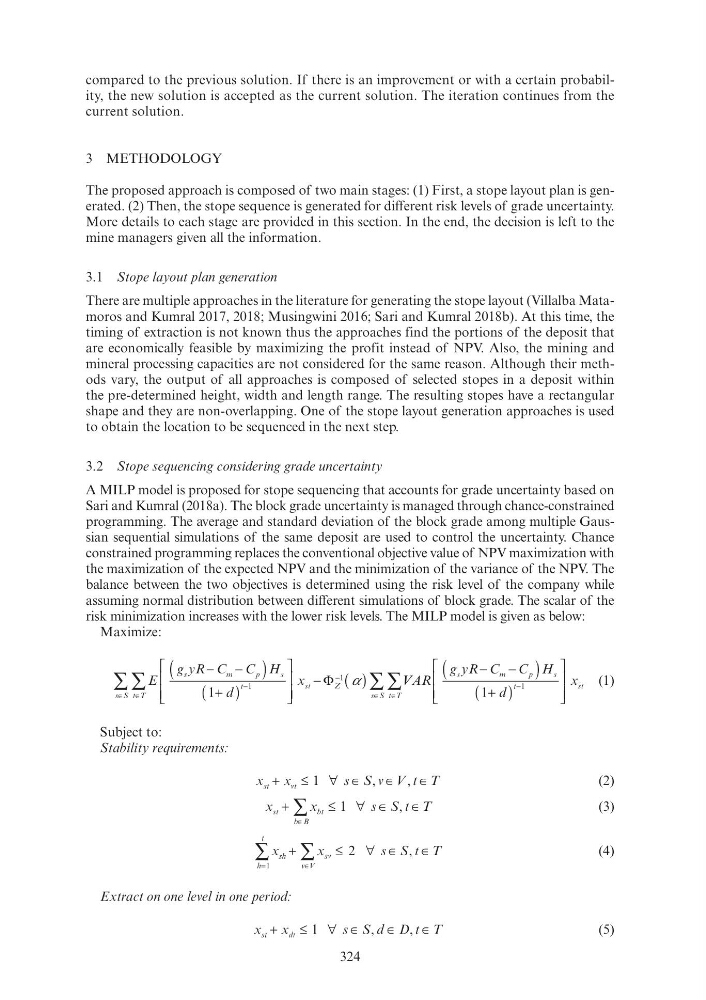
A MILP model is proposed for stope sequencing that accounts for grade uncertainty based on
Sari and Kumral (2018a). The block grade uncertainty is managed through chance-constrained
programming. The average and standard deviation of the block grade among multiple Gaussian sequential simulations of the same deposit are used to control the uncertainty. Chance
constrained programming replaces the conventional objective value of NPV maximization with
the maximization of the expected NPV and the minimization of the variance of the NPV. The
balance between the two objectives is determined using the risk level of the company while
assuming normal distribution between different simulations of block grade. The scalar of the
risk minimization increases with the lower risk levels. The MILP model is given as below:
Maximize:
s S t T
s
m
p
s
t
st
Z
s S t T
E
g y
s R C m C H
p
s
x
S t
−
−
S t
∑ ∑
∑ ∑
−
C
(
)
(
)
d
+
⎡
⎣
⎢
⎡ ⎡
⎢ ⎣ ⎣
⎢ ⎢
⎤
⎦
⎥
⎤ ⎤
⎥ ⎦ ⎦
⎥ ⎥
−
( )
1
1
Φ
VAR V V
g yR C C H
x
s
m
yR C
s
H
p
C
t
st
−
C
(
)
(
)
d
+
⎡
⎣
⎢
⎡ ⎡
⎢ ⎣ ⎣
⎢ ⎢
⎤
⎦
⎥
⎤ ⎤
⎥ ⎦ ⎦
⎥ ⎥
−1
(1)
Subject to:
Stability requirements:
x x
v V t T
st
vt
+
≤
x vt
∀
V t
1
,
s S
∀ ∈
s
,
(2)
x
x
t T
st
b B
bt
+
≤
x bt
∀
∑
1
,
s S
∀ ∈
s
(3)
h
t
v V
sv
x
t T
v
=
∑
∑
sh
x sh
≤
sv
x
∑
∀
1
2
,
s S
∀ ∈
s
(4)
Extract on one level in one period:
x x
d D t T
st
dt
+
≤
x dt
∀
D t
1
,
s S
∀ ∈
s
,
(5)
compared to the previous solution. If there is an improvement or with a certain probability, the new solution is accepted as the current solution. The iteration continues from the
current solution.
3 METHODOLOGY
The proposed approach is composed of two main stages: (1) First, a stope layout plan is generated. (2) Then, the stope sequence is generated for different risk levels of grade uncertainty.
More details to each stage are provided in this section. In the end, the decision is left to the
mine managers given all the information.
3.1 Stope layout plan generation
There are multiple approaches in the literature for generating the stope layout (Villalba Matamoros and Kumral 2017, 2018; Musingwini 2016; Sari and Kumral 2018b). At this time, the
timing of extraction is not known thus the approaches find the portions of the deposit that
are economically feasible by maximizing the profit instead of NPV. Also, the mining and
mineral processing capacities are not considered for the same reason. Although their methods vary, the output of all approaches is composed of selected stopes in a deposit within
the pre-determined height, width and length range. The resulting stopes have a rectangular
shape and they are non-overlapping. One of the stope layout generation approaches is used
to obtain the location to be sequenced in the next step.
3.2 Stope sequencing considering grade uncertainty
A MILP model is proposed for stope sequencing that accounts for grade uncertainty based on
Sari and Kumral (2018a). The block grade uncertainty is managed through chance-constrained
programming. The average and standard deviation of the block grade among multiple Gaussian sequential simulations of the same deposit are used to control the uncertainty. Chance
constrained programming replaces the conventional objective value of NPV maximization with
the maximization of the expected NPV and the minimization of the variance of the NPV. The
balance between the two objectives is determined using the risk level of the company while
assuming normal distribution between different simulations of block grade. The scalar of the
risk minimization increases with the lower risk levels. The MILP model is given as below:
Maximize:
s S t T
s
m
p
s
t
st
Z
s S t T
E
g y
s R C m C H
p
s
x
S t
−
−
S t
∑ ∑
∑ ∑
−
C
(
)
(
)
d
+
⎡
⎣
⎢
⎡ ⎡
⎢ ⎣ ⎣
⎢ ⎢
⎤
⎦
⎥
⎤ ⎤
⎥ ⎦ ⎦
⎥ ⎥
−
( )
1
1
Φ
VAR V V
g yR C C H
x
s
m
yR C
s
H
p
C
t
st
−
C
(
)
(
)
d
+
⎡
⎣
⎢
⎡ ⎡
⎢ ⎣ ⎣
⎢ ⎢
⎤
⎦
⎥
⎤ ⎤
⎥ ⎦ ⎦
⎥ ⎥
−1
(1)
Subject to:
Stability requirements:
x x
v V t T
st
vt
+
≤
x vt
∀
V t
1
,
s S
∀ ∈
s
,
(2)
x
x
t T
st
b B
bt
+
≤
x bt
∀
∑
1
,
s S
∀ ∈
s
(3)
h
t
v V
sv
x
t T
v
=
∑
∑
sh
x sh
≤
sv
x
∑
∀
1
2
,
s S
∀ ∈
s
(4)
Extract on one level in one period:
x x
d D t T
st
dt
+
≤
x dt
∀
D t
1
,
s S
∀ ∈
s
,
(5)