

311
in order to answer these five key questions in the conceptualization of the genesis of the
underlying physical process which in-situ manifestation is the collapse.
On the other hand, since collapses occur as large-scale deformations, it was necessary to
introduce a spatial reference to mathematically establish the existence of a collapsed sector
as a function of such variables, thus, using the centroids of the pillars in the production level
as the element of evaluation.
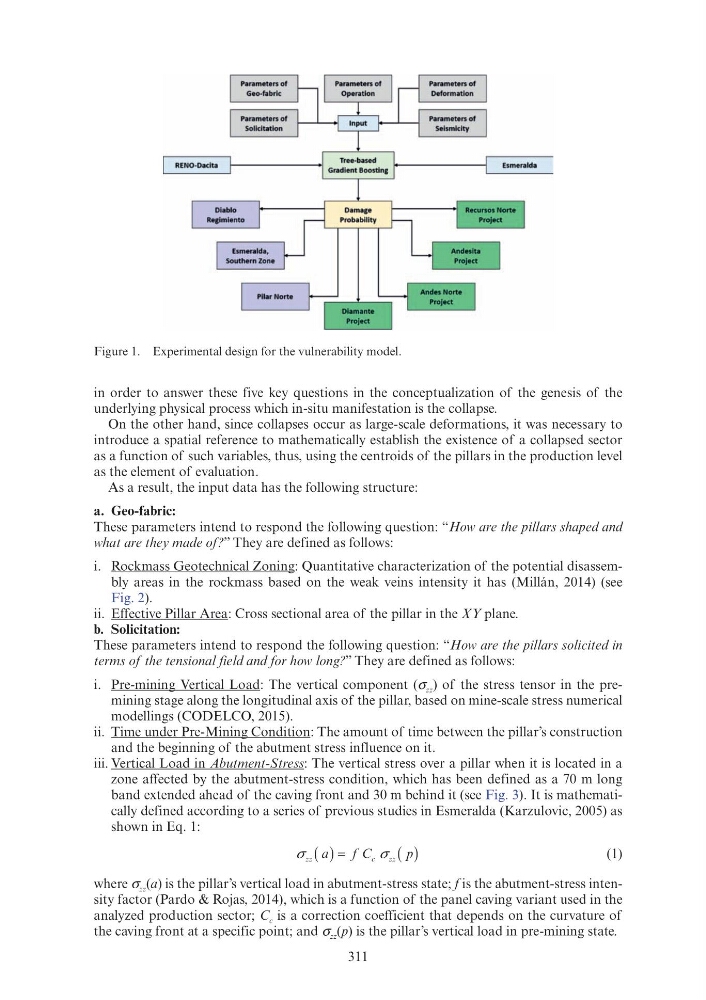
As a result, the input data has the following structure:
a. Geo-fabric:
These parameters intend to respond the following question: “How are the pillars shaped and
what are they made of?” They are defined as follows:
i. Rockmass Geotechnical Zoning: Quantitative characterization of the potential disassembly areas in the rockmass based on the weak veins intensity it has (Millán, 2014) (see
Fig. 2).
ii. Effective Pillar Area: Cross sectional area of the pillar in the XY plane.
b. Solicitation:
These parameters intend to respond the following question: “How are the pillars solicited in
terms of the tensional field and for how long?” They are defined as follows:
i. Pre-mining Vertical Load: The vertical component (σ zz ) of the stress tensor in the premining stage along the longitudinal axis of the pillar, based on mine-scale stress numerical
modellings (CODELCO, 2015).
ii. Time under Pre-Mining Condition: The amount of time between the pillar’s construction
and the beginning of the abutment stress influence on it.
iii. Vertical Load in Abutment-Stress: The vertical stress over a pillar when it is located in a
zone affected by the abutment-stress condition, which has been defined as a 70 m long
band extended ahead of the caving front and 30 m behind it (see Fig. 3). It is mathematically defined according to a series of previous studies in Esmeralda (Karzulovic, 2005) as
shown in Eq. 1:
σ zz
σ σ
c
z z
f C σ
c
z
σ z
( )
a
( )
p
(1)
where σ zz (a) is the pillar’s vertical load in abutment-stress state; f is the abutment-stress intensity factor (Pardo & Rojas, 2014), which is a function of the panel caving variant used in the
analyzed production sector; C c is a correction coefficient that depends on the curvature of
the caving front at a specific point; and σ zz (p) is the pillar’s vertical load in pre-mining state.
Figure 1. Experimental design for the vulnerability model.
in order to answer these five key questions in the conceptualization of the genesis of the
underlying physical process which in-situ manifestation is the collapse.
On the other hand, since collapses occur as large-scale deformations, it was necessary to
introduce a spatial reference to mathematically establish the existence of a collapsed sector
as a function of such variables, thus, using the centroids of the pillars in the production level
as the element of evaluation.
As a result, the input data has the following structure:
a. Geo-fabric:
These parameters intend to respond the following question: “How are the pillars shaped and
what are they made of?” They are defined as follows:
i. Rockmass Geotechnical Zoning: Quantitative characterization of the potential disassembly areas in the rockmass based on the weak veins intensity it has (Millán, 2014) (see
Fig. 2).
ii. Effective Pillar Area: Cross sectional area of the pillar in the XY plane.
b. Solicitation:
These parameters intend to respond the following question: “How are the pillars solicited in
terms of the tensional field and for how long?” They are defined as follows:
i. Pre-mining Vertical Load: The vertical component (σ zz ) of the stress tensor in the premining stage along the longitudinal axis of the pillar, based on mine-scale stress numerical
modellings (CODELCO, 2015).
ii. Time under Pre-Mining Condition: The amount of time between the pillar’s construction
and the beginning of the abutment stress influence on it.
iii. Vertical Load in Abutment-Stress: The vertical stress over a pillar when it is located in a
zone affected by the abutment-stress condition, which has been defined as a 70 m long
band extended ahead of the caving front and 30 m behind it (see Fig. 3). It is mathematically defined according to a series of previous studies in Esmeralda (Karzulovic, 2005) as
shown in Eq. 1:
σ zz
σ σ
c
z z
f C σ
c
z
σ z
( )
a
( )
p
(1)
where σ zz (a) is the pillar’s vertical load in abutment-stress state; f is the abutment-stress intensity factor (Pardo & Rojas, 2014), which is a function of the panel caving variant used in the
analyzed production sector; C c is a correction coefficient that depends on the curvature of
the caving front at a specific point; and σ zz (p) is the pillar’s vertical load in pre-mining state.
Figure 1. Experimental design for the vulnerability model.