

Mining Goes Digital – Mueller et al. (Eds)
© 2019 Taylor & Francis Group, London, ISBN 978-0-367-33604-2
292
Economic optimization of rib pillars placement in
underground mines
A.B. Andrade & A.R.C. Faria
AngloGold Ashanti, Sabará, MG, Brazil
P.C.B. Rampazzo
Unicamp, Limeira, SP, Brazil
ABSTRACT: Many long hole stoping methods applied in underground mines make use
of rib pillars to keep stope stability. It is commonly seen stopes with 30–35 m along strike
intercalated by 4–8 m length rib pillars. Depending on the situation (rock mass condition,
depth, orebody thickness, etc.) around 15 to 25% of the mine’s reserves have to be left as rib
pillars, especially when considered retreat methods where, after stoping, pillars are hardly
reaccessed. Usually, engineers make use of a standard pattern to place rib pillars along a
oredrive. Having the longest stope span possible generally means leaving fewer metal content.
However, many orebodies vary along strike in terms of grade and thickness, thus varying in
terms of metal content and revenue. As a consequence, regular pattern may not be the best
solution. This paper aims to develop a mixed integer linear programming algorithm to optimize rib pillar placement in a sublevel oredrive.
Keywords: mixed integer programming, rib pillars optimization
1 INTRODUCTION
Operational Research is a methodology that makes use of mathematical, statistical and algorithmic models for analysis and decision making (Winston, 2004; Taha, 2017). Problems that
can be represented by an optimization model are found in the most diverse areas of applications: transport, communications, energy, mining, petroleum, production, and manufacturing, etc. In all these situations, the objective is to find the best choice within a set of
alternatives, respecting the constraints of the problem.
Improper allocation of resources and poorly defined planning processes can lead to loss of
time, money, and resources. The optimization is applied to these processes to carry out planning for the sequencing of tasks that respects the constraints of the problem and that results
in a more efficient production flow.
As stated by Hustrulid et al (1982), sublevel stoping mining method is usually applied to a
relatively steeply dipping, competent orebody, surrounded by competent wall rock.
There are some variations of this mine method regarding layout, sequence, orebody dip
and width, etc. as detailed and explained by Hustrulid et al (1982) and by Linder et al (2007),
but since it is a method with minimum support, pillars are needed to keep productivity and
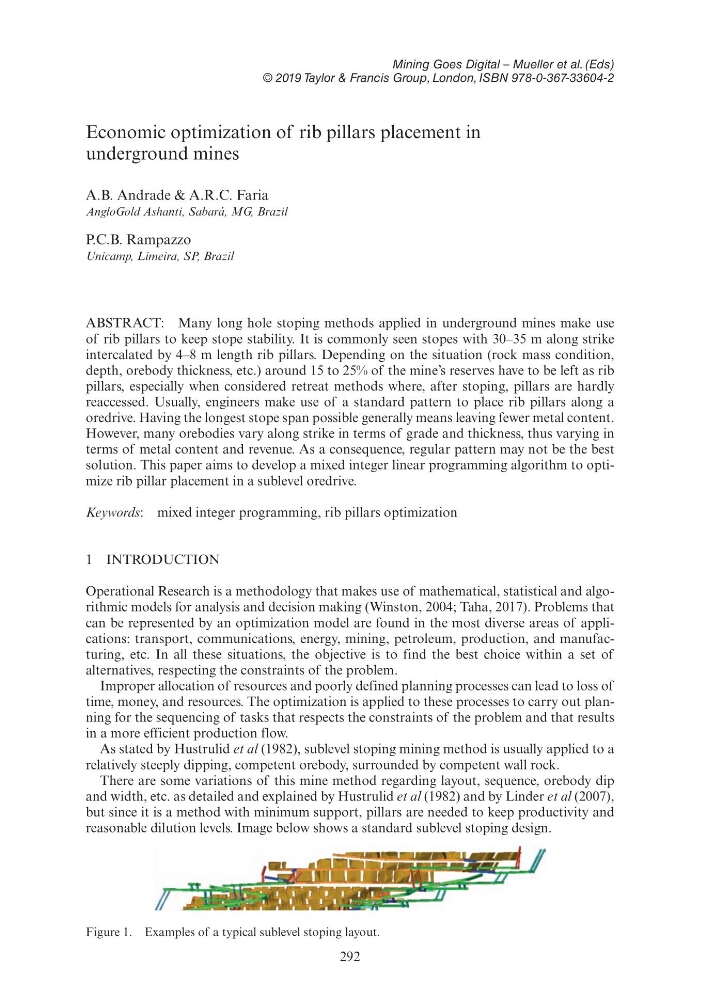
reasonable dilution levels. Image below shows a standard sublevel stoping design.
Figure 1. Examples of a typical sublevel stoping layout.
© 2019 Taylor & Francis Group, London, ISBN 978-0-367-33604-2
292
Economic optimization of rib pillars placement in
underground mines
A.B. Andrade & A.R.C. Faria
AngloGold Ashanti, Sabará, MG, Brazil
P.C.B. Rampazzo
Unicamp, Limeira, SP, Brazil
ABSTRACT: Many long hole stoping methods applied in underground mines make use
of rib pillars to keep stope stability. It is commonly seen stopes with 30–35 m along strike
intercalated by 4–8 m length rib pillars. Depending on the situation (rock mass condition,
depth, orebody thickness, etc.) around 15 to 25% of the mine’s reserves have to be left as rib
pillars, especially when considered retreat methods where, after stoping, pillars are hardly
reaccessed. Usually, engineers make use of a standard pattern to place rib pillars along a
oredrive. Having the longest stope span possible generally means leaving fewer metal content.
However, many orebodies vary along strike in terms of grade and thickness, thus varying in
terms of metal content and revenue. As a consequence, regular pattern may not be the best
solution. This paper aims to develop a mixed integer linear programming algorithm to optimize rib pillar placement in a sublevel oredrive.
Keywords: mixed integer programming, rib pillars optimization
1 INTRODUCTION
Operational Research is a methodology that makes use of mathematical, statistical and algorithmic models for analysis and decision making (Winston, 2004; Taha, 2017). Problems that
can be represented by an optimization model are found in the most diverse areas of applications: transport, communications, energy, mining, petroleum, production, and manufacturing, etc. In all these situations, the objective is to find the best choice within a set of
alternatives, respecting the constraints of the problem.
Improper allocation of resources and poorly defined planning processes can lead to loss of
time, money, and resources. The optimization is applied to these processes to carry out planning for the sequencing of tasks that respects the constraints of the problem and that results
in a more efficient production flow.
As stated by Hustrulid et al (1982), sublevel stoping mining method is usually applied to a
relatively steeply dipping, competent orebody, surrounded by competent wall rock.
There are some variations of this mine method regarding layout, sequence, orebody dip
and width, etc. as detailed and explained by Hustrulid et al (1982) and by Linder et al (2007),
but since it is a method with minimum support, pillars are needed to keep productivity and
reasonable dilution levels. Image below shows a standard sublevel stoping design.
Figure 1. Examples of a typical sublevel stoping layout.