

281
where
r o – radius of explosive cavity (m),
P o – initial pressure in explosive cavity (MPa),
E yu , K – Young’s modulus and uniform compression modulus (MPa),
ν – Poisson’s ratio,
σ g , σ p
σ – dynamic ultimate compressive and break line strength (MPa).
r r
P
g
c
r r
c
P P
g
⋅
r
⎛
⎝
⎜
⎛ ⎛
⎝ ⎝
⎞
⎠
⎟
⎞ ⎞
⎠ ⎠
σ
2 5
.
(2)
where
P c – final pressure in explosive cavity (MPa).
Initial and final pressures in explosive cavity are calculated by the formulas (3) and (4)
respectively.
P K Q
o
c
P K
P
h
l
Q
i
l
e
l osiv
l
e
⋅
K h
⋅
( )
−
e
Q Q p
e
losiv l l
e
p
ρ losiv l l e ⋅(
(3)
where
K ch – coefficient of chemical losses,
Q explosive – energy of explosive (J/kg),
ρ explosive – density of explosive (kg/m
3
),
γ – adiabatic index.
P P
r
r
c
o
P P
P P
o
r
c
r
⋅
P
⎛
⎝ ⎜
⎛ ⎛
⎝ ⎝
⎞
⎠ ⎟
⎞ ⎞
⎠ ⎠
2γ
(4)
To find the boundaries of a break line of rocks from the rock mass using the superposition
method, the vector of the maximum stress on the free surface from the action of all charges
exploded by one delay is calculated. Achieving a critical modulus of the stress vector indicates
the penetration of a break line fissure from the charge to the free surface; and the vector itself
and its magnitude of stresses are used to calculate the velocity and direction of dispersion of
the rock fragments separated from the rock mass.
3 CONSTRUCTION OF A BLOCK MODEL OF THE SIMULATION AREA
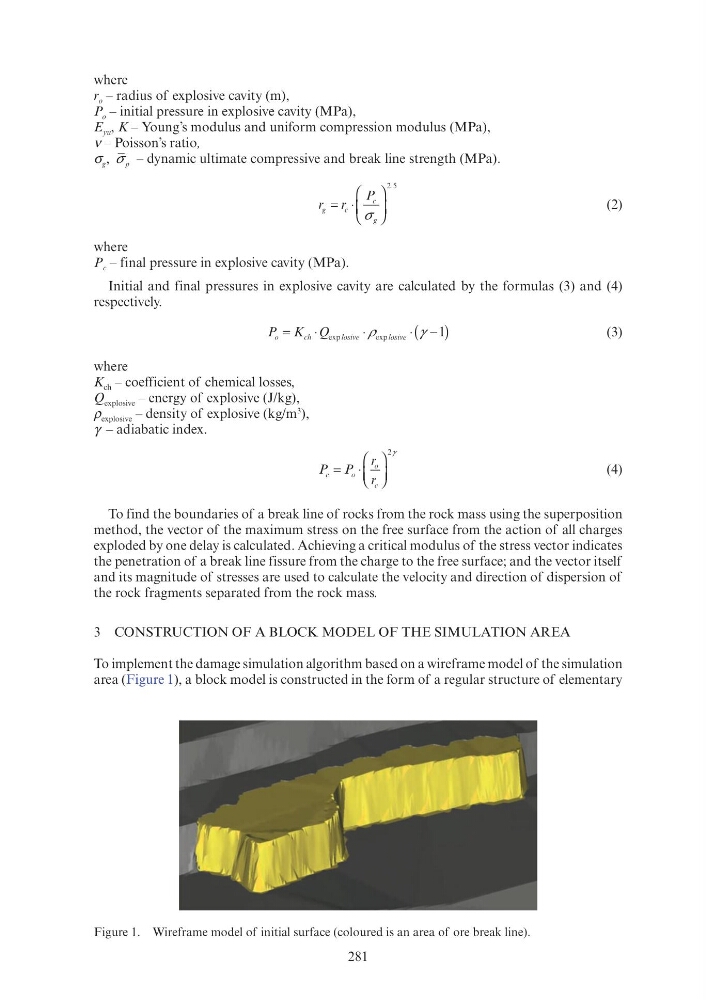
To implement the damage simulation algorithm based on a wireframe model of the simulation
area (Figure 1), a block model is constructed in the form of a regular structure of elementary
Figure 1. Wireframe model of initial surface (coloured is an area of ore break line).
where
r o – radius of explosive cavity (m),
P o – initial pressure in explosive cavity (MPa),
E yu , K – Young’s modulus and uniform compression modulus (MPa),
ν – Poisson’s ratio,
σ g , σ p
σ – dynamic ultimate compressive and break line strength (MPa).
r r
P
g
c
r r
c
P P
g
⋅
r
⎛
⎝
⎜
⎛ ⎛
⎝ ⎝
⎞
⎠
⎟
⎞ ⎞
⎠ ⎠
σ
2 5
.
(2)
where
P c – final pressure in explosive cavity (MPa).
Initial and final pressures in explosive cavity are calculated by the formulas (3) and (4)
respectively.
P K Q
o
c
P K
P
h
l
Q
i
l
e
l osiv
l
e
⋅
K h
⋅
( )
−
e
Q Q p
e
losiv l l
e
p
ρ losiv l l e ⋅(
(3)
where
K ch – coefficient of chemical losses,
Q explosive – energy of explosive (J/kg),
ρ explosive – density of explosive (kg/m
3
),
γ – adiabatic index.
P P
r
r
c
o
P P
P P
o
r
c
r
⋅
P
⎛
⎝ ⎜
⎛ ⎛
⎝ ⎝
⎞
⎠ ⎟
⎞ ⎞
⎠ ⎠
2γ
(4)
To find the boundaries of a break line of rocks from the rock mass using the superposition
method, the vector of the maximum stress on the free surface from the action of all charges
exploded by one delay is calculated. Achieving a critical modulus of the stress vector indicates
the penetration of a break line fissure from the charge to the free surface; and the vector itself
and its magnitude of stresses are used to calculate the velocity and direction of dispersion of
the rock fragments separated from the rock mass.
3 CONSTRUCTION OF A BLOCK MODEL OF THE SIMULATION AREA
To implement the damage simulation algorithm based on a wireframe model of the simulation
area (Figure 1), a block model is constructed in the form of a regular structure of elementary
Figure 1. Wireframe model of initial surface (coloured is an area of ore break line).