

280
Despite the use of a rather simplified model of the blast action in the rock mass, the
GEOMIX developers managed to obtain a completely realistic large-scale blast model with
the formation of break line and geometry of shotpile.
The Mining Institute KSC RAS has studied the issues in the field of borehole rock
breaking, including modelling of large-scale blasts, for many decades. At that, the approach
developed at the Institute differs significantly from those implemented in both BLAST
MAKER and GEOMIX.
Developed on the basis of the mining and geological information system MINEFRAME
[4], a set of programs allows dynamical modelling of changes in break line and geometry of
shotpile with a short-delay blast of borehole charges in an open pit using simulation modelling
tools. Modelling is performed in Geotech-3D software, which is a part of MINEFRAME
and is a graphical platform for modelling mining technology objects [5].
Initial data for modeling:
• 3D model of a blasting block,
• Elastic-strength characteristics of rock mass,
• Spatial location of blast boreholes,
• Constructions of borehole charges,
• Energy characteristics of explosive used,
• Scheme of initiation of borehole charges.
These data are formed by the software tools of a module for automated design of borehole
breaking [6, 7].
The result of the blast simulation is modified models of a blasting site, containing:
• a wireframe model of the break line surface,
• a wireframe model of the shotpile surface,
• a blocked model of distribution of ore quality in the shotpile.
The algorithm of large-scale blast simulation includes several steps, which are described below.
2 DETERMINATION OF THE DAMAGE ZONE DIMENSIONS AFTER
A BOREHOLE CHARGE BLAST
An explosion funnel after the borehole charge blast can only be formed in the case when the
zone of radial fissures from the charge goes to the free surface. To calculate the boundaries of
the explosion funnel, the dependence is used to calculate the radial stresses in the zone of radial
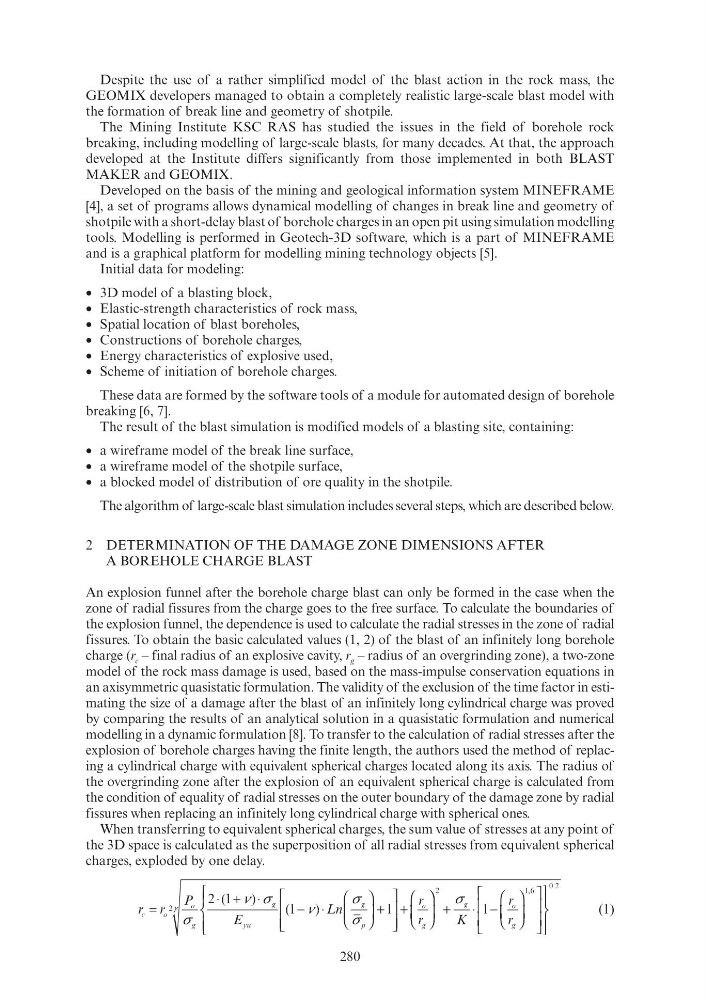
fissures. To obtain the basic calculated values (1, 2) of the blast of an infinitely long borehole
charge (r c – final radius of an explosive cavity, r g – radius of an overgrinding zone), a two-zone
model of the rock mass damage is used, based on the mass-impulse conservation equations in
an axisymmetric quasistatic formulation. The validity of the exclusion of the time factor in estimating the size of a damage after the blast of an infinitely long cylindrical charge was proved
by comparing the results of an analytical solution in a quasistatic formulation and numerical
modelling in a dynamic formulation [8]. To transfer to the calculation of radial stresses after the
explosion of borehole charges having the finite length, the authors used the method of replacing a cylindrical charge with equivalent spherical charges located along its axis. The radius of
the overgrinding zone after the explosion of an equivalent spherical charge is calculated from
the condition of equality of radial stresses on the outer boundary of the damage zone by radial
fissures when replacing an infinitely long cylindrical charge with spherical ones.
When transferring to equivalent spherical charges, the sum value of stresses at any point of
the 3D space is calculated as the superposition of all radial stresses from equivalent spherical
charges, exploded by one delay.
r r
P
E
n
r
r
c
o
r r
o
P P
g
g
yu
E
g
p
o
r
g
r
⎛
⎝
⎜
⎝ ⎝
⎞
⎠
⎟
⎠ ⎠
⎡
⎣
⎢
⎡ ⎡
⎢ ⎣ ⎣
⎢ ⎢
⎤
⎦
⎥
⎤ ⎤
⎥ ⎦ ⎦
⎥ ⎥ +
⎛
⎝
⎜
⎛ ⎛
⎝ ⎝
σ
σ
⋅
σ
σ p
2 ⋅
1
Ln
g
⋅
⎛
⎜
⎛ ⎛ ⎞
⎟
⎞ ⎞ +
(
)
+ ν
1
(
)
ν
1− ν
⎞ ⎞
⎠
⎟
⎞ ⎞ ⎞ ⎞
⎠ ⎠
+
⋅ −
⎛
⎝
⎜
⎛ ⎛
⎝ ⎝
⎞
⎠
⎟
⎞ ⎞
⎠ ⎠
⎡
⎣
⎢
⎡ ⎡
⎢
⎣ ⎣
⎢ ⎢
⎤
⎦
⎥
⎤ ⎤
⎥
⎦ ⎦
⎥ ⎥
⎧
⎨
⎪
⎧ ⎧
⎨ ⎨
⎩ ⎪
⎨ ⎨
⎩ ⎩
⎫
⎬
⎪
⎫ ⎫
⎬ ⎬
⎭ ⎪
⎬ ⎬
⎭ ⎭
2
1
⎛ ⎞
⎡
6
0 2
2
1
σ
γ
g
o
g
K
r o
r g
,
.
(1)
Despite the use of a rather simplified model of the blast action in the rock mass, the
GEOMIX developers managed to obtain a completely realistic large-scale blast model with
the formation of break line and geometry of shotpile.
The Mining Institute KSC RAS has studied the issues in the field of borehole rock
breaking, including modelling of large-scale blasts, for many decades. At that, the approach
developed at the Institute differs significantly from those implemented in both BLAST
MAKER and GEOMIX.
Developed on the basis of the mining and geological information system MINEFRAME
[4], a set of programs allows dynamical modelling of changes in break line and geometry of
shotpile with a short-delay blast of borehole charges in an open pit using simulation modelling
tools. Modelling is performed in Geotech-3D software, which is a part of MINEFRAME
and is a graphical platform for modelling mining technology objects [5].
Initial data for modeling:
• 3D model of a blasting block,
• Elastic-strength characteristics of rock mass,
• Spatial location of blast boreholes,
• Constructions of borehole charges,
• Energy characteristics of explosive used,
• Scheme of initiation of borehole charges.
These data are formed by the software tools of a module for automated design of borehole
breaking [6, 7].
The result of the blast simulation is modified models of a blasting site, containing:
• a wireframe model of the break line surface,
• a wireframe model of the shotpile surface,
• a blocked model of distribution of ore quality in the shotpile.
The algorithm of large-scale blast simulation includes several steps, which are described below.
2 DETERMINATION OF THE DAMAGE ZONE DIMENSIONS AFTER
A BOREHOLE CHARGE BLAST
An explosion funnel after the borehole charge blast can only be formed in the case when the
zone of radial fissures from the charge goes to the free surface. To calculate the boundaries of
the explosion funnel, the dependence is used to calculate the radial stresses in the zone of radial
fissures. To obtain the basic calculated values (1, 2) of the blast of an infinitely long borehole
charge (r c – final radius of an explosive cavity, r g – radius of an overgrinding zone), a two-zone
model of the rock mass damage is used, based on the mass-impulse conservation equations in
an axisymmetric quasistatic formulation. The validity of the exclusion of the time factor in estimating the size of a damage after the blast of an infinitely long cylindrical charge was proved
by comparing the results of an analytical solution in a quasistatic formulation and numerical
modelling in a dynamic formulation [8]. To transfer to the calculation of radial stresses after the
explosion of borehole charges having the finite length, the authors used the method of replacing a cylindrical charge with equivalent spherical charges located along its axis. The radius of
the overgrinding zone after the explosion of an equivalent spherical charge is calculated from
the condition of equality of radial stresses on the outer boundary of the damage zone by radial
fissures when replacing an infinitely long cylindrical charge with spherical ones.
When transferring to equivalent spherical charges, the sum value of stresses at any point of
the 3D space is calculated as the superposition of all radial stresses from equivalent spherical
charges, exploded by one delay.
r r
P
E
n
r
r
c
o
r r
o
P P
g
g
yu
E
g
p
o
r
g
r
⎛
⎝
⎜
⎝ ⎝
⎞
⎠
⎟
⎠ ⎠
⎡
⎣
⎢
⎡ ⎡
⎢ ⎣ ⎣
⎢ ⎢
⎤
⎦
⎥
⎤ ⎤
⎥ ⎦ ⎦
⎥ ⎥ +
⎛
⎝
⎜
⎛ ⎛
⎝ ⎝
σ
σ
⋅
σ
σ p
2 ⋅
1
Ln
g
⋅
⎛
⎜
⎛ ⎛ ⎞
⎟
⎞ ⎞ +
(
)
+ ν
1
(
)
ν
1− ν
⎞ ⎞
⎠
⎟
⎞ ⎞ ⎞ ⎞
⎠ ⎠
+
⋅ −
⎛
⎝
⎜
⎛ ⎛
⎝ ⎝
⎞
⎠
⎟
⎞ ⎞
⎠ ⎠
⎡
⎣
⎢
⎡ ⎡
⎢
⎣ ⎣
⎢ ⎢
⎤
⎦
⎥
⎤ ⎤
⎥
⎦ ⎦
⎥ ⎥
⎧
⎨
⎪
⎧ ⎧
⎨ ⎨
⎩ ⎪
⎨ ⎨
⎩ ⎩
⎫
⎬
⎪
⎫ ⎫
⎬ ⎬
⎭ ⎪
⎬ ⎬
⎭ ⎭
2
1
⎛ ⎞
⎡
6
0 2
2
1
σ
γ
g
o
g
K
r o
r g
,
.
(1)