

Mining Goes Digital – Mueller et al. (Eds)
© 2019 Taylor & Francis Group, London, ISBN 978-0-367-33604-2
264
Parametric analysis of the optimal depth of an open-pit gold mine
R. Motta, C. Porto, D. Machado & O.C. Souto
Universidade Federal do Rio de Janeiro, Rio de Janeiro, RJ, Brazil
ABSTRACT: This paper aims at demonstrating the optimum Percentage of Resource
Mined (PRM – mineable reserve divided by total ore resources) by means of a parametric
analysis, given three ore body geometries, namely: tabular, cylindrical and pipelike, showing
the threshold between open-pit and underground mining, using the so-called Ore Quality Factor (OQF), which will be defined in the text. A conycal open-pit mine was considered to calculate the OQF, the economics of underground mining to go beyond the established limit by
underground mining being not considered, which, in the case of the pipelike orebody would
be more important. The relative dimensions of the aforesaid shapes were chosen in a way, that
resulting volumes are the same and therefore tonnages. The overburden thicknesses considered for the three shapes being the same, the waste-to-ore ratio varies a lot, whether PRM is
10% or 100%. Sensitivity analyses included overburden thickness, ore grades, and slope angles.
1 INTRODUCTION
Open pit mining has often been applied to gold mining worldwide since the low cost of
mining allows profitable extraction of low grade ores. In open pit mining the slope angle
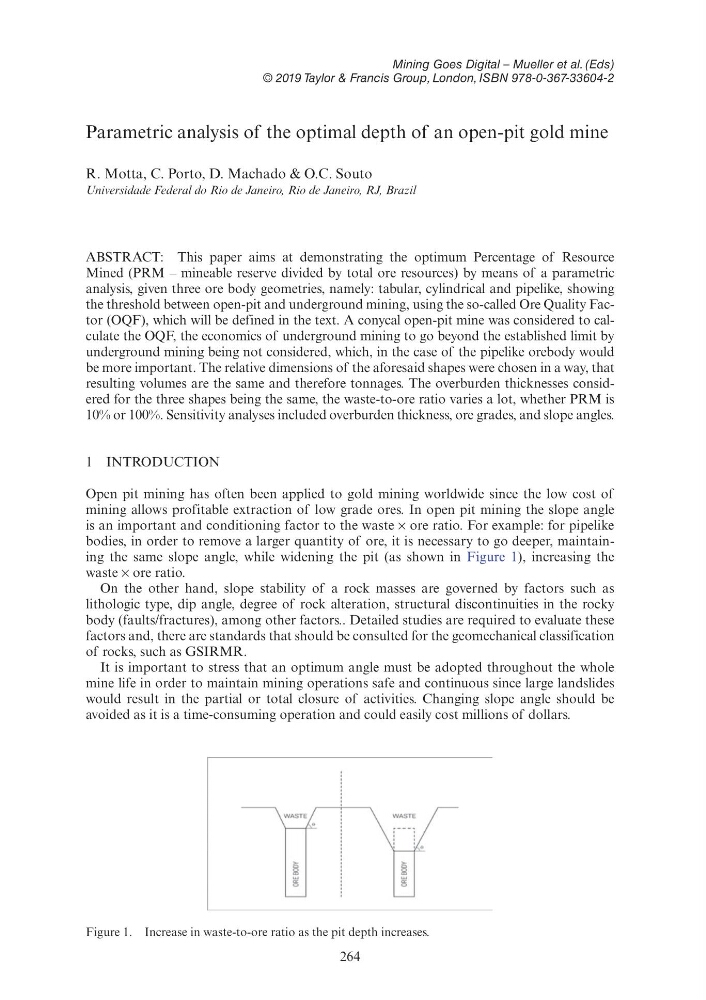
is an important and conditioning factor to the waste × ore ratio. For example: for pipelike
bodies, in order to remove a larger quantity of ore, it is necessary to go deeper, maintaining the same slope angle, while widening the pit (as shown in Figure 1), increasing the
waste × ore ratio.
On the other hand, slope stability of a rock masses are governed by factors such as
lithologic type, dip angle, degree of rock alteration, structural discontinuities in the rocky
body (faults/fractures), among other factors.. Detailed studies are required to evaluate these
factors and, there are standards that should be consulted for the geomechanical classification
of rocks, such as GSIRMR.
It is important to stress that an optimum angle must be adopted throughout the whole
mine life in order to maintain mining operations safe and continuous since large landslides
would result in the partial or total closure of activities. Changing slope angle should be
avoided as it is a time-consuming operation and could easily cost millions of dollars.
Figure 1. Increase in waste-to-ore ratio as the pit depth increases.
WASTE
© 2019 Taylor & Francis Group, London, ISBN 978-0-367-33604-2
264
Parametric analysis of the optimal depth of an open-pit gold mine
R. Motta, C. Porto, D. Machado & O.C. Souto
Universidade Federal do Rio de Janeiro, Rio de Janeiro, RJ, Brazil
ABSTRACT: This paper aims at demonstrating the optimum Percentage of Resource
Mined (PRM – mineable reserve divided by total ore resources) by means of a parametric
analysis, given three ore body geometries, namely: tabular, cylindrical and pipelike, showing
the threshold between open-pit and underground mining, using the so-called Ore Quality Factor (OQF), which will be defined in the text. A conycal open-pit mine was considered to calculate the OQF, the economics of underground mining to go beyond the established limit by
underground mining being not considered, which, in the case of the pipelike orebody would
be more important. The relative dimensions of the aforesaid shapes were chosen in a way, that
resulting volumes are the same and therefore tonnages. The overburden thicknesses considered for the three shapes being the same, the waste-to-ore ratio varies a lot, whether PRM is
10% or 100%. Sensitivity analyses included overburden thickness, ore grades, and slope angles.
1 INTRODUCTION
Open pit mining has often been applied to gold mining worldwide since the low cost of
mining allows profitable extraction of low grade ores. In open pit mining the slope angle
is an important and conditioning factor to the waste × ore ratio. For example: for pipelike
bodies, in order to remove a larger quantity of ore, it is necessary to go deeper, maintaining the same slope angle, while widening the pit (as shown in Figure 1), increasing the
waste × ore ratio.
On the other hand, slope stability of a rock masses are governed by factors such as
lithologic type, dip angle, degree of rock alteration, structural discontinuities in the rocky
body (faults/fractures), among other factors.. Detailed studies are required to evaluate these
factors and, there are standards that should be consulted for the geomechanical classification
of rocks, such as GSIRMR.
It is important to stress that an optimum angle must be adopted throughout the whole
mine life in order to maintain mining operations safe and continuous since large landslides
would result in the partial or total closure of activities. Changing slope angle should be
avoided as it is a time-consuming operation and could easily cost millions of dollars.
Figure 1. Increase in waste-to-ore ratio as the pit depth increases.
WASTE