

252
7 CASE STUDY SUMMARY
This paper presented two case studies with client data. Although the projects are not named,
the data are real.
In the two case studies, a final cell size of double the variogram range was used. It is uncertain whether this observation can be considered as a “rule-of-thumb”, but it is possible that
there is a relation of a reasonable declustering cell size to the variogram range. This is a cautious suggestion, and the decision and interpretation is at the discretion of the QP or CP.
There are similarities and differences between the declustering technique under discussion
and that of the declustering effect of kriging. The declustering program utilizes the variogram
anisotropy to calculate the weights assigned to samples. It only utilizes the geometry, but not
the sample-to-sample variance from the theoretical variogram model used in kriging.
Both estimation and declustering require good geological modeling and appropriate
assignment of estimation domains. (Verly, et al. 2017) states that “Complex simulation can be
completed as long as the main geological features can be simulated separately.” The simulation
study results is defining the sufficient drill hole spacing to achieve adequate confidence. (Reid
and Parker 2017) focuses on the density of holes with a Selected Mineralized Zone in each
pod of the sandstone hosted uranium deposit. ( Jewbali, et al. 2017) utilizes a random search
to optimize the cost of infill drilling to achieve adequate drill spacing to convert the resource
class of the mineral.
The commonality of most authors is the definition of a necessary spacing to classify the
mineral resources. The authors believe that the technique presented herein provides a useful
method whereby the needed spacing as determined by the qualified person can be mapped
into a pragmatic classification of estimation confidence that is useful for planning and reporting of mineral resources and reserves.
8 CONCLUSIONS
Based on the idea that a mineral resource classification should reflect the average sample
density in the local area. It appears that the use of declustering weights as a corollary may
be useful. This paper is empirical and is based on general principles used in mineral resource
modeling. It is not a theoretical treatment of declustering by kriging during estimation.
The declustering weight method appears to emulate these features of multiple searches
and does not require multiple runs to calculate the classifications. It eliminates some of the
artifacts such as the floating measured blocks and internal edge effects in the estimated grade.
Like all classification techniques, the final classification needs to be checked against the
data density on plans and cross sections. The method is empirical rather than theoretical, and
requires that some decisions and interpretations be made by the QP or CP. These include the
cell size for declustering and the thresholds for differentiating the mineral resource categories.
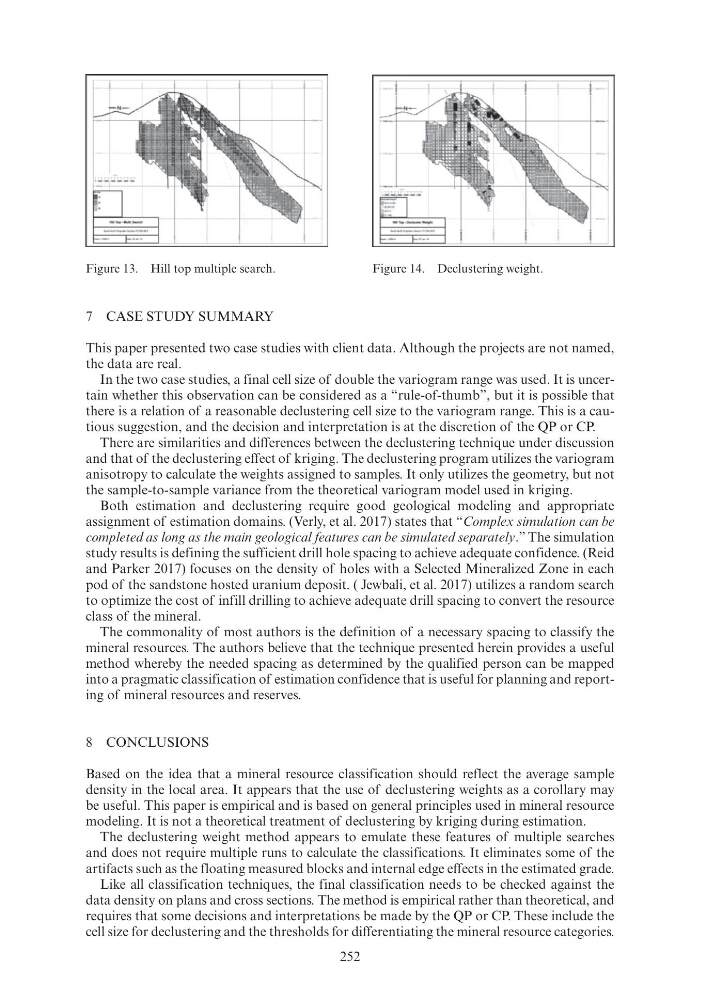
Figure 13. Hill top multiple search.
Figure 14. Declustering weight.
7 CASE STUDY SUMMARY
This paper presented two case studies with client data. Although the projects are not named,
the data are real.
In the two case studies, a final cell size of double the variogram range was used. It is uncertain whether this observation can be considered as a “rule-of-thumb”, but it is possible that
there is a relation of a reasonable declustering cell size to the variogram range. This is a cautious suggestion, and the decision and interpretation is at the discretion of the QP or CP.
There are similarities and differences between the declustering technique under discussion
and that of the declustering effect of kriging. The declustering program utilizes the variogram
anisotropy to calculate the weights assigned to samples. It only utilizes the geometry, but not
the sample-to-sample variance from the theoretical variogram model used in kriging.
Both estimation and declustering require good geological modeling and appropriate
assignment of estimation domains. (Verly, et al. 2017) states that “Complex simulation can be
completed as long as the main geological features can be simulated separately.” The simulation
study results is defining the sufficient drill hole spacing to achieve adequate confidence. (Reid
and Parker 2017) focuses on the density of holes with a Selected Mineralized Zone in each
pod of the sandstone hosted uranium deposit. ( Jewbali, et al. 2017) utilizes a random search
to optimize the cost of infill drilling to achieve adequate drill spacing to convert the resource
class of the mineral.
The commonality of most authors is the definition of a necessary spacing to classify the
mineral resources. The authors believe that the technique presented herein provides a useful
method whereby the needed spacing as determined by the qualified person can be mapped
into a pragmatic classification of estimation confidence that is useful for planning and reporting of mineral resources and reserves.
8 CONCLUSIONS
Based on the idea that a mineral resource classification should reflect the average sample
density in the local area. It appears that the use of declustering weights as a corollary may
be useful. This paper is empirical and is based on general principles used in mineral resource
modeling. It is not a theoretical treatment of declustering by kriging during estimation.
The declustering weight method appears to emulate these features of multiple searches
and does not require multiple runs to calculate the classifications. It eliminates some of the
artifacts such as the floating measured blocks and internal edge effects in the estimated grade.
Like all classification techniques, the final classification needs to be checked against the
data density on plans and cross sections. The method is empirical rather than theoretical, and
requires that some decisions and interpretations be made by the QP or CP. These include the
cell size for declustering and the thresholds for differentiating the mineral resource categories.
Figure 13. Hill top multiple search.
Figure 14. Declustering weight.