

250
estimated into blocks, and shows the successive halos of higher estimated weights reflecting
the decreasing sample density.
5 CASE STUDY 1 – MIDDLE OF NOWHERE GOLD
The Middle of Nowhere is a epithermal gold deposit at the contact of sediments and
tertiary volcanics. Additional faulting and fracturing normal to the contact adds structural complexity to the deposit, and a higher-grade domain overprint. The case study will
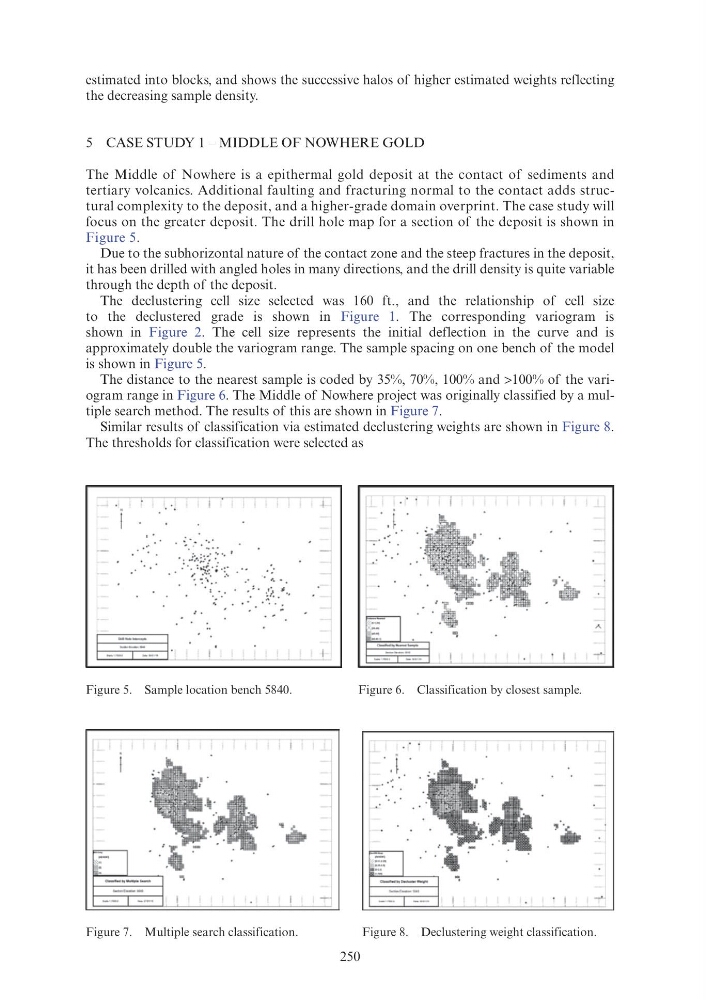
focus on the greater deposit. The drill hole map for a section of the deposit is shown in
Figure 5.
Due to the subhorizontal nature of the contact zone and the steep fractures in the deposit,
it has been drilled with angled holes in many directions, and the drill density is quite variable
through the depth of the deposit.
The declustering cell size selected was 160 ft., and the relationship of cell size
to the declustered grade is shown in Figure 1. The corresponding variogram is
shown in Figure 2. The cell size represents the initial deflection in the curve and is
approximately double the variogram range. The sample spacing on one bench of the model
is shown in Figure 5.
The distance to the nearest sample is coded by 35%, 70%, 100% and >100% of the variogram range in Figure 6. The Middle of Nowhere project was originally classified by a multiple search method. The results of this are shown in Figure 7.
Similar results of classification via estimated declustering weights are shown in Figure 8.
The thresholds for classification were selected as
Figure 5. Sample location bench 5840.
Figure 6. Classification by closest sample.
Figure 8. Declustering weight classification.
Figure 7. Multiple search classification.
estimated into blocks, and shows the successive halos of higher estimated weights reflecting
the decreasing sample density.
5 CASE STUDY 1 – MIDDLE OF NOWHERE GOLD
The Middle of Nowhere is a epithermal gold deposit at the contact of sediments and
tertiary volcanics. Additional faulting and fracturing normal to the contact adds structural complexity to the deposit, and a higher-grade domain overprint. The case study will
focus on the greater deposit. The drill hole map for a section of the deposit is shown in
Figure 5.
Due to the subhorizontal nature of the contact zone and the steep fractures in the deposit,
it has been drilled with angled holes in many directions, and the drill density is quite variable
through the depth of the deposit.
The declustering cell size selected was 160 ft., and the relationship of cell size
to the declustered grade is shown in Figure 1. The corresponding variogram is
shown in Figure 2. The cell size represents the initial deflection in the curve and is
approximately double the variogram range. The sample spacing on one bench of the model
is shown in Figure 5.
The distance to the nearest sample is coded by 35%, 70%, 100% and >100% of the variogram range in Figure 6. The Middle of Nowhere project was originally classified by a multiple search method. The results of this are shown in Figure 7.
Similar results of classification via estimated declustering weights are shown in Figure 8.
The thresholds for classification were selected as
Figure 5. Sample location bench 5840.
Figure 6. Classification by closest sample.
Figure 8. Declustering weight classification.
Figure 7. Multiple search classification.