

231
Class 1 (Region A): Fe grade
−
≈
grade 18 6
. %
6
Class 2 (Region B): Fe grade
−
≈
grade 57. %
2
Class 3 (Region C): Fe grade
−
≈
grade 41. %
4
Class 4 (Region D): Fe grade
−
≈
grade 50. %
2
After the suggested pre-processing methods are applied to the raw recorded MWD data,
an SVM classification model is developed based on Gaussian kernel method using the supervised processed data. Also, 5-fold cross validation is used as a performance indicator to validate the achieved model.
5 RESULTS AND DISCUSSION
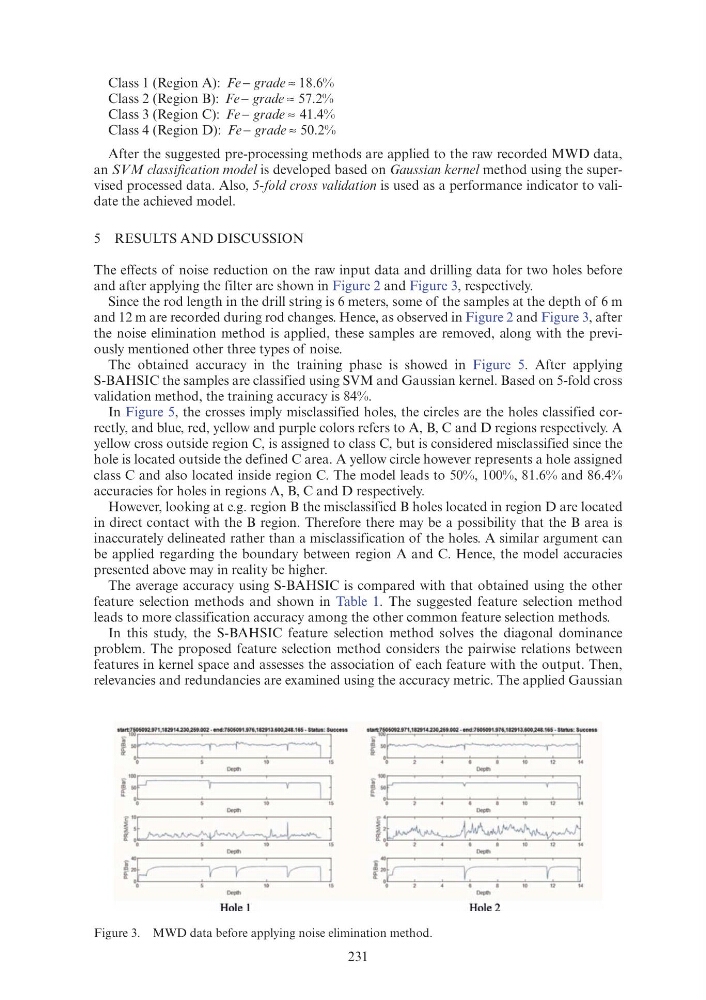
The effects of noise reduction on the raw input data and drilling data for two holes before
and after applying the filter are shown in Figure 2 and Figure 3, respectively.
Since the rod length in the drill string is 6 meters, some of the samples at the depth of 6 m
and 12 m are recorded during rod changes. Hence, as observed in Figure 2 and Figure 3, after
the noise elimination method is applied, these samples are removed, along with the previously mentioned other three types of noise.
The obtained accuracy in the training phase is showed in Figure 5. After applying
S-BAHSIC the samples are classified using SVM and Gaussian kernel. Based on 5-fold cross
validation method, the training accuracy is 84%.
In Figure 5, the crosses imply misclassified holes, the circles are the holes classified correctly, and blue, red, yellow and purple colors refers to A, B, C and D regions respectively. A
yellow cross outside region C, is assigned to class C, but is considered misclassified since the
hole is located outside the defined C area. A yellow circle however represents a hole assigned
class C and also located inside region C. The model leads to 50%, 100%, 81.6% and 86.4%
accuracies for holes in regions A, B, C and D respectively.
However, looking at e.g. region B the misclassified B holes located in region D are located
in direct contact with the B region. Therefore there may be a possibility that the B area is
inaccurately delineated rather than a misclassification of the holes. A similar argument can
be applied regarding the boundary between region A and C. Hence, the model accuracies
presented above may in reality be higher.
The average accuracy using S-BAHSIC is compared with that obtained using the other
feature selection methods and shown in Table 1. The suggested feature selection method
leads to more classification accuracy among the other common feature selection methods.
In this study, the S-BAHSIC feature selection method solves the diagonal dominance
problem. The proposed feature selection method considers the pairwise relations between
features in kernel space and assesses the association of each feature with the output. Then,
relevancies and redundancies are examined using the accuracy metric. The applied Gaussian
Figure 3. MWD data before applying noise elimination method.
start7606092.971,182914.230,269.002 - ei"KI:7606091.976,18291 3.600,248.166 - Status: Succ .. s
~·:~l
0
5
10
15
start7606092.971,1rn14.230,269.002 · end:7605091.976,182913.600,248.165 - Status: Succ .. s
~·:~
0
2
4
6
8
10
12
14
f:P
: \ : =--J l
.~--------~.----------~,--------~~ ...
l':f : < : :---4
~~--~----.~--~.----~--~. ~.----. ~,--~ ..
r:k-:~ l
0
5
10
15
r:k-----,r--:-a
0
6
10
12
14
""""
Hole l
Hole2
Class 1 (Region A): Fe grade
−
≈
grade 18 6
. %
6
Class 2 (Region B): Fe grade
−
≈
grade 57. %
2
Class 3 (Region C): Fe grade
−
≈
grade 41. %
4
Class 4 (Region D): Fe grade
−
≈
grade 50. %
2
After the suggested pre-processing methods are applied to the raw recorded MWD data,
an SVM classification model is developed based on Gaussian kernel method using the supervised processed data. Also, 5-fold cross validation is used as a performance indicator to validate the achieved model.
5 RESULTS AND DISCUSSION
The effects of noise reduction on the raw input data and drilling data for two holes before
and after applying the filter are shown in Figure 2 and Figure 3, respectively.
Since the rod length in the drill string is 6 meters, some of the samples at the depth of 6 m
and 12 m are recorded during rod changes. Hence, as observed in Figure 2 and Figure 3, after
the noise elimination method is applied, these samples are removed, along with the previously mentioned other three types of noise.
The obtained accuracy in the training phase is showed in Figure 5. After applying
S-BAHSIC the samples are classified using SVM and Gaussian kernel. Based on 5-fold cross
validation method, the training accuracy is 84%.
In Figure 5, the crosses imply misclassified holes, the circles are the holes classified correctly, and blue, red, yellow and purple colors refers to A, B, C and D regions respectively. A
yellow cross outside region C, is assigned to class C, but is considered misclassified since the
hole is located outside the defined C area. A yellow circle however represents a hole assigned
class C and also located inside region C. The model leads to 50%, 100%, 81.6% and 86.4%
accuracies for holes in regions A, B, C and D respectively.
However, looking at e.g. region B the misclassified B holes located in region D are located
in direct contact with the B region. Therefore there may be a possibility that the B area is
inaccurately delineated rather than a misclassification of the holes. A similar argument can
be applied regarding the boundary between region A and C. Hence, the model accuracies
presented above may in reality be higher.
The average accuracy using S-BAHSIC is compared with that obtained using the other
feature selection methods and shown in Table 1. The suggested feature selection method
leads to more classification accuracy among the other common feature selection methods.
In this study, the S-BAHSIC feature selection method solves the diagonal dominance
problem. The proposed feature selection method considers the pairwise relations between
features in kernel space and assesses the association of each feature with the output. Then,
relevancies and redundancies are examined using the accuracy metric. The applied Gaussian
Figure 3. MWD data before applying noise elimination method.
start7606092.971,182914.230,269.002 - ei"KI:7606091.976,18291 3.600,248.166 - Status: Succ .. s
~·:~l
0
5
10
15
start7606092.971,1rn14.230,269.002 · end:7605091.976,182913.600,248.165 - Status: Succ .. s
~·:~
0
2
4
6
8
10
12
14
f:P
: \ : =--J l
.~--------~.----------~,--------~~ ...
l':f : < : :---4
~~--~----.~--~.----~--~. ~.----. ~,--~ ..
r:k-:~ l
0
5
10
15
r:k-----,r--:-a
0
6
10
12
14
""""
Hole l
Hole2