

229
data points. A noise reduction method for identifying invalid data has been proposed by the
authors based on removing sudden changes in a smooth neighborhood and is described in
detail in (Liaghat et al., in prep.). Four types of eliminated samples are:
• Samples recorded at the beginning of each hole (collaring)
• Samples recorded during the rod change process
• Samples related to a sudden peak in a smooth environment
• Samples with a negative or zero drilling parameter value
3.2 Feature selection
In previous work, an unsupervised feature selection method was proposed based on HSIC 2
(Liaghat & Mansoori 2016, 2018). The feature selection is termed unsupervised when no
label is coupled with the data. As the input MWD data have labels, this study proposes a
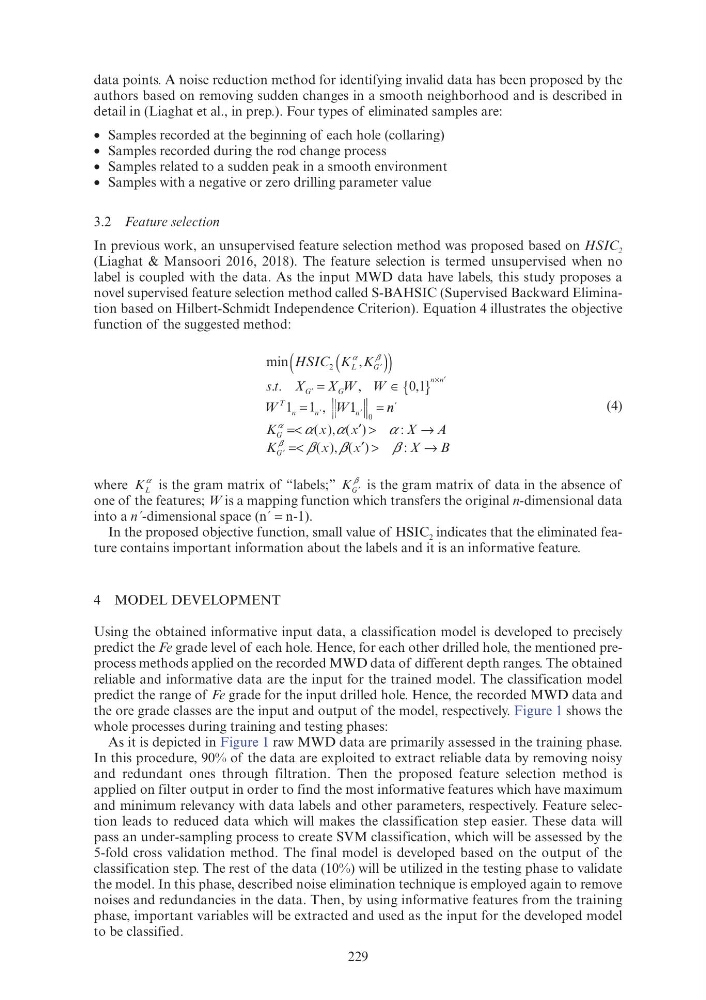
novel supervised feature selection method called S-BAHSIC (Supervised Backward Elimination based on Hilbert-Schmidt Independence Criterion). Equation 4 illustrates the objective
function of the suggested method:
min
. .
,
s t
. X
X W W
,
W
W
,
G
G
X
n n
T
n
n
, W
,
0
1 1
1 1 ′
W
,
1
(
)
HSIC 2 (
)
K K
,
L
G
,K ,
α
β
K ′
∈
X W W
,
G
X
{ }
,
0 1
,
=
W1 ′
W1
′
×
n n
K
x
X
A
K
x
X
B
G
K
G
K
′
α
β
α
β
β
β
′
→
X
′
→
X
( )
α x , (
α α )
:
α α
β β x (
β )
:
β β
(4)
where K L
K
α is the gram matrix of “labels;” K G
K ′
β is the gram matrix of data in the absence of
one of the features; W is a mapping function which transfers the original n-dimensional data
into a n´-dimensional space (n´ = n-1).
In the proposed objective function, small value of HSIC 2 indicates that the eliminated feature contains important information about the labels and it is an informative feature.
4 MODEL DEVELOPMENT
Using the obtained informative input data, a classification model is developed to precisely
predict the Fe grade level of each hole. Hence, for each other drilled hole, the mentioned preprocess methods applied on the recorded MWD data of different depth ranges. The obtained
reliable and informative data are the input for the trained model. The classification model
predict the range of Fe grade for the input drilled hole. Hence, the recorded MWD data and
the ore grade classes are the input and output of the model, respectively. Figure 1 shows the
whole processes during training and testing phases:
As it is depicted in Figure 1 raw MWD data are primarily assessed in the training phase.
In this procedure, 90% of the data are exploited to extract reliable data by removing noisy
and redundant ones through filtration. Then the proposed feature selection method is
applied on filter output in order to find the most informative features which have maximum
and minimum relevancy with data labels and other parameters, respectively. Feature selection leads to reduced data which will makes the classification step easier. These data will
pass an under-sampling process to create SVM classification, which will be assessed by the
5-fold cross validation method. The final model is developed based on the output of the
classification step. The rest of the data (10%) will be utilized in the testing phase to validate
the model. In this phase, described noise elimination technique is employed again to remove
noises and redundancies in the data. Then, by using informative features from the training
phase, important variables will be extracted and used as the input for the developed model
to be classified.
data points. A noise reduction method for identifying invalid data has been proposed by the
authors based on removing sudden changes in a smooth neighborhood and is described in
detail in (Liaghat et al., in prep.). Four types of eliminated samples are:
• Samples recorded at the beginning of each hole (collaring)
• Samples recorded during the rod change process
• Samples related to a sudden peak in a smooth environment
• Samples with a negative or zero drilling parameter value
3.2 Feature selection
In previous work, an unsupervised feature selection method was proposed based on HSIC 2
(Liaghat & Mansoori 2016, 2018). The feature selection is termed unsupervised when no
label is coupled with the data. As the input MWD data have labels, this study proposes a
novel supervised feature selection method called S-BAHSIC (Supervised Backward Elimination based on Hilbert-Schmidt Independence Criterion). Equation 4 illustrates the objective
function of the suggested method:
min
. .
,
s t
. X
X W W
,
W
W
,
G
G
X
n n
T
n
n
, W
,
0
1 1
1 1 ′
W
,
1
(
)
HSIC 2 (
)
K K
,
L
G
,K ,
α
β
K ′
∈
X W W
,
G
X
{ }
,
0 1
,
=
W1 ′
W1
′
×
n n
K
x
X
A
K
x
X
B
G
K
G
K
′
α
β
α
β
β
β
′
→
X
′
→
X
( )
α x , (
α α )
:
α α
β β x (
β )
:
β β
(4)
where K L
K
α is the gram matrix of “labels;” K G
K ′
β is the gram matrix of data in the absence of
one of the features; W is a mapping function which transfers the original n-dimensional data
into a n´-dimensional space (n´ = n-1).
In the proposed objective function, small value of HSIC 2 indicates that the eliminated feature contains important information about the labels and it is an informative feature.
4 MODEL DEVELOPMENT
Using the obtained informative input data, a classification model is developed to precisely
predict the Fe grade level of each hole. Hence, for each other drilled hole, the mentioned preprocess methods applied on the recorded MWD data of different depth ranges. The obtained
reliable and informative data are the input for the trained model. The classification model
predict the range of Fe grade for the input drilled hole. Hence, the recorded MWD data and
the ore grade classes are the input and output of the model, respectively. Figure 1 shows the
whole processes during training and testing phases:
As it is depicted in Figure 1 raw MWD data are primarily assessed in the training phase.
In this procedure, 90% of the data are exploited to extract reliable data by removing noisy
and redundant ones through filtration. Then the proposed feature selection method is
applied on filter output in order to find the most informative features which have maximum
and minimum relevancy with data labels and other parameters, respectively. Feature selection leads to reduced data which will makes the classification step easier. These data will
pass an under-sampling process to create SVM classification, which will be assessed by the
5-fold cross validation method. The final model is developed based on the output of the
classification step. The rest of the data (10%) will be utilized in the testing phase to validate
the model. In this phase, described noise elimination technique is employed again to remove
noises and redundancies in the data. Then, by using informative features from the training
phase, important variables will be extracted and used as the input for the developed model
to be classified.