

194
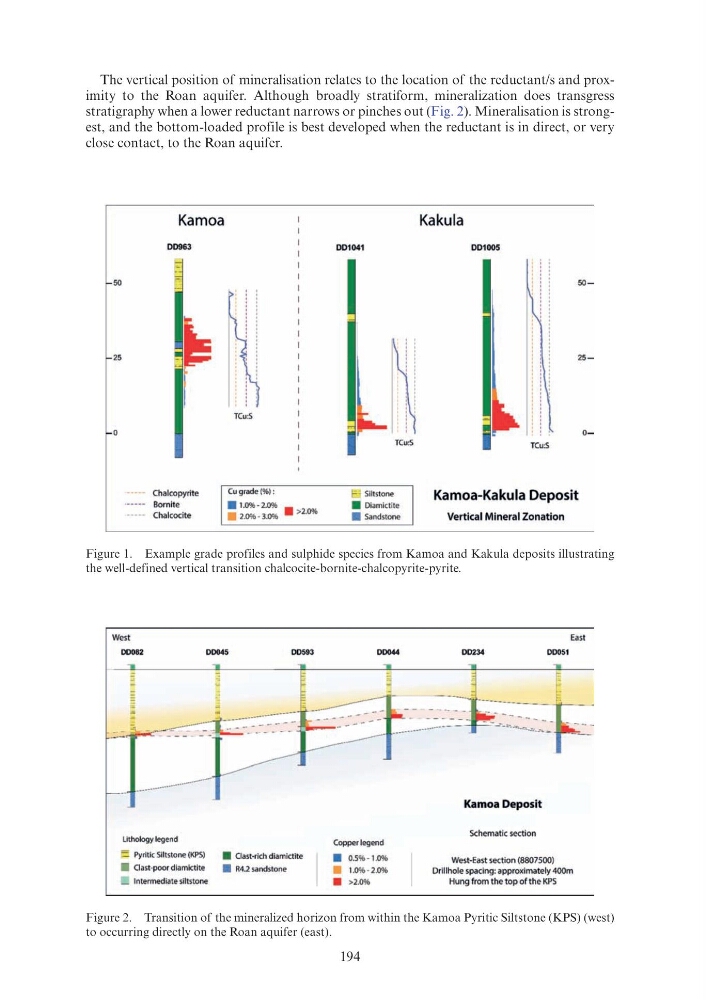
The vertical position of mineralisation relates to the location of the reductant/s and proximity to the Roan aquifer. Although broadly stratiform, mineralization does transgress
stratigraphy when a lower reductant narrows or pinches out (Fig. 2). Mineralisation is strongest, and the bottom-loaded profile is best developed when the reductant is in direct, or very
close contact, to the Roan aquifer.
Figure 1. Example grade profiles and sulphide species from Kamoa and Kakula deposits illustrating
the well-defined vertical transition chalcocite-bornite-chalcopyrite-pyrite.
Figure 2. Transition of the mineralized horizon from within the Kamoa Pyritic Siltstone (KPS) (west)
to occurring directly on the Roan aquifer (east).
Kamoa
00963
50
25
TCu:S
Cu grade (% ):
Chalcopyrit e
Bornite
Chalcocite
• 1.0%-2.0% • >2.0%
• 2.0% - 3.0%
West
00082
Lithology legend
00045
00593
~ Pyritic Siltstone (KPS)
• Clast-rich diamictite
Clast -poor diamict ite
• R4.2 sandstone
Intermediate siltstone
001041
00044
Copper leg end
•
0.5% - 1.0%
•
1.0% - 2.0%
•
>2.0%
Kakul a
001005
50
25
Kamoa-Kakula Deposit
Vertical Mineral Zonation
East
00234
00051
Kamoa Deposit
Sch emat ic sect ion
West-East section (8807500)
Drillhole spacing: approximately 400m
Hung from t he top of the KPS
The vertical position of mineralisation relates to the location of the reductant/s and proximity to the Roan aquifer. Although broadly stratiform, mineralization does transgress
stratigraphy when a lower reductant narrows or pinches out (Fig. 2). Mineralisation is strongest, and the bottom-loaded profile is best developed when the reductant is in direct, or very
close contact, to the Roan aquifer.
Figure 1. Example grade profiles and sulphide species from Kamoa and Kakula deposits illustrating
the well-defined vertical transition chalcocite-bornite-chalcopyrite-pyrite.
Figure 2. Transition of the mineralized horizon from within the Kamoa Pyritic Siltstone (KPS) (west)
to occurring directly on the Roan aquifer (east).
Kamoa
00963
50
25
TCu:S
Cu grade (% ):
Chalcopyrit e
Bornite
Chalcocite
• 1.0%-2.0% • >2.0%
• 2.0% - 3.0%
West
00082
Lithology legend
00045
00593
~ Pyritic Siltstone (KPS)
• Clast-rich diamictite
Clast -poor diamict ite
• R4.2 sandstone
Intermediate siltstone
001041
00044
Copper leg end
•
0.5% - 1.0%
•
1.0% - 2.0%
•
>2.0%
Kakul a
001005
50
25
Kamoa-Kakula Deposit
Vertical Mineral Zonation
East
00234
00051
Kamoa Deposit
Sch emat ic sect ion
West-East section (8807500)
Drillhole spacing: approximately 400m
Hung from t he top of the KPS