

119
VarDat
krwt
krwt
i
n
i
i
n
i
=
(
)
v i
v −
=
=
∑
∑
1
2
1
*
) )
(3)
where krwt i represents the accumulated kriging weight for sample i.
Based on a number of drill holes in those panels, average drill hole spacing can be calculated in both the high and the low grade variability panels. This drill hole spacing can be
applied for necessary infill drilling in panels assigned to an Inferred category.
3.2 Local statistics from simulation
The second approach to access local statistics for risk assessment is to use conditional simulation (Isaaks, 1990; Journel, 1993; Goovaerts, 1997; Chilès and Delfiner, 1999; Deutsch, 2002;
Murphy et al, 2004). While simulation is preferred, from the standpoint of quantifying both
local and global uncertainty, it is somewhat more complicated and time consuming than
the conventional kriging approach. Some commercial software packages provide options for
simulating point grades. Sequential Gaussian simulation methodology is the most popular
for this type of work, though Turning Bands is also a practical option depending on the commercial platform. In essence, points are simulated and these simulated points can be averaged
in a block or a panel resulting in simulated block or panel grades. Instead of having just one
block model with estimated panel grades as in the kriging approach above, multiple (e.g. 100)
equally likely panel models (realizations) can be designed that honour drill hole data, assay
variability, and the spatial continuity of the grades.
Monthly production panel simulated grade values can be derived from each realization.
This results in a full distribution of potential average grades in each panel (Figure 3). This
time, instead of relying on kriging variance and data variance as given in formula (1), the
uncertainty on the estimate can be directly derived from the conditional mean and standard
deviation of the simulated panel grades.
The relative 90% confidence limit can be calculated as in formula (2):
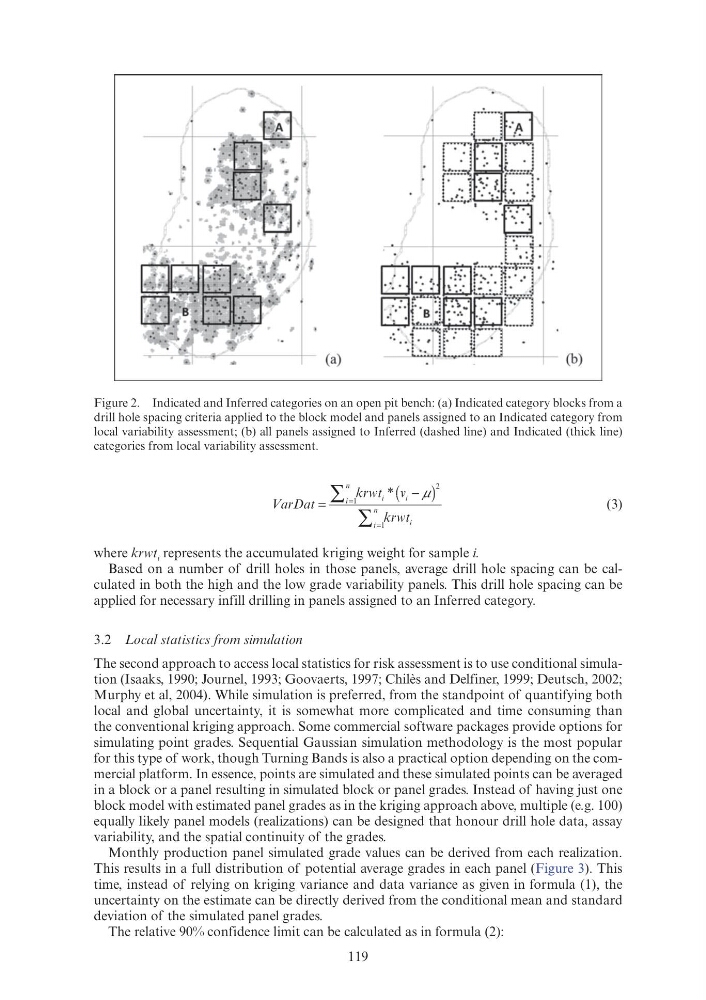
Figure 2. Indicated and Inferred categories on an open pit bench: (a) Indicated category blocks from a
drill hole spacing criteria applied to the block model and panels assigned to an Indicated category from
local variability assessment; (b) all panels assigned to Inferred (dashed line) and Indicated (thick line)
categories from local variability assessment.
(a)
(b)
VarDat
krwt
krwt
i
n
i
i
n
i
=
(
)
v i
v −
=
=
∑
∑
1
2
1
*
) )
(3)
where krwt i represents the accumulated kriging weight for sample i.
Based on a number of drill holes in those panels, average drill hole spacing can be calculated in both the high and the low grade variability panels. This drill hole spacing can be
applied for necessary infill drilling in panels assigned to an Inferred category.
3.2 Local statistics from simulation
The second approach to access local statistics for risk assessment is to use conditional simulation (Isaaks, 1990; Journel, 1993; Goovaerts, 1997; Chilès and Delfiner, 1999; Deutsch, 2002;
Murphy et al, 2004). While simulation is preferred, from the standpoint of quantifying both
local and global uncertainty, it is somewhat more complicated and time consuming than
the conventional kriging approach. Some commercial software packages provide options for
simulating point grades. Sequential Gaussian simulation methodology is the most popular
for this type of work, though Turning Bands is also a practical option depending on the commercial platform. In essence, points are simulated and these simulated points can be averaged
in a block or a panel resulting in simulated block or panel grades. Instead of having just one
block model with estimated panel grades as in the kriging approach above, multiple (e.g. 100)
equally likely panel models (realizations) can be designed that honour drill hole data, assay
variability, and the spatial continuity of the grades.
Monthly production panel simulated grade values can be derived from each realization.
This results in a full distribution of potential average grades in each panel (Figure 3). This
time, instead of relying on kriging variance and data variance as given in formula (1), the
uncertainty on the estimate can be directly derived from the conditional mean and standard
deviation of the simulated panel grades.
The relative 90% confidence limit can be calculated as in formula (2):
Figure 2. Indicated and Inferred categories on an open pit bench: (a) Indicated category blocks from a
drill hole spacing criteria applied to the block model and panels assigned to an Indicated category from
local variability assessment; (b) all panels assigned to Inferred (dashed line) and Indicated (thick line)
categories from local variability assessment.
(a)
(b)