

90
The nature of the geological context of the Chaketma region can explain the high concentration of these minerals, with a maximum around 97% and around 68%, respectively for dolomite and calcite. Quartz (SiO 2 ) is also present with a relative important percent around 30%.
The principal mineral indicating the presence of phosphate is the fluorapatite (Ca 5 (PO 4 )
3 F)
which reaches 27.21%, particularly in the sector of Sidi Ali Ben Oum Ezzine.
Reflectance spectroscopy has confirmed the presence of this mineralogical composition
within samples based on their absorption features detected between visible (VIS) and shortwave infrared (SWIR) (350–2500 nm). Indeed, carbonates were revealed based on vibrational
absorption feature in the SWIR region at 2336 nm due to CO 3
2− ion (Alayet et al., 2017). Particularly, dolomite (MgCaCO3) presents a displaced carbonate absorption feature at 2326 nm
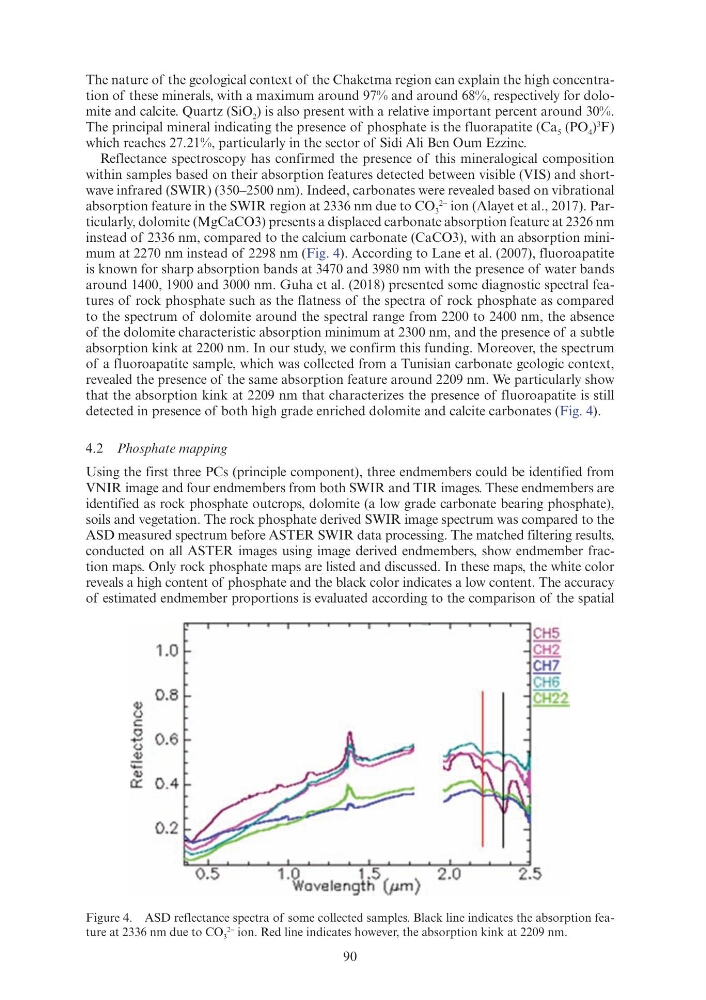
instead of 2336 nm, compared to the calcium carbonate (CaCO3), with an absorption minimum at 2270 nm instead of 2298 nm (Fig. 4). According to Lane et al. (2007), fluoroapatite
is known for sharp absorption bands at 3470 and 3980 nm with the presence of water bands
around 1400, 1900 and 3000 nm. Guha et al. (2018) presented some diagnostic spectral features of rock phosphate such as the flatness of the spectra of rock phosphate as compared
to the spectrum of dolomite around the spectral range from 2200 to 2400 nm, the absence
of the dolomite characteristic absorption minimum at 2300 nm, and the presence of a subtle
absorption kink at 2200 nm. In our study, we confirm this funding. Moreover, the spectrum
of a fluoroapatite sample, which was collected from a Tunisian carbonate geologic context,
revealed the presence of the same absorption feature around 2209 nm. We particularly show
that the absorption kink at 2209 nm that characterizes the presence of fluoroapatite is still
detected in presence of both high grade enriched dolomite and calcite carbonates (Fig. 4).
4.2 Phosphate mapping
Using the first three PCs (principle component), three endmembers could be identified from
VNIR image and four endmembers from both SWIR and TIR images. These endmembers are
identified as rock phosphate outcrops, dolomite (a low grade carbonate bearing phosphate),
soils and vegetation. The rock phosphate derived SWIR image spectrum was compared to the
ASD measured spectrum before ASTER SWIR data processing. The matched filtering results,
conducted on all ASTER images using image derived endmembers, show endmember fraction maps. Only rock phosphate maps are listed and discussed. In these maps, the white color
reveals a high content of phosphate and the black color indicates a low content. The accuracy
of estimated endmember proportions is evaluated according to the comparison of the spatial
Figure 4. ASD reflectance spectra of some collected samples. Black line indicates the absorption feature at 2336 nm due to CO 3
2− ion. Red line indicates however, the absorption kink at 2209 nm.
1.0
0.8
~
c
0
0.6
-
(.)
~
Q)
a: 0.4
0.2
1.0
\·5 ( ......... ) 2.0
Woveleng h \J-6'"
2.5
The nature of the geological context of the Chaketma region can explain the high concentration of these minerals, with a maximum around 97% and around 68%, respectively for dolomite and calcite. Quartz (SiO 2 ) is also present with a relative important percent around 30%.
The principal mineral indicating the presence of phosphate is the fluorapatite (Ca 5 (PO 4 )
3 F)
which reaches 27.21%, particularly in the sector of Sidi Ali Ben Oum Ezzine.
Reflectance spectroscopy has confirmed the presence of this mineralogical composition
within samples based on their absorption features detected between visible (VIS) and shortwave infrared (SWIR) (350–2500 nm). Indeed, carbonates were revealed based on vibrational
absorption feature in the SWIR region at 2336 nm due to CO 3
2− ion (Alayet et al., 2017). Particularly, dolomite (MgCaCO3) presents a displaced carbonate absorption feature at 2326 nm
instead of 2336 nm, compared to the calcium carbonate (CaCO3), with an absorption minimum at 2270 nm instead of 2298 nm (Fig. 4). According to Lane et al. (2007), fluoroapatite
is known for sharp absorption bands at 3470 and 3980 nm with the presence of water bands
around 1400, 1900 and 3000 nm. Guha et al. (2018) presented some diagnostic spectral features of rock phosphate such as the flatness of the spectra of rock phosphate as compared
to the spectrum of dolomite around the spectral range from 2200 to 2400 nm, the absence
of the dolomite characteristic absorption minimum at 2300 nm, and the presence of a subtle
absorption kink at 2200 nm. In our study, we confirm this funding. Moreover, the spectrum
of a fluoroapatite sample, which was collected from a Tunisian carbonate geologic context,
revealed the presence of the same absorption feature around 2209 nm. We particularly show
that the absorption kink at 2209 nm that characterizes the presence of fluoroapatite is still
detected in presence of both high grade enriched dolomite and calcite carbonates (Fig. 4).
4.2 Phosphate mapping
Using the first three PCs (principle component), three endmembers could be identified from
VNIR image and four endmembers from both SWIR and TIR images. These endmembers are
identified as rock phosphate outcrops, dolomite (a low grade carbonate bearing phosphate),
soils and vegetation. The rock phosphate derived SWIR image spectrum was compared to the
ASD measured spectrum before ASTER SWIR data processing. The matched filtering results,
conducted on all ASTER images using image derived endmembers, show endmember fraction maps. Only rock phosphate maps are listed and discussed. In these maps, the white color
reveals a high content of phosphate and the black color indicates a low content. The accuracy
of estimated endmember proportions is evaluated according to the comparison of the spatial
Figure 4. ASD reflectance spectra of some collected samples. Black line indicates the absorption feature at 2336 nm due to CO 3
2− ion. Red line indicates however, the absorption kink at 2209 nm.
1.0
0.8
~
c
0
0.6
-
(.)
~
Q)
a: 0.4
0.2
1.0
\·5 ( ......... ) 2.0
Woveleng h \J-6'"
2.5