

79
where:
m
n
Z
i
p
Z
i
Z
n
i
Z =
( )
u
∀ =
i
p
=
∑
1
1
1
p −
p
1
α =
(6)
• Calculate the covariance matrix:
C
n
Z
C
T
= (
)
Z m
Z
(
)
Z m
⋅
1
(7)
• Decompose the covariance through an eigen-decomposition:
C
Q
Q
Z
C
T
⋅
Q ⋅
Λ
(8)
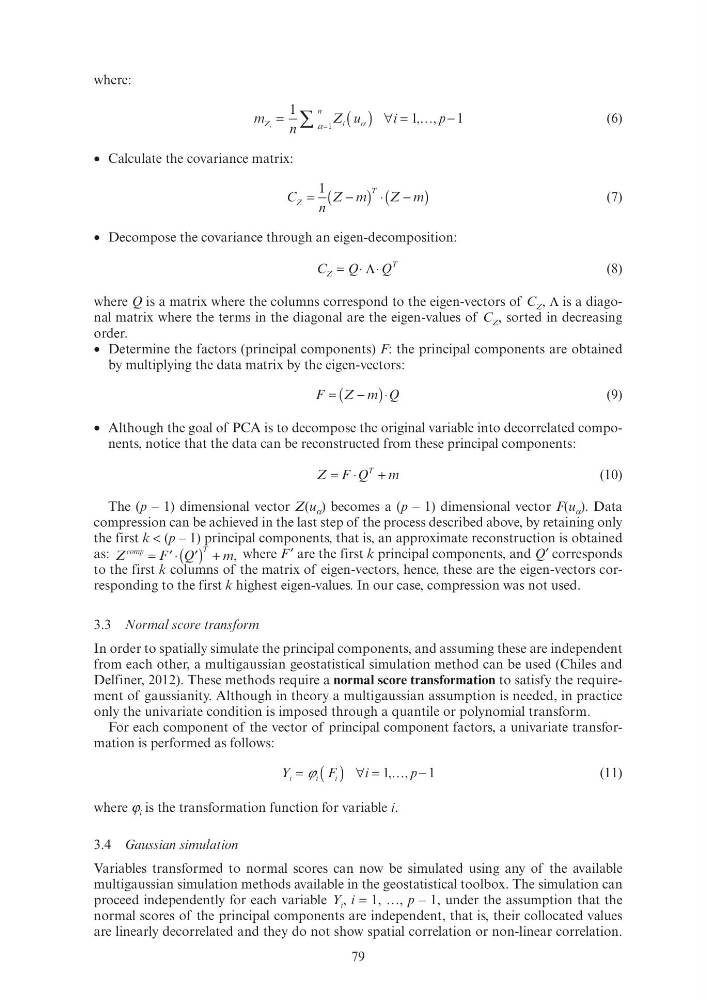
where Q is a matrix where the columns correspond to the eigen-vectors of C Z , Λ is a diagonal matrix where the terms in the diagonal are the eigen-values of C Z , sorted in decreasing
order.
• Determine the factors (principal components) F: the principal components are obtained
by multiplying the data matrix by the eigen-vectors:
F
Q
(
)
Z m
−
Z
(9)
• Although the goal of PCA is to decompose the original variable into decorrelated components, notice that the data can be reconstructed from these principal components:
Z F Q
m
T
⋅
F
(10)
The (p – 1) dimensional vector Z(u α ) becomes a (p – 1) dimensional vector F(u α ). Data
compression can be achieved in the last step of the process described above, by retaining only
the first k < (p – 1) principal components, that is, an approximate reconstruction is obtained
as: Z
F
m
comp
T
⋅
F ( )
Q
′ (Q
, where F ′ are the first k principal components, and Q′ corresponds
to the first k columns of the matrix of eigen-vectors, hence, these are the eigen-vectors corresponding to the first k highest eigen-values. In our case, compression was not used.
3.3 Normal score transform
In order to spatially simulate the principal components, and assuming these are independent
from each other, a multigaussian geostatistical simulation method can be used (Chiles and
Delfiner, 2012). These methods require a normal score transformation to satisfy the requirement of gaussianity. Although in theory a multigaussian assumption is needed, in practice
only the univariate condition is imposed through a quantile or polynomial transform.
For each component of the vector of principal component factors, a univariate transformation is performed as follows:
Y
i
p
i
i
Y Y
( )
F i
F F ∀ =
i
p
1
1
p −
p
(11)
where ϕ i is the transformation function for variable i.
3.4 Gaussian simulation
Variables transformed to normal scores can now be simulated using any of the available
multigaussian simulation methods available in the geostatistical toolbox. The simulation can
proceed independently for each variable Y i , i = 1, …, p – 1, under the assumption that the
normal scores of the principal components are independent, that is, their collocated values
are linearly decorrelated and they do not show spatial correlation or non-linear correlation.
where:
m
n
Z
i
p
Z
i
Z
n
i
Z =
( )
u
∀ =
i
p
=
∑
1
1
1
p −
p
1
α =
(6)
• Calculate the covariance matrix:
C
n
Z
C
T
= (
)
Z m
Z
(
)
Z m
⋅
1
(7)
• Decompose the covariance through an eigen-decomposition:
C
Q
Q
Z
C
T
⋅
Q ⋅
Λ
(8)
where Q is a matrix where the columns correspond to the eigen-vectors of C Z , Λ is a diagonal matrix where the terms in the diagonal are the eigen-values of C Z , sorted in decreasing
order.
• Determine the factors (principal components) F: the principal components are obtained
by multiplying the data matrix by the eigen-vectors:
F
Q
(
)
Z m
−
Z
(9)
• Although the goal of PCA is to decompose the original variable into decorrelated components, notice that the data can be reconstructed from these principal components:
Z F Q
m
T
⋅
F
(10)
The (p – 1) dimensional vector Z(u α ) becomes a (p – 1) dimensional vector F(u α ). Data
compression can be achieved in the last step of the process described above, by retaining only
the first k < (p – 1) principal components, that is, an approximate reconstruction is obtained
as: Z
F
m
comp
T
⋅
F ( )
Q
′ (Q
, where F ′ are the first k principal components, and Q′ corresponds
to the first k columns of the matrix of eigen-vectors, hence, these are the eigen-vectors corresponding to the first k highest eigen-values. In our case, compression was not used.
3.3 Normal score transform
In order to spatially simulate the principal components, and assuming these are independent
from each other, a multigaussian geostatistical simulation method can be used (Chiles and
Delfiner, 2012). These methods require a normal score transformation to satisfy the requirement of gaussianity. Although in theory a multigaussian assumption is needed, in practice
only the univariate condition is imposed through a quantile or polynomial transform.
For each component of the vector of principal component factors, a univariate transformation is performed as follows:
Y
i
p
i
i
Y Y
( )
F i
F F ∀ =
i
p
1
1
p −
p
(11)
where ϕ i is the transformation function for variable i.
3.4 Gaussian simulation
Variables transformed to normal scores can now be simulated using any of the available
multigaussian simulation methods available in the geostatistical toolbox. The simulation can
proceed independently for each variable Y i , i = 1, …, p – 1, under the assumption that the
normal scores of the principal components are independent, that is, their collocated values
are linearly decorrelated and they do not show spatial correlation or non-linear correlation.