

account for a finite size of the nucleus in the model uniformly charged sphere and
the standard Uhling-Serber radiation corrections are listed too.
2 Relativistic Theory of Exotic Quantum Systems
with Accounting of the Electromagnetic and Strong
Interaction Effects
2.1 The Klein-Gordon-Fock Equation. Electromagnetic
Interactions and Nuclear Potential
Here we present a brief description of the key moments of our approach (more
details can be found in Refs. [61–79]). The relativistic electron wave functions are
determined from solution of the Klein-Gordon-Fock equation (pion is the Boson
with spin 0, mass: m π − = 139.57018 MэB, r π− = 0.672 ± 0.08 fm) with a general
potential (the latter includes an electric and polarization potentials of a nucleus plus
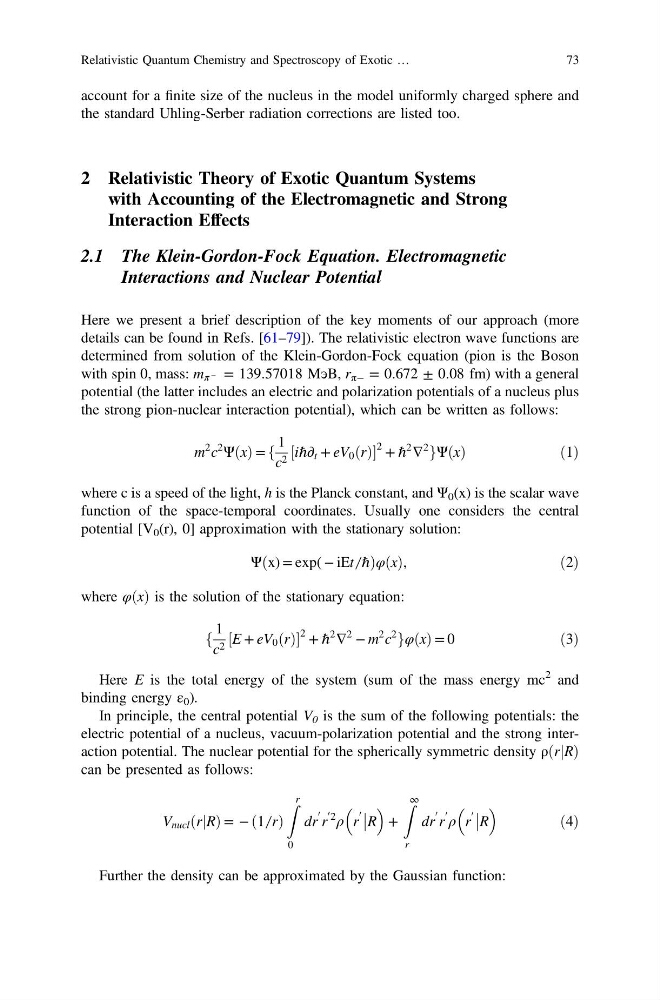
the strong pion-nuclear interaction potential), which can be written as follows:
m
2 c
2
ΨðxÞ = f
1
c 2 ½iℏ∂ t + eV 0 ðrÞ
2 + ℏ
2
∇
2
gΨðxÞ
ð 1Þ
where c is a speed of the light, h is the Planck constant, and Ψ 0 (x) is the scalar wave
function of the space-temporal coordinates. Usually one considers the central
potential [V 0 (r), 0] approximation with the stationary solution:
Ψðx) = exp( − iEt ̸ ℏÞφðxÞ,
ð2Þ
where φðxÞ is the solution of the stationary equation:
f
1
c 2 ½E + eV 0 ðrÞ
2 + ℏ
2
∇
2
− m
2 c
2
gφðxÞ = 0
ð3Þ
Here E is the total energy of the system (sum of the mass energy mc
2 and
binding energy ε 0 ).
In principle, the central potential V 0 is the sum of the following potentials: the
electric potential of a nucleus, vacuum-polarization potential and the strong interaction potential. The nuclear potential for the spherically symmetric density ρ rjR
ð Þ
can be presented as follows:
V nucl rjR
ð Þ= − 1 ̸ r
ð Þ
Z r
0
dr
0 r
0 2
ρ r
0
R
+
Z ∞
r
dr
0 r
0 ρ r
0
R
ð4Þ
Further the density can be approximated by the Gaussian function:
Relativistic Quantum Chemistry and Spectroscopy of Exotic …
73
the standard Uhling-Serber radiation corrections are listed too.
2 Relativistic Theory of Exotic Quantum Systems
with Accounting of the Electromagnetic and Strong
Interaction Effects
2.1 The Klein-Gordon-Fock Equation. Electromagnetic
Interactions and Nuclear Potential
Here we present a brief description of the key moments of our approach (more
details can be found in Refs. [61–79]). The relativistic electron wave functions are
determined from solution of the Klein-Gordon-Fock equation (pion is the Boson
with spin 0, mass: m π − = 139.57018 MэB, r π− = 0.672 ± 0.08 fm) with a general
potential (the latter includes an electric and polarization potentials of a nucleus plus
the strong pion-nuclear interaction potential), which can be written as follows:
m
2 c
2
ΨðxÞ = f
1
c 2 ½iℏ∂ t + eV 0 ðrÞ
2 + ℏ
2
∇
2
gΨðxÞ
ð 1Þ
where c is a speed of the light, h is the Planck constant, and Ψ 0 (x) is the scalar wave
function of the space-temporal coordinates. Usually one considers the central
potential [V 0 (r), 0] approximation with the stationary solution:
Ψðx) = exp( − iEt ̸ ℏÞφðxÞ,
ð2Þ
where φðxÞ is the solution of the stationary equation:
f
1
c 2 ½E + eV 0 ðrÞ
2 + ℏ
2
∇
2
− m
2 c
2
gφðxÞ = 0
ð3Þ
Here E is the total energy of the system (sum of the mass energy mc
2 and
binding energy ε 0 ).
In principle, the central potential V 0 is the sum of the following potentials: the
electric potential of a nucleus, vacuum-polarization potential and the strong interaction potential. The nuclear potential for the spherically symmetric density ρ rjR
ð Þ
can be presented as follows:
V nucl rjR
ð Þ= − 1 ̸ r
ð Þ
Z r
0
dr
0 r
0 2
ρ r
0
R
+
Z ∞
r
dr
0 r
0 ρ r
0
R
ð4Þ
Further the density can be approximated by the Gaussian function:
Relativistic Quantum Chemistry and Spectroscopy of Exotic …
73