

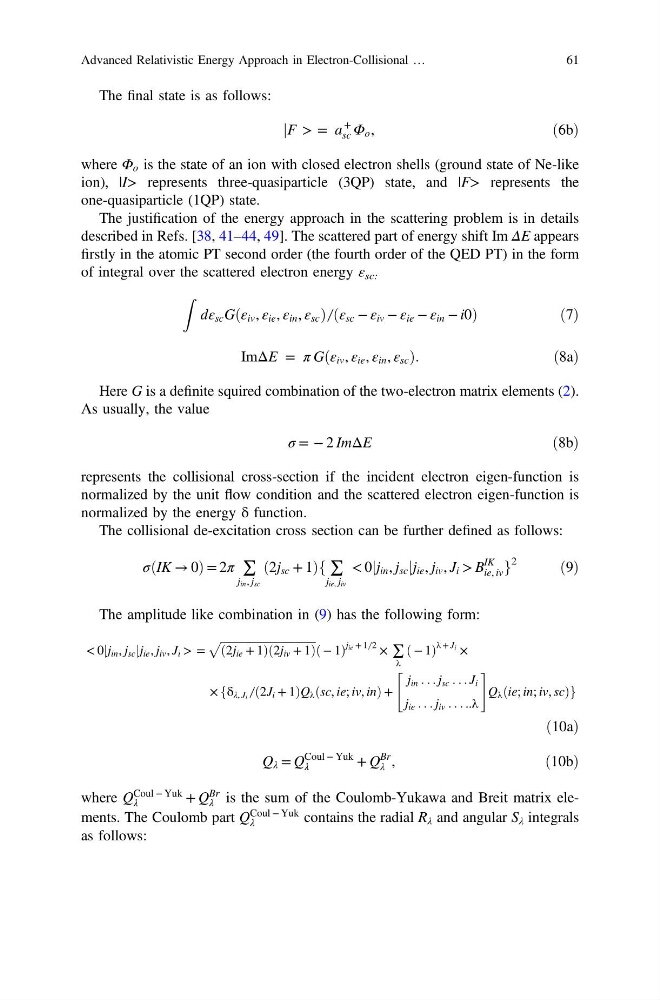
The final state is as follows:
jF > = a
+
sc Φ o ,
ð6bÞ
where Φ o is the state of an ion with closed electron shells (ground state of Ne-like
ion), |I> represents three-quasiparticle (3QP) state, and |F> represents the
one-quasiparticle (1QP) state.
The justification of the energy approach in the scattering problem is in details
described in Refs. [38, 41–44, 49]. The scattered part of energy shift Im ΔE appears
firstly in the atomic PT second order (the fourth order of the QED PT) in the form
of integral over the scattered electron energy ε sc:
Z
dε sc Gðε iv , ε ie , ε in , ε sc Þ ̸ ðε sc − ε iv − ε ie − ε in − i0Þ
ð 7Þ
ImΔE = π Gðε iv , ε ie , ε in , ε sc Þ.
ð8aÞ
Here G is a definite squired combination of the two-electron matrix elements (2).
As usually, the value
σ = − 2 ImΔE
ð8bÞ
represents the collisional cross-section if the incident electron eigen-function is
normalized by the unit flow condition and the scattered electron eigen-function is
normalized by the energy δ function.
The collisional de-excitation cross section can be further defined as follows:
σðIK → 0Þ = 2π ∑
j in , j sc
ð2j sc + 1Þf ∑
j ie, j iv
< 0jj in , j sc jj ie , j iv , J i > B
IK
ie, iv g
2
ð9Þ
The amplitude like combination in (9) has the following form:
< 0jj in , j sc jj ie , j iv , J i > =
ffiffiffiffiffiffiffiffiffiffiffiffiffiffiffiffiffiffiffiffiffiffiffiffiffiffiffiffiffiffiffiffiffiffiffi
ð2j ie + 1Þð2j iv + 1Þ
p
ð − 1Þ
jie + 1 ̸ 2 × ∑
λ
ð − 1Þ
λ + Ji ×
× fδ λ, Ji ̸ ð2J i + 1ÞQ λ ðsc, ie; iv, inÞ +
j in . . . j sc . . . J i
j ie . . . j iv . . . ..λ
"
#
Q λ ðie; in; iv, scÞg
ð10aÞ
Q λ = Q
Coul − Yuk
λ
+ Q
Br
λ ,
ð10bÞ
where Q
Coul − Yuk
λ
+ Q
Br
λ is the sum of the Coulomb-Yukawa and Breit matrix elements. The Coulomb part Q
Coul − Yuk
λ
contains the radial R λ and angular S λ integrals
as follows:
Advanced Relativistic Energy Approach in Electron-Collisional …
61
jF > = a
+
sc Φ o ,
ð6bÞ
where Φ o is the state of an ion with closed electron shells (ground state of Ne-like
ion), |I> represents three-quasiparticle (3QP) state, and |F> represents the
one-quasiparticle (1QP) state.
The justification of the energy approach in the scattering problem is in details
described in Refs. [38, 41–44, 49]. The scattered part of energy shift Im ΔE appears
firstly in the atomic PT second order (the fourth order of the QED PT) in the form
of integral over the scattered electron energy ε sc:
Z
dε sc Gðε iv , ε ie , ε in , ε sc Þ ̸ ðε sc − ε iv − ε ie − ε in − i0Þ
ð 7Þ
ImΔE = π Gðε iv , ε ie , ε in , ε sc Þ.
ð8aÞ
Here G is a definite squired combination of the two-electron matrix elements (2).
As usually, the value
σ = − 2 ImΔE
ð8bÞ
represents the collisional cross-section if the incident electron eigen-function is
normalized by the unit flow condition and the scattered electron eigen-function is
normalized by the energy δ function.
The collisional de-excitation cross section can be further defined as follows:
σðIK → 0Þ = 2π ∑
j in , j sc
ð2j sc + 1Þf ∑
j ie, j iv
< 0jj in , j sc jj ie , j iv , J i > B
IK
ie, iv g
2
ð9Þ
The amplitude like combination in (9) has the following form:
< 0jj in , j sc jj ie , j iv , J i > =
ffiffiffiffiffiffiffiffiffiffiffiffiffiffiffiffiffiffiffiffiffiffiffiffiffiffiffiffiffiffiffiffiffiffiffi
ð2j ie + 1Þð2j iv + 1Þ
p
ð − 1Þ
jie + 1 ̸ 2 × ∑
λ
ð − 1Þ
λ + Ji ×
× fδ λ, Ji ̸ ð2J i + 1ÞQ λ ðsc, ie; iv, inÞ +
j in . . . j sc . . . J i
j ie . . . j iv . . . ..λ
"
#
Q λ ðie; in; iv, scÞg
ð10aÞ
Q λ = Q
Coul − Yuk
λ
+ Q
Br
λ ,
ð10bÞ
where Q
Coul − Yuk
λ
+ Q
Br
λ is the sum of the Coulomb-Yukawa and Breit matrix elements. The Coulomb part Q
Coul − Yuk
λ
contains the radial R λ and angular S λ integrals
as follows:
Advanced Relativistic Energy Approach in Electron-Collisional …
61