

“ab initio” optimization principle for construction of an effective one-quasiparticle
representation. The minimization of the gauge dependent multielectron contribution
of the lowest QED PT corrections to the radiation widths of atomic levels, which is
determined by the imaginary part of an energy shift ΔE, is used. In the fourth order
of QED PT there appear diagrams, whose contribution into the ImΔE accounts for
the polarization effects. This contribution describes collective effects and it is
dependent upon the electromagnetic potentials gauge (the gauge non-invariant
contribution ΔE ninv ). This value is considered to be the typical representative of the
electron correlation effects, whose minimization is a reasonable criteria in the
searching for the optimal one-electron basis of the PT. Let us note that this topic is
of a great importance (look, for example, Refs. [49, 50, 89–98], where there are
presented some alternative optimization approaches).
It is worth to remind that E. Davidson had pointed the principal disadvantages of
the traditional representation based on the self-consistent field approach and suggested the optimal “natural orbitals” representation (for example, see Refs. [89,
90]). Our procedure derives an undoubted profit in the routine spectroscopic calculations as it provides the way of the refinement of the atomic characteristics
calculations, based on the “first principles”. The resulting expression looks as the
correction due to the additional nonlocal interaction of the active quasiparticle with
the closed shells. Nevertheless, its calculation is reducible to the solving of the
system of the ordinary differential equations (one-D procedure) [49]. The most
important refinements can be introduced by accounting for the relativistic and the
density gradient corrections to the Tomas- Fermi formula (look details in Refs. [49,
50]). The minimization of the functional Im ΔE ninv leads to the integral differential
equation, that is numerically solved. In result one can get the optimal one-electron
representation of the PT, which is further improved within the Dirac-Kohn-ShamSturm approach in order to take into account for the continuum states [49, 50, 60,
61, 96–98].
As some ideas of the energy approach in application to a scattering problem have
been presented in a literature (look, for example, [37, 41, 42], below we concern the
most principal points. Further for definiteness, let us consider a collisional
de-excitation of, say, the Ne-like ion [41]:
ð 2j iv
ð Þ
− 1 3j ie J i M i
½
, ε in Þ → ðΦ o , ε sc Þ.
Here Φ o is the state of the ion with the closed shells (ground state of the Ne-like
ion); J i is the total angular moment of the initial target state; indices iv, i.e. are
related to the initial states of a vacancy and an electron; indices ε in and ε sc are the
incident and scattered energies, respectively to the incident and scattered electrons.
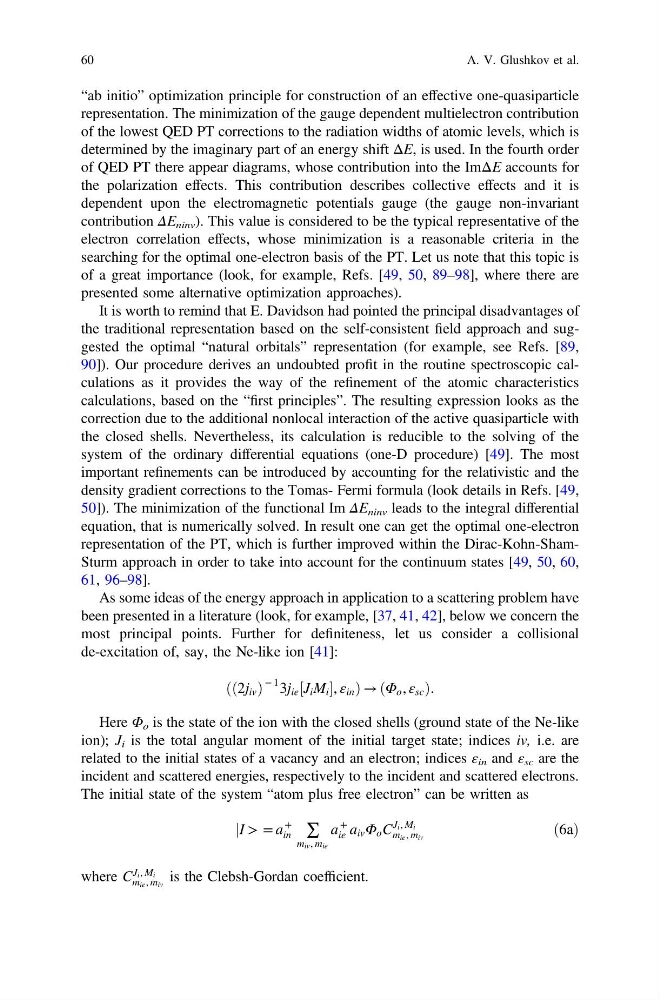
The initial state of the system “atom plus free electron” can be written as
jI > = a
+
in ∑
m iv , m ie
a
+
ie a iv Φ o C
J i , M i
m ie , m iv
ð6aÞ
where C
J i , M i
m ie , m iv
is the Clebsh-Gordan coefficient.
60
A. V. Glushkov et al.
representation. The minimization of the gauge dependent multielectron contribution
of the lowest QED PT corrections to the radiation widths of atomic levels, which is
determined by the imaginary part of an energy shift ΔE, is used. In the fourth order
of QED PT there appear diagrams, whose contribution into the ImΔE accounts for
the polarization effects. This contribution describes collective effects and it is
dependent upon the electromagnetic potentials gauge (the gauge non-invariant
contribution ΔE ninv ). This value is considered to be the typical representative of the
electron correlation effects, whose minimization is a reasonable criteria in the
searching for the optimal one-electron basis of the PT. Let us note that this topic is
of a great importance (look, for example, Refs. [49, 50, 89–98], where there are
presented some alternative optimization approaches).
It is worth to remind that E. Davidson had pointed the principal disadvantages of
the traditional representation based on the self-consistent field approach and suggested the optimal “natural orbitals” representation (for example, see Refs. [89,
90]). Our procedure derives an undoubted profit in the routine spectroscopic calculations as it provides the way of the refinement of the atomic characteristics
calculations, based on the “first principles”. The resulting expression looks as the
correction due to the additional nonlocal interaction of the active quasiparticle with
the closed shells. Nevertheless, its calculation is reducible to the solving of the
system of the ordinary differential equations (one-D procedure) [49]. The most
important refinements can be introduced by accounting for the relativistic and the
density gradient corrections to the Tomas- Fermi formula (look details in Refs. [49,
50]). The minimization of the functional Im ΔE ninv leads to the integral differential
equation, that is numerically solved. In result one can get the optimal one-electron
representation of the PT, which is further improved within the Dirac-Kohn-ShamSturm approach in order to take into account for the continuum states [49, 50, 60,
61, 96–98].
As some ideas of the energy approach in application to a scattering problem have
been presented in a literature (look, for example, [37, 41, 42], below we concern the
most principal points. Further for definiteness, let us consider a collisional
de-excitation of, say, the Ne-like ion [41]:
ð 2j iv
ð Þ
− 1 3j ie J i M i
½
, ε in Þ → ðΦ o , ε sc Þ.
Here Φ o is the state of the ion with the closed shells (ground state of the Ne-like
ion); J i is the total angular moment of the initial target state; indices iv, i.e. are
related to the initial states of a vacancy and an electron; indices ε in and ε sc are the
incident and scattered energies, respectively to the incident and scattered electrons.
The initial state of the system “atom plus free electron” can be written as
jI > = a
+
in ∑
m iv , m ie
a
+
ie a iv Φ o C
J i , M i
m ie , m iv
ð6aÞ
where C
J i , M i
m ie , m iv
is the Clebsh-Gordan coefficient.
60
A. V. Glushkov et al.